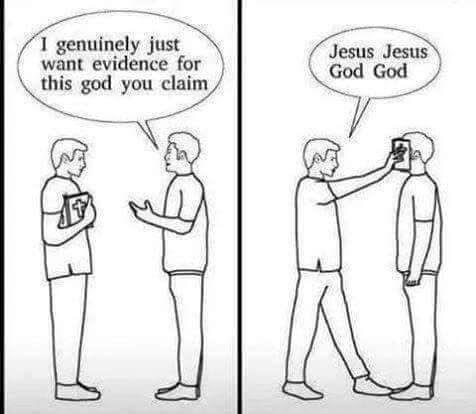
im christian
and i am sick of people shoving it down clearly uninterested peoples throats
Welcome to Lemmy Shitpost. Here you can shitpost to your hearts content.
Anything and everything goes. Memes, Jokes, Vents and Banter. Though we still have to comply with lemmy.world instance rules. So behave!
1. Be Respectful
Refrain from using harmful language pertaining to a protected characteristic: e.g. race, gender, sexuality, disability or religion.
Refrain from being argumentative when responding or commenting to posts/replies. Personal attacks are not welcome here.
...
2. No Illegal Content
Content that violates the law. Any post/comment found to be in breach of common law will be removed and given to the authorities if required.
That means:
-No promoting violence/threats against any individuals
-No CSA content or Revenge Porn
-No sharing private/personal information (Doxxing)
...
3. No Spam
Posting the same post, no matter the intent is against the rules.
-If you have posted content, please refrain from re-posting said content within this community.
-Do not spam posts with intent to harass, annoy, bully, advertise, scam or harm this community.
-No posting Scams/Advertisements/Phishing Links/IP Grabbers
-No Bots, Bots will be banned from the community.
...
4. No Porn/Explicit
Content
-Do not post explicit content. Lemmy.World is not the instance for NSFW content.
-Do not post Gore or Shock Content.
...
5. No Enciting Harassment,
Brigading, Doxxing or Witch Hunts
-Do not Brigade other Communities
-No calls to action against other communities/users within Lemmy or outside of Lemmy.
-No Witch Hunts against users/communities.
-No content that harasses members within or outside of the community.
...
6. NSFW should be behind NSFW tags.
-Content that is NSFW should be behind NSFW tags.
-Content that might be distressing should be kept behind NSFW tags.
...
If you see content that is a breach of the rules, please flag and report the comment and a moderator will take action where they can.
Also check out:
Partnered Communities:
1.Memes
10.LinuxMemes (Linux themed memes)
Reach out to
All communities included on the sidebar are to be made in compliance with the instance rules. Striker
im christian
and i am sick of people shoving it down clearly uninterested peoples throats
Have you seen Wake Up Dead Man? Had a really intriguing take on reconciling atheists and theists in a way I found very valuable.
I mean there's nothing wrong with believing. I don't, but I also don't go around trying to convince people to be like me. If it comes up I might share why I don't believe and I'm more than willing to listen to someone who does. I see the value in it.
if someone wants to respectfully discuss their beliefs, im happy to listen, thats a nice thing to talk about! but i wouldnt want to talk about it to someone whos uninterested
Jesus Jesus God God!
That's convincing
It's fun to sing it to the tune of Happy Happy Joy Joy!
I like it when you ask for proof and they open their arms and gesture broadly at everything.
To be fair, I wish I was a simpleton. I think life is more fun that way.
The term “faith” made a lot more sense to me once I thought of believing in the goodness of other people like a faith.
You have no logic saying it’s there, even get disproved often. But you keep believing in it in spite of the absence of evidence.
This is why I can't discredit faith, but I still do my best to point out how organizational religion has always exploited people. Not that all of it is bad. But there needs to be better safeguards for people to have the opportunity to find or reject faith for themselves, and instead it's mostly indoctrination.
You can't have a rational discussion with a religionist, particularly one of the Christian/Islamic variety. They will appeal to their book of stories and to them, that should be enough for us.
Doesn’t believe in god, wile masterbating keeps saying “oh my god!” Checkmated myself…
I shout "By Grabthar's Hammer"
Usually the response I get is
"Actually there's historical fact that jesus was alive and there was a flood and that the earth is 5000s year old and there's a firmament. Scientific fact! 🤓👆"
Drives me insane. Even the reasonable Christians eat this shit up.
they do this alot in shows that remotely christianity plotlines, anything deviating from thier bible that they never read, they would either call it woke, or something else. SPN, LUCIFER, sandman all recieved alot of hate from christians.
Gravity Falls--
Yeah, once I was searching something about Bill Cipher, my mother passed by and gave me a whole lecture about "satanic media"
Bible is essentially the sole source, a novel of historical fiction. Just enough reality tossed in to make it all real. You’d think news that a dude running around magically healing people, or magically creating food and wine, would have spread like wildfire and the authorities would have snatched him up immediately and made him serve the wealthy and powerful on demand. Greed hasn’t changed in thousands of years, there would have been official Roman records of magical deeds. But no, it wasn’t the magic that bothered the authorities, it was bucking the system.
That's easy, it's all in the Bible. You can't deny anything that's in the Bible. That's always the checkmate.
And by bible you mean one of the many different versions from different denominations because none of them could agree what was correct. Or because the powers in charge at whatever period of time decided to create their own edited version to better control the population.
All translated from translations of translations of languages that nobody speaks. So I'm sure the final product of this inter-millenial game of telephone is perfect. Why? Because it is the ordained word of God, so of course it is. Checkmate.
What a stupid premise to begin with. God is at least as real as money, love, or America.
All of these are useful ideas to describe things that cannot be "proven" with objective evidence, but still have a meaningful impact on the reality of our lives.
Arguing about the objective existence of God is a red herring. I wish we spent as much time talking about the very well studied social benefits and harms of religion. Then we could start talking about meaningful reforms.
Science flies you to the moon. Religion flies you into buildings.
Why make an ideological argument against ideologies?
Science also led to eugenics and atom bombs. Religion also builds food pantries, wells, and hospitals. It is not about the tool but how we choose to use it.
eugenics
Not science.
atom bombs
No argument here. Science was also used to develop airplanes and buildings. You can create with the knowledge earned from science, but religion (can) give the justification to misuse those creations.
It is not about the tool but how we choose to use it.
Well said.
Science did not lead to eugenics. People used a young science as an excuse to advance their ideals by willingly misinterpreting genetics. Also, atom bombs are arguably more technology than science, and technology is rather neutral with its purpose.
Religion also builds food pantries, wells, and hospitals.
Do they, though? A woman called churches for baby formula and the majority of churches weren't very cooperative. Also, even if the religious build hospitals, who's to say they won't follow some insane creed like Mother Teresa did, who willingly let people suffer because she believed that suffering led people to God? Not to mention that a lot of religious ideas tend to make people worse off, like denying blood transfusions with Jehovah's Witnesses, or so many other topics that leave people out of proper care like objecting to abortions and IVF, prioritizing faith healing over evidence-based medicine, historical opposition to preventative medicine like vaccines, etc. More often than not, religion seems to get in the way of major health interests.
What religion does do is build community, and communities come together to provide for necessities like community wells, but even an absolutely secular community would build a well. I think it's a little undeserving to give so much credit to religion.
Credit where it's due, science built the plane.
Well, the main reason for that big plain-into-building debacle was US going to the middle east to do some bombing, and the main reason for that is economical (well, and racist, but that's a given). The only religious part there was people doing suicide bombing instead of shooting rockets.
It's not a red herring. Religious people don't treat god like some social concept that doesn't physically exist but still plays a role in how we interact in our society. They claim their god literally exists.
You appear to be moving the goalposts. These are all concepts. God is not as real as Money or Love or America. You're conflating several things here to try and obfuscate that the existence of God being proven isn't a "big deal".
You've ironically created the best counter to your statement by making the claim that it's as real as 3 abstract concepts that are all man made.
If something is real, it can be proven, observed, the effects replicated. This is how every thing in the universe works. No exceptions.
Money can be proven, even the idea of it, even though it's "conceptual". It has real value, it's a construct we created and it has physical objects in the real world and can be exchanged for goods and services. It's a real idea that takes physical shape in the world and it can be proven as a real world concept that we are 100% in control over. The idea of money changes over time, as our understanding of it grows and improves (or devolves). It is an abstract concept to explain a very real thing that exists in our world. Which we created.
Love is a concept, and while the nuances behind it aren't well understood, it's as real as anything anyone feels, like hate, fear, or any emotion. It's an emotion, and emotions are a part of the human empathic experience. It's something we've evolved and learned over time. It's real because we make it real every day. Love isn't existential, it doesn't have some power we're unable to measure. It can't bend or warp or shift reality. It can't do anything more than we can do as a human. In all the ways that matter, any result of love is 100% measurable and observable in the physical world, no matter how it manifests it is observable and measurable in the real world. It is an abstract concept to explain a very real thing that exists in our world. Which we created.
America is a real place, a real continent, a real country, with real people, and while the idea of a country or its people changes over time, it's not "fake" or made up, in the same way a claim about a deity is. The idea of America might be what you're referring to, but it's as real as any other shared idea or dream people have had in history, including Rome, the EU, etc. It is an abstract concept to explain a very real thing that exists in our world. Which we created.
God is not a real place. It is not anything more than an abstract concept that we shoved everything we didn't currently understand into the category of for thousands of years until we developed the tools and systems to better explain the world around us. There are real things from this abstract concept, like churches, and bibles, and books, and songs and stuff like that. All things humans created. None of the spiritual claims have ever been proven true, despite an insane amount of testing and observations made over millennia. There's nothing repeatable here. The only things we can observe about God that can be measured are the things the followers of the religion do. There's zero things we've observed or measured with regards to religion in the real world that have ever gone beyond the physical abilities of what a normal human or collective of humans can do. It is an abstract concept to explain things in the world we couldn't explain before.
And like the concepts you called out: Love, Money, America; God is also a concept that humans created.
I disagree.
Money and nations are well understood to be merely human made systems. They exist within the realm of human control to some degree, and therefore immediately invite open discussions and criticism.
God, in the eyes of those that believe in him, is the ultimate force of the universe of whom all existence and morality hinges upon. Unlike the other things you mentioned, there is fundamentally zero negotiations, criticisms, objections nor doubt's that can be had against God.
It is significantly harder to convince someone that their perfect being of a God is evil and than it is that money or nations are tools of evil.
How is it stupid if religious people really do argue that their god as an entity is real? I don't think the comic tries to dispute that the concept of gods aren't.
Neither money nor states are dogmatic in their nature. They exist under some basis, that can be verified, and that defines their properties. Gods have arbitrary abilities that cannot be verified.
The only benefits of a religion are being a part of community and coping with reality. The first is not unique to religion, the second is delusional and leads to lots of misjudgement, harms one's ability to percieve and analyze the objective reality. In other words, even the benefits are quite controversial in their usefulness here.
By the way, if you think about this, religion as a coping mechanism is as widespread only because it have been a substitute for more healthy alternatives for literal milleniums.
Religion should be a thing of past, but alas, magical thinking is still strong in modern society. To get rid of religions, first and foremost we should teach people about common logic fallacies and manipulations, so they would detect and avoid them more easily
The whole point of faith is that you accept it blindly without evidence and should not try to find evidence as this would be s sign of weak faith.
It’s all part of the plan innit.

Spider-Man, Batman, aqua man, Garfield
I'm not religious, but I can see the immense value that religion had historically as an imperfect guide to ethics and practical knowledge.
Sure, we can scoff at the hypocrisy and flaws now with our years of schooling, but the common person didn't have the same access to academia back them. Short, memorable stories that show people getting punished for misdeeds and others rewarded for positive deeds is much easier to impart onto peasants than the nuances of collectivism.
Someone could point to the horrible acts done in the name of religion, but just imagine if those people didn't have the fear of god in them. Tribalism would have separated humans into different nonreligious groups to genocide in a world without religion.
Someone could point to the horrible acts done in the name of religion, but just imagine if those people didn't have the fear of god in them
Lol no. Imagine if these people didn't think they were still righteous in the eyes of god, maybe they might not have felt the need to torture in the name of their god.
Short, memorable stories that show people getting punished for misdeeds and others rewarded for positive deeds
You don't need religion for that when there's folklore
If book = proof of a deity, and there is also book titled Revelations of Gla'aki, logic then dictates that we have proof of Cthulu, Gla'aki, and countless other elder gods who are so far beyond us they may not even recognize the fact we exist at all.
SO
By Catholic logic, they'll be offing themselves out of existential nightmares any minute now, right?