
Aldi and Lidl.
this post was submitted on 14 May 2026
101 points (97.2% liked)
Ask Lemmy
41725 readers
1642 users here now
A Fediverse community for open-ended, thought provoking questions
Rules: (interactive)
1) Be nice and; have fun
Doxxing, trolling, sealioning, racism, toxicity and dog-whistling are not welcomed in AskLemmy. Remember what your mother said: if you can't say something nice, don't say anything at all. In addition, the site-wide Lemmy.world terms of service also apply here. Please familiarize yourself with them
2) All posts must end with a '?'
This is sort of like Jeopardy. Please phrase all post titles in the form of a proper question ending with ?
3) No spam
Please do not flood the community with nonsense. Actual suspected spammers will be banned on site. No astroturfing.
4) NSFW is okay, within reason
Just remember to tag posts with either a content warning or a [NSFW] tag. Overtly sexual posts are not allowed, please direct them to either !asklemmyafterdark@lemmy.world or !asklemmynsfw@lemmynsfw.com.
NSFW comments should be restricted to posts tagged [NSFW].
5) This is not a support community.
It is not a place for 'how do I?', type questions.
If you have any questions regarding the site itself or would like to report a community, please direct them to Lemmy.world Support or email info@lemmy.world. For other questions check our partnered communities list, or use the search function.
6) No US Politics.
Please don't post about current US Politics. If you need to do this, try !politicaldiscussion@lemmy.world or !uspolitics@lemmy.world
7) No Hit-and-Run questions.
Please don't delete your post for no apparent reason. If you plan on deleting a question later, say so in the post, or if you feel that you have a good reason to remove it, message a mod beforehand. It's not fair to the ones who took their time to answer, and it's not in the spirit of the community.
8) No Bots.
Posts or comments from bots, LLM's, AIs, Neural Networks, Transformers, or Marvin the Paranoid Android are not welcome in AskLemmy. Real humans only please.
Reminder: The terms of service apply here too.
Partnered Communities:
Logo design credit goes to: tubbadu
founded 3 years ago
MODERATORS
Look for red 50% off stickers at Aldi (US). You can freeze meat and save for later
Only buy in bulk what you can and WILL eat before it spoils. Staring into a cupboard that's empty except for a huge box of something that seemed like a deal but now makes you gag is .... a life lesson.
Since it's just you, buy cooking vegetables frozen in bags, so you can take out one serving and don't have to hurry to eat up the broccoli wilting in the fridge. Unlike canned, frozen veg keep their nutrients. Which you do need. Being unhealthy isn't frugal.
Good point about frozen veggies. It's also easier to portion out what you need compared to the binary state of a can of food.
When it comes to prepping, cans should be reserved for calorie and nutrient dense ingredients that benefit from canning anyways, like canned meats, condensed milk, sardines and shellfish, or ingredients that primarily come in canned form like diced or pureed tomatoes. Like frozen food they're canned at peak freshness compared to store bought produce which has to be picked early to ripen in transit.
The biggest risk right now is food prices are going up due to inflation (plus corporate greed and food cartels like the meat cartel), but will soon be going up due to a lack of fertillizer globally due to the strait of Hormuz. Next year is going to be worse by far. With a lack of oil you might get rolling blackouts so be careful to not get too much frozen food...
A deep freezer can help though. You can freeze bags of water inside the deep freeze and as long as you don't open it during a blackout it can last for a day or two (depending on how much water you freeze in there) to keep your stuff from going bad.
load more comments
(2 replies)
I have a farm share (CSA). At the start of the year, you pay up front for a share; in return, you get boxes of veggies during the season. Since the farmer is paid up front, they don't need to borrow money from the bank and hope for a decent harvest to repay the loan, so there's less pressure on them: they know their farm will still be around next year. And you get boxes of veggies that were picked within the past 24 hours, so they're all incredibly fresh. You'll get some stuff you can find in the grocery store (ex: roma tomatoes, bell peppers) but since all the middlemen have been cut out, they last a long time (I've had heads of lettuce last like a month); and you'll get some that's either heirloom varieties (too fragile for handling by the supply chain feeding grocery stores) or unusual (ex: pawpaws, ground cherries).
I'm going to say up front that a farm share isn't for everyone; it takes some adjustment and a bit of work to make it work well, but for me it's worth it. I'll note that I'm single (so it all falls on me) and vegetarian (so I can sometimes eat a lot of veggies).
Each farm chooses how to operate, so I can only speak in generalities. To accommodate different family sizes, some farms offer boxes of different sizes/prices; others offer a half-share, so instead of getting a box every week for 20-26 weeks, you get a box for 10-13 weeks (you choose which weeks you want a box). You can also find a friend to split the cost and content of a share, either splitting each box, or alternating pickup weeks.
Some farms will pre-pack the boxes for you; others will put the veggies on a table and let you choose among them; for example, this week's share might be something like "choose 3 zucchinis/eggplants; choose 2 lbs of a bunch of different types of tomatoes; choose 4 varieties of hot peppers", etc. Some farms you have to pick up at the farm itself; other farms have distribution points in outlying areas, will let you pick up at local farmers markets, or have home delivery for an additional fee. Some farms have work shares: instead of paying for a share, you can choose to work like 4 hours a week during the season and get a box of veggies each week in return. Most farms have pick-your-own availability for veggies that may not be to everyone's taste (okra, herbs), where some people may want extras (tomatoes, peppers, beans), or where personal taste is important (flowers).
I've been with a bunch of different farms over the years (I've moved several times; and sometimes I've joined a farm that isn't a great fit for me). For the past couple years, I've been getting my own box instead of splitting a share, and I've opted to get a 10-week share (I choose the weeks). One thing I like with the 10-week share is that I'm not facing fresh veggies to work with every week; sometimes a weekly share can seem overwhelming!
Most people make some adaptations to make a CSA work for them. It's taken me a while, but I've finally come up with a set a recipes for stuff that I like, that uses the veggies I tend to get, much of which stores well; and I have a pattern of processing that works for me:
Each week, the farm sends out an email ahead of time, letting you know what's in season and sometimes with a rough idea of how much to expect ("this'll be the last week for blackberries, but we have lots of tomatoes!"); that helps me plan what to do ahead of time.
On weeks that I have a share, I go to the farm, do the PYO (it's included in my share, and my starving Irish ancestors would be upset if I didn't get them!), and choose the veggies for my box. When I get home, I wash everything, then sit in front of the tv, watching my guilty-pleasure shows and processing the veggies - as applicable, I trim, peel, slice, dice, mince, etc. As I finish each veggie, it goes into a sealed bowl or a Ziploc and goes into the fridge. I also have a spare bowl for scraps - ends and peels of onions and carrots, trimmings from peppers and leeks, etc. Those join other scraps in a big Ziploc in the freezer; when I have enough scraps, I use it to make veggie stock. And there's another bowl for stuff I can't use, that either goes in the garbage or a compost pile (I've stopped composting in recent years).
On Saturday, I spend a couple hours cooking, usually 2-3 big dishes or 4-5 smaller ones - it depends on my mood and what's in season. Then half the food gets portion-sized and frozen; the other half gets eaten over the week or so following. While cooking, I may pickle some veggies. Pickling is easy: you put your chosen veggies and spices in a jar, heat up your pickling brine, pour the brine over the veggies, and seal the jar. During a season, I may pickle dilly beans, beets, giardinieri, garlic, onions, cucumbers, etc; I may eat them out of the jar or use them as ingredients in future dishes.
[continued in next comment]
On Sunday night, I sit in front of the tv, once again watching guilty-pleasure shows, and I use whatever veggies are left over to make salads. Each week I try for a mix of styles so I don't get bored: for a couple salads I may toss in some nuts and berries or apple pieces to make it a bit sweet, while others I'll put in extra peppers or onions to give it some zing. Any lettuce goes on top so it doesn't get soggy over the week; crunchy stuff like croutons goes in a snack Ziploc on the side so it stays crunchy (ziplocs get rinsed and reused every week, and some recycled year to year). Dressing goes in an old pill bottle along the side. I make ten salads: one for each lunch and dinner for the week.
In front of Sunday night's tv, I'll also make little veggie snack-packs: veggies in a Ziploc (add a little water to keep them fresh), some of them with an old pill bottle of dressing or dip on the side After I've finished, any veggies that haven't been used cooking, salads or snack-packs, they get frozen to be used in future meals.
Herbs tend to come in small bunches during the season and it can be annoying to process small amounts each time. I've settled on cleaning and chopping them up each week (in front of Friday nights tv), then freezing them. At the end of the season, I'll take them out of the freezer and dry them and add them to my spice cabinet.
Once or twice a year, I'll spend a couple hours making freezer jam, which is insanely simple: mash the berries, add sugar and pectin, stir, put in containers, leave them on the counter for a day, then move to the freezer. I can use the jam for sandwiches, cake filling, topping for pancakes and waffles, or give them out as stocking stuffers over the holidays.
And once a year during high tomato season, I'll spend a Saturday afternoon processing tomato: I'll make and can some salsa, make and freeze some marinara, boil down a bunch of tomatoes into tomato paste (freeze them in ice cube trays, then move them to ziplocs; you can use them as-is or dilute them into soup, sauce or puree).
How much time is all this? I find it helps to reframe things and count them toward other goals or desires. The hour I spend doing PYO on alternate weeks isn't "farm-share time", it's counted toward my weekly exercise goals. Time in front of the tv isn't counted either, as I'm catching up on guilty-pleasure tv (without the guilt, since I'm actually working, lol). The couple hours batch-cooking on alternate Saturdays, I would likely to have been batch-cooking anyway. That really leaves like 1.5 to 2 Saturdays each year, where I'm making jam, making and canning salsa, etc.
Price-wise, I'm paying $400 a year for a ten-week share, but again I re-frame it: I eat the fresh meals over the summer and fall and the frozen meals over the winter and spring, plus there's also whatever I've pickled, canned, jammed or frozen. For me, it's really a year-round benefit that works out to about $7.70 per week for farm-fresh (often organic) ingredients and homemade meals spiced to my personal tastes. It provides over half the food I eat each year, which means the rest of my food budget stretches further. And I'm eating healthy foods, not highly-processed stuff.
For me, the key has been coming up with a set of recipes for the ingredients I'll get, for dishes that I'll enjoy, and that preserve well - usually frozen. I only have the normal freezer-on-top-of-fridge, but by the end of the season, it's crammed with lasagna, French onion soup, eggplant Parmesan, scalloped daikon, strawberry pancakes, blueberry muffins, stuffed tomatoes and peppers, zucchini boats, butternut squash bread, seven-layer casserole, chili, etc.
I'll admit this isn't for everyone: you need to adjust your habits to what's in season instead of what you buy from the store, you need to find recipes that work for you, you need to spend time cleaning, processing and cooking the veggies. But for the people who do adjust, it can save money.
Wow thank you for your insights. That sounds great. I realy have to look into that.
I usually struggle with finding new recepies I want to make and end up resorting to my usual rotation. Do you by any chance have a recipe that you find interesting and thats not too hard to make for a single person? Would be greatly appreciated :)
load more comments
(1 replies)
load more comments
(2 replies)
Not really financially constrained, but I also don't spend a lot on groceries as I just don't like wastefulness. Some tips:
- No alcohol.
- No tobacco.
- No branded products.
- No soda. I drink mostly tap water, though considering you're American that might not be a viable option.
- I eat quite a lot of bread, though again it might be difficult for you to get edible bread.
- Frozen vegetables are good, decently healthy and easy to buy in bulk.
- Rice and dried pasta are cheap and easy to combine with the above.
- Modest amounts of animal protein, if any. Cheap alternatives include tofu and peanuts.
- Since you're alone, you can cook for two or three days and save some time and money. One option is to cook for two servings but alternate, so that you eat the second serving 2 days after. That way you don't have to eat the same thing twice in a row.
I drink mostly tap water, though considering you're American that might not be a viable option. it might be difficult for you to get edible bread.
Stereotypes about America get weird.
I base that assessment on my experiences visiting the USA, and what I heard from colleagues who lived there.
When I visited (Aspen, CO) the tap water tasted like dirty pool water. I guess it can be better in other areas. The bread was terrible as well, easily the worst I had in any hotel breakfast in any country I've visited. From what I understand, Whole Foods has some decent options, but is expensive. You can make your own bread of course, but that's a more time-consuming option.
You based your impression on a hotel breakfast buffet. That's bread designed to be shelf-stable, not delicious. Let me assure you right now, we have bakeries here, and not just in supermarkets.
If you think it's normal that a hotel breakfast buffet (in a very expensive hotel at that) doesn't serve good bread, I think it underscores my point.
load more comments
(1 replies)
It is true that, if you remove any joy from life, it becomes a lot cheaper.
load more comments
(4 replies)
I'm an old guy. I usually go to my local grocery store when the kids get out from school for lunch. It gets really crowded in there and everyone is looking at the kids with suspicion while I'm shoving cans of beans and lunchmeat into my haversack.
load more comments
(18 replies)
While pretty much everyone here is taking a moment to talk about beans, peas are higher in a lot of nutrients and a lot easier to digest (I think they are tastier to). You can often get them frozen in bulk if you don't want to deal with dried and they can disappear into a lot of recipes.
Consider backing up your rice dishes with peas if you aren't a bean fan.
load more comments
(1 replies)
Food pantry. It'll be full of stuff that's grocery overstock or about to expire. You'll have to toss some fresh fruit and veg that's gone off, and the breads will mold in a day or two, but otherwise it's the same stuff that's on the shelves at the store, just a more limited selection.
Bulk on the dry staples. I’ve found that a good hack for saving on having to buy on storage containers is buy the giant pickle jars and then reusing them for beans, rice, and oats. I break down my prices per ounce, so while most of my food comes from Winco, there’s a few things I get at Albertsons on occasion because their overpriced foods are less likely to sell and end up on exceptional markdowns. I hit food banks.
I’m fortunate to have a lot of growing space and ramped up my casual, for fun garden to an actual food producing garden. I’m planting in waves, little fast growers like radishes in the boxes the tomatoes are starting in. Eventually the tomatoes will block but I can get a few cycles of the radishes before that happens. Also built a coop and have four lovely little hens that should start laying in a couple more weeks. The trade off is that all of this takes a lot of time.
I bought quality pressure cooker and make giant batches of beans that can be divided and frozen. About every three weeks I have to cook a batch but they work as burrito filling, nacho topper, taco salad fill. I do a lot of stir fries with frozen veggies and ramen or brown rice I made in the pressure cooker.
Bread machines are a frequent find at thrift shops. People buy them, never use them, dump them, so they’re brand new but 1/10 the cost. You can get fancy with them or just spend about 10min getting the ingredients assembled, set it and forget it. It’s been one of the best investments I’ve made.
I've been meal prepping more and getting into tinned fish.
Sardines are nature's protein bars and are full of healthy fat and cholesterol. Lots of vitamins too plus calcium from their bones, plus they taste good! I quite like smoked sprats or just Deenz in olive oil or tomato sauce.
They also work well as an ingredient. I haven't tried this recipe yet but it looks fantastic!
I would get dried beans and rice and make that a staple. You can soak the beans overnight, rinse them, and then boil them for 10 minutes with salt and freeze them. Then when you need beans you take a bag out (I freeze mine in flat sheets. Same with soups stews and home made stocks) and either simmer them for 3 hours or you pressure cook them for 20-60 mins (depending on what type of bean)
Mexican and Brazilian recipes use a lot of rice and beans so you can use those as a reference on what to make and which seasonings to use.
$/kcal it's hard to beat those two.
Love sardines. Watch out for the bigger tinned fish though,  levels can sneak up on you if you consume them regularly.
I've found even tinned fish is getting muuch more expensive than I remember it being not that long ago
load more comments
(1 replies)
Start with a goal of no food waste. If you manage your food inventory like rations in a bunker then the savings on wasted food can help offset the expense.
Together with inventory management is preserving your food. Not jarring your stuff or pickling. Utilizing your fridge and freezer to limit food waste is good at saving you money.
Learning to cook and tapering your food expectations helps a lot with savings. Also learning that cooking with vinegar or acid can extend cooked food just like sweeter food lasting longer.
Or get a partner that came from poverty and learn how to cook(/s).
-
Buy a rice cooker. Not only does it make rice so much more convenient, you can make meals directly in it.
-
Get a deep freezer, its useful for the points below. Honorable mentions go to a label printer and a vacuum bag machine.
-
Buy in bulk, but repack your bulk goods as soon as you buy them. I use cleaned, cylindrical PET bottles but you can use vaccum bags, glass jars (purchased or repurposed) or food storage buckets. The reason you repack them right away is because bulk goods aren't as clean, sterile and impervious to atmosphere as you might think. There can be microscopic insect eggs in them, mould spores which will activate with the slightest moisture, and the packaging is often damaged in microscopic ways. I like to use PET bottles, washed, dried, and then pack an oxygen absorber into each one. Then I fill it with rice, small pasta, dried beans, chick peas, grains, lentils, etc. All these dry goods are way cheaper to buy in large qty. Once packed, I seal them, freeze them for 48 hrs, thaw them for 72 hrs to allow any dormant eggs to hatch, then freeze again for another 48 hrs. The oxygen absorber will collapse the PET bottle around the dried goods so you get a satisfied hiss when you open it. This way, when you get some rice, you're only opening a single 1 liter bottle which might take a month or so to use up rather than a 25kg bag of rice which will take a year or more to use up while it gathers insects, dust, rodents, mould, moisture, etc. Stored in PET bottles, these dried goods will last for 20 years or more. I also store sugar and salt this way, but I don't use an oxygen absorbers because these things don't really expire at all.
-
You can buy bulk fresh vegetables (and even meat) and process it yourself. For meat, buy in bulk and portion it out into vacuum bags or ziploc bags. For fresh vegetables, buy them when they are inexpensive (usually when they are approaching the end of their shelf life, or from farmers market. I get a ton of very cheap veg from asian grocers near me) One of my favorite things to buy is butternut pumpkin for very cheap. I roast a couple of them, cut in halves, for a few hours. Then scoop out the flesh with a spoon, put it in ziploc bags, and freeze it into flat plates. When frozen, I break it up into chunks and keep them in a big tupperware in the freezer. I use them to thicken stews, pasta sauces, and make really quick soups. You can do something similar with any vegetable, whether you're blanching them and freezing broccoli florets, or making apple sauce, or diced carrots. This also makes meal prep much easier.
-
Make more soup. Soup is really easy to make, but is infinitely variable. I have about 10-12 that I rotate through, but even if you're just trying to use up leftovers or deal with wilty veg, you can make a soup
-
Learn how to make a bread that you like. I'm not suggesting you make loaves of whitebread, but you should try making a few different kinds of bread and find one that you like making and like eating. My go-to is foccaica, because its simple, easy, no-knead, and its not boring, it has salt and olive oil in it which makes any sandwich tasty. I make one a week, it takes about 30 minutes of actual work, and lasts me a long time. Sometimes I make mini loaves and use them for sandwiches and hamburgers. If you make your own bread with plain flour, which is the cheapest kind, it will cost you way less than storebought bread.
load more comments
(1 replies)
When I had no money and no time, I relied heavily on a rotation of the following meals, with current 2026 costs in my expensive city:
- Chili Mac: 1 lb dried pasta ($1.25 for 1600 calories, 54g protein) boiled in salty water (let's call salt and water basically free), a can of chili ($2.50 for 540 calories, 32g protein), 2 oz of shredded cheese ($1 for 220 calories, 12g protein), 0.25 oz of hot sauce ($0.25 for flavor but negligible calories/protein). Total: $5, 2360 calories, 98g protein.
- Stir fried chicken and broccoli on rice: 1 lb chicken thigh ($4.50, 600 calories, 87g protein), 1 lb broccoli ($1.50, 150 calories, 9g protein), 1 lb rice ($1.50 for 1600 calories, 32g protein), $0.50 of condiments/seasoning. Total: $8, 2350 calories, 128g protein.
- Ramen with enough stuff to make it not suck: 1 package of Shin Ramyun ($2 for 500 calories, 10 g protein), 2 eggs ($0.30, 150 calories, 12g protein), 4 oz frozen edamame ($2, 90 calories, 9g protein), 2 oz scallions ($0.20, let's round down to 0 calories and 0g protein). Total: $4.50, 740 calories, 31g protein.
load more comments
(1 replies)
- Don't eat out.
- Buy staples and spices and learn to make tasty dishes from them. Pretty much every culture on this planet has figured out super tasty and nutritious dishes from the staples that are available to them. Learn from them. (This will take time, as in it's a long term goal, but it's so worth it.)
- Don't buy processed products of any kind. Pre-processing terribly bad ingredients for convenience is how the food industry takes your money. Buy real food.
- If you can, don't buy meat. If you can't, buy as little as possible. It will be better for you, for your wallet, for the animals, and for the planet. But also don't buy any preprocessed meat replacement products (see point 3).
For dinners and lunches, buy grains like rice, bulgar, farro in bulk. International grocery stores sell big bags on the cheap. Buy protein in bulk at a store like Aldi. Simple meals are 2 parts grain, one part protein, one part vegetable. Sautee or roast and sauce.
Breakfast, buy oats. Lots of ways to do oatmeal/hot cereal.
Cooking for yourself is the cheapest way to eat. My wife and I spend around $120 per week for all the meals for a family of 4 because we can cook.
Dried, Canned, Frozen, Fresh in that order of preference for us anyways. Off-screen half size chest freezer we've finally just finished the frozen sour cherries from the backyard tree last year that's now budding for spring. Besides that it usually has a bunch of frozen baked potatoes from my backyard again, pork cuts that were on sale, Mennonite colony DIY chicken. Vacuum packing keeps away the freezer burn. I have the choice of three discount grocery/markets near me where I can buy fresh produce it's just b-grade/misshapen. I've been slowly adding more backyard planters too but I focus on fruit tree/berry bushes since I'm a shite veggie gardener. Too lazy for the upkeep so just hardy stuff that I can't easily kill from neglect in our short growing season, hardiness zone 3B. Potatoes are easy at least but we ran out half way through winter.
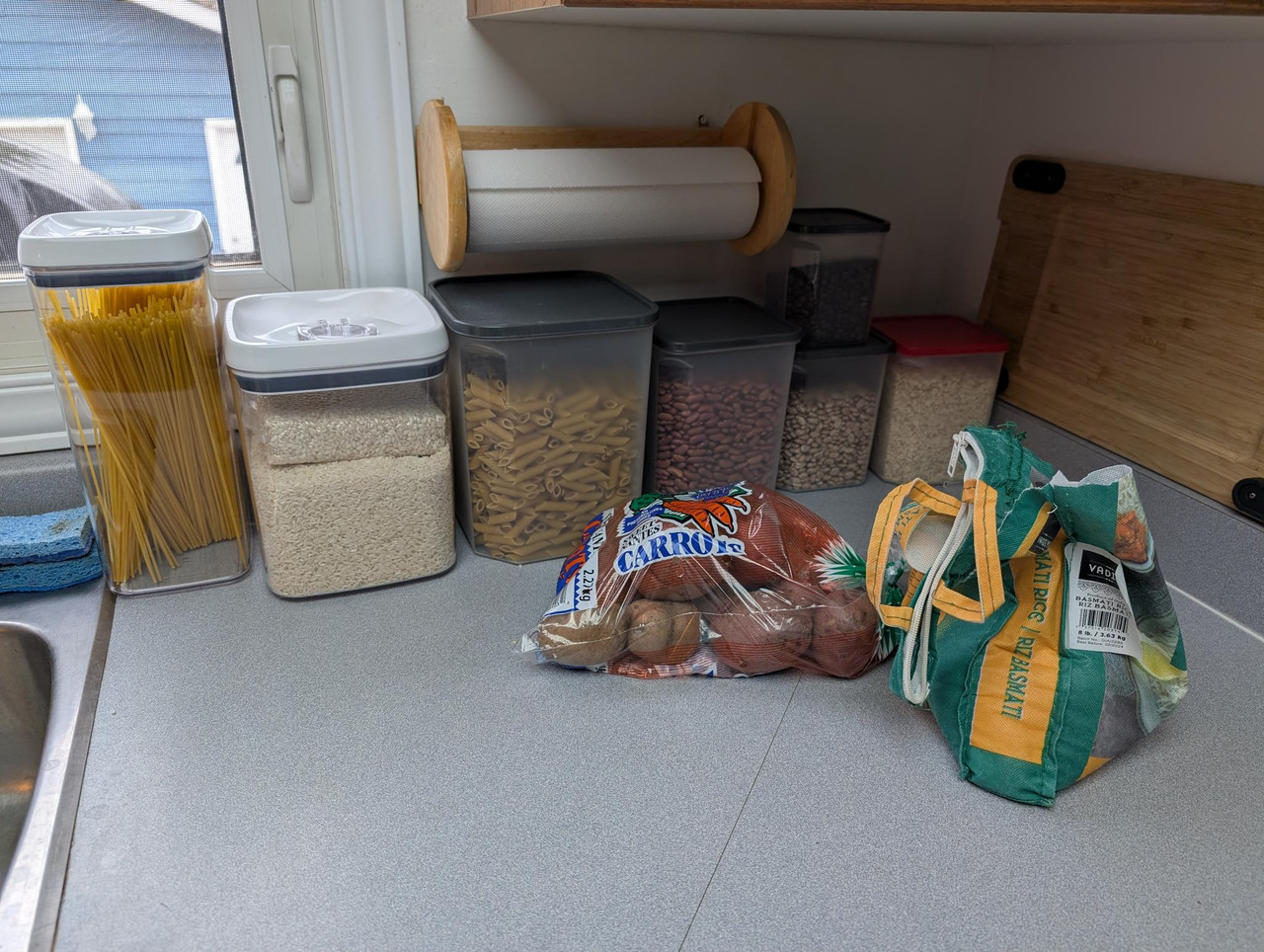
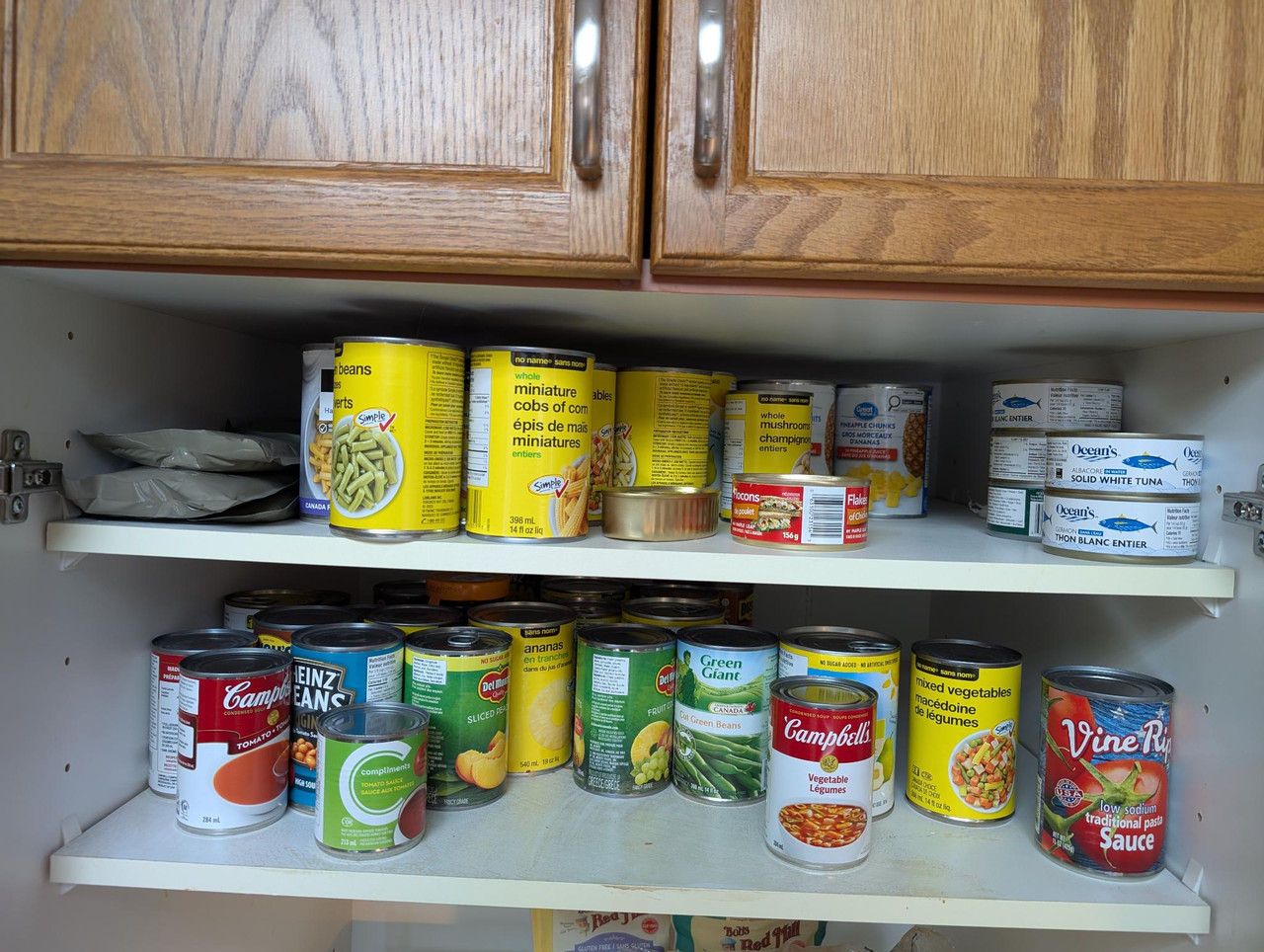
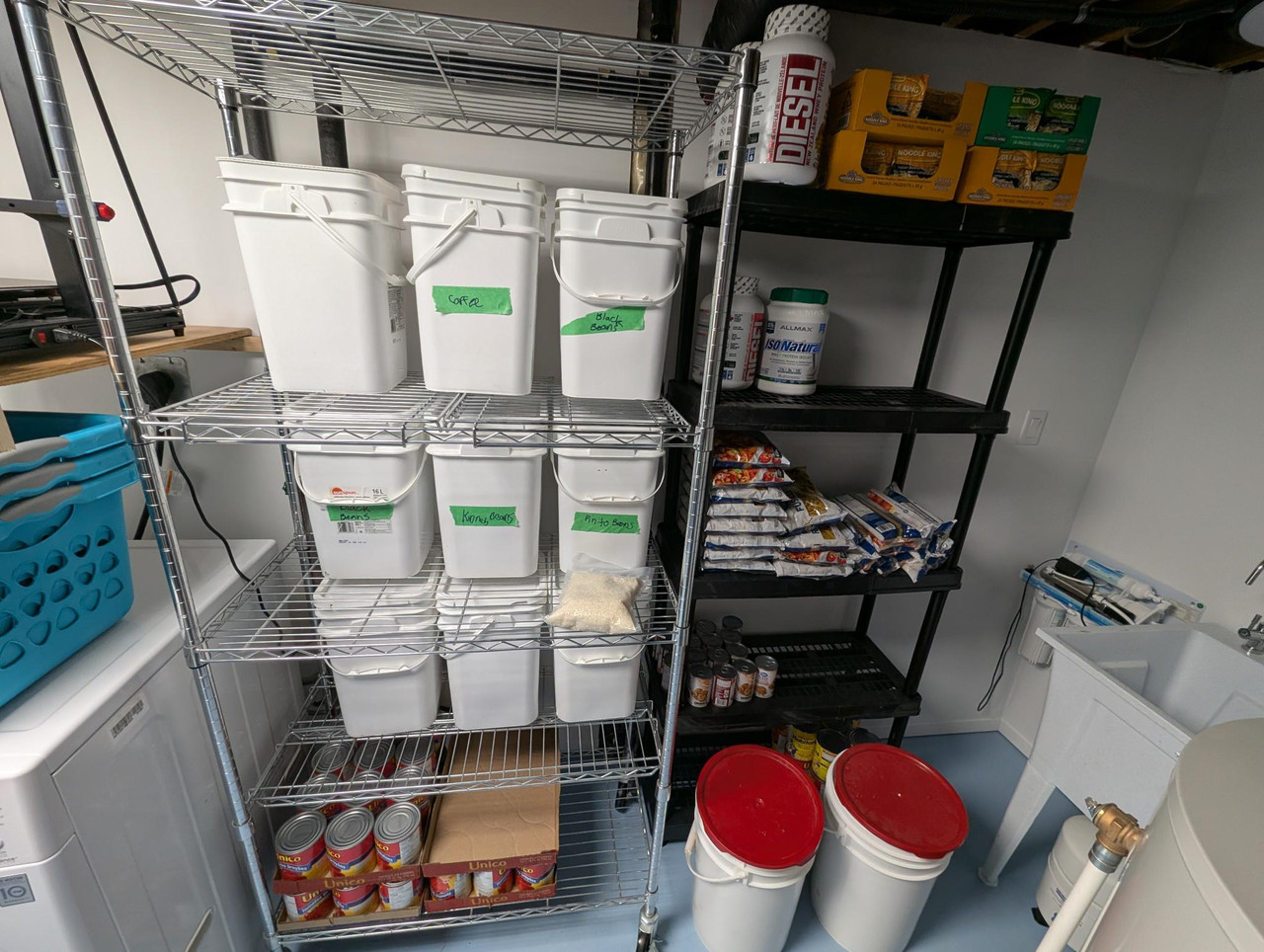
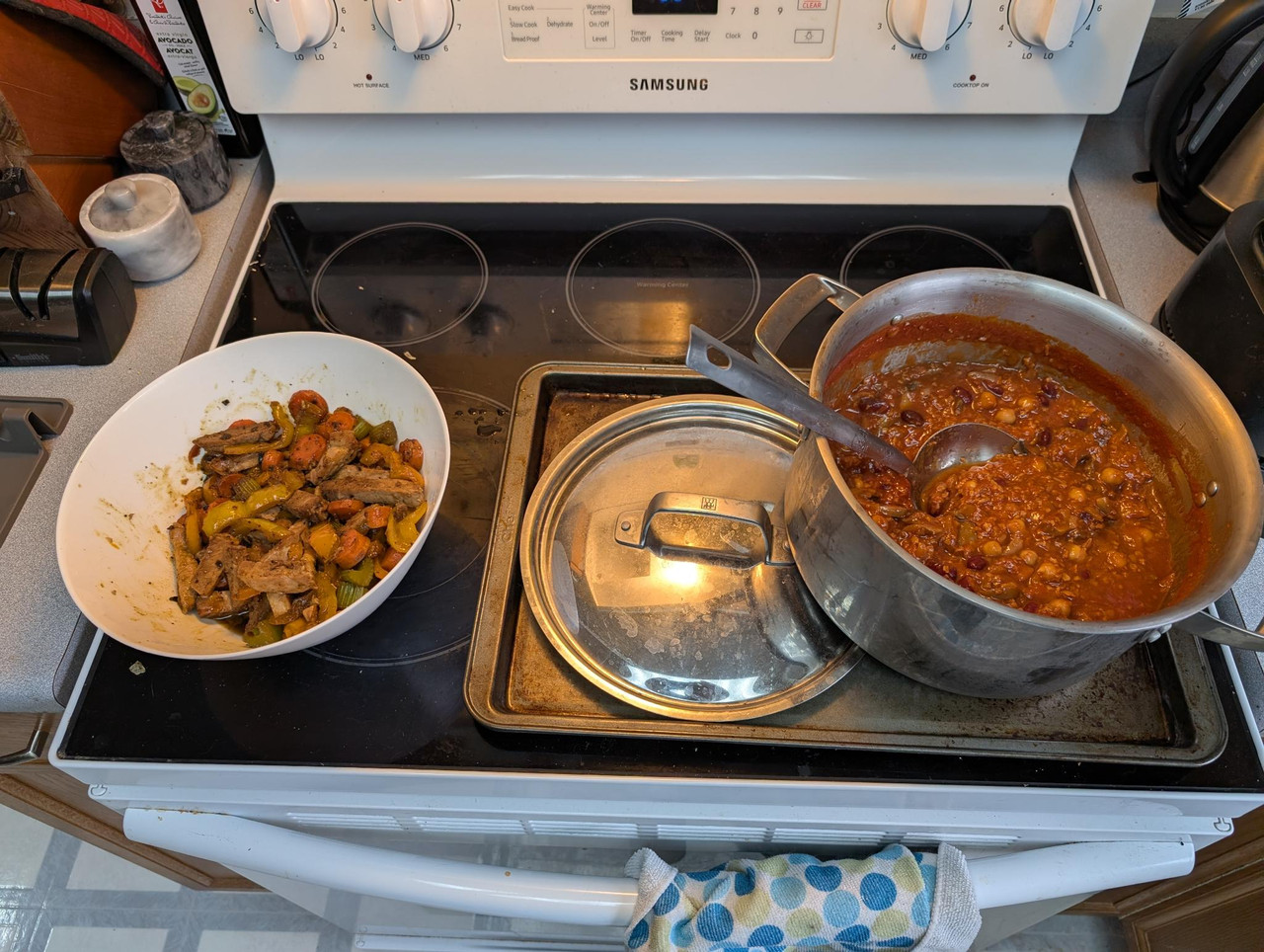
Bonus: This week's slop pots. Metal pot used textured vegetable protein: https://i.postimg.cc/xdm5S0c8/signal-2026-05-14-144201.jpg
load more comments
(6 replies)
Dry goods. Bulk bags of dry rice, beans, lentils, corn grits. That stuff will last forever, and are healthy!
If you and some friends/family can pool your money together and afford it, buy a whole entire cow. Parcel out the meat, and freeze it. My family has been doing this for a long time now, and a whole cow, split between 3 households, lasts a little over a year.
Get into canning, pickling, etc. Don't let the fresh produce you buy at the store, or grow in a garden, just flounder in your fridge, preserve it!
I can a lot of salsa over the summer. Its easy, and it's easy to make in big batches that last awhile.
I eat out less, I order in less, I'm not going to events as much. I see the increases and it sucks but I'm fortunate enough that I can handle it. For now.
The restaurant prices are the real shockers to me. I'm trying to find some places to grab a burger for two in Toronto; not just a burger joint but a proper restaurant. I'm looking at something like $30 per person average before tax and tip, without fries. Lol. Like excuse the fuck out of me but... dining in it is.
Without govt assistance your best bet is to shop smart. Get the 3 lb package of chicken breasts, when you get home pack a breast in a zip lock and leave one in fridge to get cooked rest go in freezer and thaw/cook as needed. Buy rice in the big bulk bags, same with beans. Don't forget to eat vegetables (carrots and potatoes go well with lots of other food items and are reasonably priced). Buying the big bulk bags like this has allowed me to get my meal cost somewhere in the 3$ range. Always pack up leftovers for work. You have to look at what your spending on groceries and determine what you can go without, what has a cheaper alternative, and what can be had cheaper in bulk. It sucks man year and change ago my weekly groceries were both 100 and change for my SO and I now it's closer to 200 a week pretty consistently
load more comments
(3 replies)
Step No. 1 is find the lowest cost grocery store in your area. Stores like Lidl and Aldi are usually substantially cheaper than other big name alternatives, even Walmart.
Step No 2. Especially if you’re talking about actual food insecurity, is shaping what you eat. A pound of spaghetti and red sauce will feed 4 people for less than $5. Actual sacks of rice and orzo are extremely cost effective. If you have an honest to goodness local meat butchers around (these aren’t so common so you may have to go looking), they will often have bulk deals in meat you can buy and freeze. This is much more cost effective than $8-$12 a pound refrigerated ground beef in your local grocery store.
Step No 3. Is something to approach with caution, but certain credit cards often have good cash back rates on grocery stores. If you use them exclusively for grocery and gas purchases, and only use them to pre-spend the money in your checking account so you’re never carrying a balance or paying any interest, they can save you some money. American Express for example has a no-fee rewards card that gives you 3% back on groceries, and a higher tier one that was a $100 annual fee that gives you 6% back on groceries and 3% on gas. Make it your dedicated gas and groceries card, don’t spend more on it than you have money to pay for, and you get a nice little break on two of the most expensive costs of living right now. Something else that might work in this arena is to join a bulk membership store like BJs, Sam’s Club, or Costco and they might have a rewards credit card or even just a store card that puts a little money back into your pocket when you use it.
I know BJs has a program too where if you spend a certain amount on groceries you get a discount on gas if you fill up that day at one of their gas stations, which are usually already cheaper than regular gas stations.
If things are very dicey you can always visit a food pantry. Some Christian churches also do weekly/monthly free meals no questions asked. I know Episcopal churches are usually big on this.
Rice and beans are useful low cost calories. Canned tuna is an affordable protein source. There are often food kitchens you can access even if you don't qualify for SNAP
load more comments
(7 replies)
The main thing I find helpful is planning meals for the week. If you have a solid plan, you're less likely to get takeout, which is were the biggest meal cost is.
Find many ways to use the same/similar ingredients for your weeks meals.
Maybe Monday is grilled chicken BLTs. Tuesday you use the leftover chicken in a pasta. Wednesday you use the leftover sandwhich toppings in a salad with something. Thursday you have eggs with whatever bacon is left.
Also pay attention to sale flyers with all your local stores. If chicken is cheaper than normal, that's the time to buy in bulk. After a while you'll get a feel for a stores sale patterns, maybe chicken goes on sale every 3 months, so if you can afford to, you get enough for 3-4 months. Holiday sales help too, for my local stores, memorial day is usually a good time to get enough hotdogs for the summer.
It really depends on circumstance. Do you have a broad pallette, do you cook, do you have access to land or community garden to grow pricer food per calorie (lettuce, fruit), will you lower your meat intake, can you reduce meals on the go or nights out?
There are a lot of ways to reduce your food budget, the biggest is refraining from eating out. Probably followed by more meals without meat, which is healthier anyway. Americans eat way too much meat. If you are a creative cook you can make the food you have on hand go further, instead of letting random ingredients go to waste.
load more comments
(3 replies)
Nutrition is expensive, and controlling waste is crucial. So yes, if you can get a price break on anything essential, consider freezing and pickling (veggies) what would otherwise spoil. In general, try to learn about how different vegetables and meats will keep.
Rice, beans, and potatoes are great staples that last a while and are good for you.
Lower-end "potted meat product" and similar canned meats may be less expensive per ounce than full cuts. That said, it's usually full of sodium and is usually only good on sandwiches and things like that.
Some grocery stores sell cooked rotisserie chicken as a loss-leader (discount). That said, cost-compare against whole birds in the freezer section just in case. Besides, you can't beat home-made roast chicken, and it's fairly easy to do.
I was broke-as-a-joke back in the 2000's. So the following advice may have aged like the milk I bought back then:
- Obviously, go down-market on your grocery store chain. Cost-compare if your time/energy budget allows it.
- Learn how to cook what's cheap. What's not imported and in season is usually (not always) in this category.
- Avoid box-mixes (e.g. hamburger helper). Buy raw ingredients and consider seasoning packets or bulk seasoning to make the same dishes.
- Bologna, souise loaf, and pickle loaf (if they even still make that) can be cheaper than non-processed cuts
- Bananas and corn are subsidized as fuck. There are likely others. As a result, they're artificially cheap.
- Regularly check the store circular (those newspaper things nobody reads) and jump on limited store specials and BOGOs.
- Tofu can be pretty cheap IF you buy it at an asian grocery store; there may even be bulk options. Making these can be a chore, but a huge bargain if you buy soybeans in bulk. It also freezes okay too, but it does change the texture (some recipes use this).
Not sure if it'll help, but I don't think soylent prices have gone up. At least not in Canada.
I usually only have it for breakfast and lunch especially to avoid those shitty factory burritos.
Occasionally you have to throw food that is spoiled. Not buying it in the first place is better. I'm very good at this, my gf is not. She eats half a corn cob, puts the rest in the fridge and two weeks later i have to throw it out after I find it grazing on the lettuce.
Most meat you can buy in bulk and split into smaller packages freeze If you have the freezer space. Vegetables are usually not cheaper in bulk here outside the occasional buy two for $X deal and they don't survive the freezer as a rule.
You can tinker with what you eat. But it's harder to do.
If you can stop eating candy and soft drinks that is probably the first I'd suggest. Zero nutritional value outside the sugar and a non zero cost.
Check what is most protein per $ in your area. Used to be ground beef here, but now it's frozen chicken filet and the leaner cuts of pork.
Investing, assuming you have some spare room for storage.
I own 2x50 lb bags of rice, 25lbs of dry black beans, 40 lbs of pizza flour, 50lbs of masa flour, 100lbs of AP flour. Bulk pasta.
At those bag sizes, the cost per serving is tiny.
Rebag all the flours, freeze the individual bags, then store them in Beren's cans. I fit most of that in 2 cans.
Buy and freeze protein when it's on sale.
Learn how to make pancake/waffle mix, pizza crust. bread, chicken breading.
Shop for perishables at Aldi or Lidl, Walmart if need be.
You save so much on non-perisable bulk that you can start out with one or two things and slowly grow you pantry to the point there you can afford to bulk buy easily, but you must save for it and reinvest.
Dumpster diving.
You'll be distressed to find out how much shit your local supermarket throws out.
I feel pretty lucky in this regard, in that I've got family members who work at a grocery store, and they let me bum off their employee discount.
Buying in bulk can absolutely be helpful, if you can shop at wholesalers or warehouse clubs, and take advantage of coupons and sales. Wouldn't recommend doing this for perishables though, if you're only buying for yourself. Might also be annoying trying to find space for everything at home.
Learning to cook for yourself is helpful, and that means not just avoiding eating out, but avoiding the purchase of prepared foods.
For instance: Instead of buying a jar of Spaghetti sauce, get a large can of crushed tomatoes, add garlic and Italian herbs, and let it simmer for several hours. It's super easy, and tastes far better, and is much cheaper. Cook up several cans in a giant pot, and freeze the sauce in single or double containers.
Chili is another cheap, nutritious meal that freezes easily. Just ground meat, beans, a can of diced tomatoes, and herbs. Just don't forget the Cumin, that's the taste of Chili.
When pork shoulders are on sale, cook one up in a slow cooker, and freeze that. Cheap pulled pork available whenever you want it. Do the same with chicken breast and/or thighs, when they're on sale.
Do one of those, and a couple more, every Sunday, and you'll have a lot of cheap meals for the next month or two.
load more comments
(2 replies)
Living abroad is very comfortable and means an instant, massive reduction in cost of living. if prices get too crazy or you're interested in the idea of living abroad, feel free to reach out or head over to Travel.
Loss of appetite do to depression
Plant-based diet. I still see inflation but avoided the worst of it
Where I live, oats or potatoes are even cheaper than beans and rice. Dairy (milk, yoghurt etc), peanuts and eggs are also cheap here. Meat is expensive but frozen is cheaper.
Anything that is in season and produced locally/in my country (and/or has excellent shelf-life) tend to be what I look for.
A bowl of oats, yoghurt and peanuts is a simple and filling staple when I don't feel like cooking something "proper".
view more: next ›