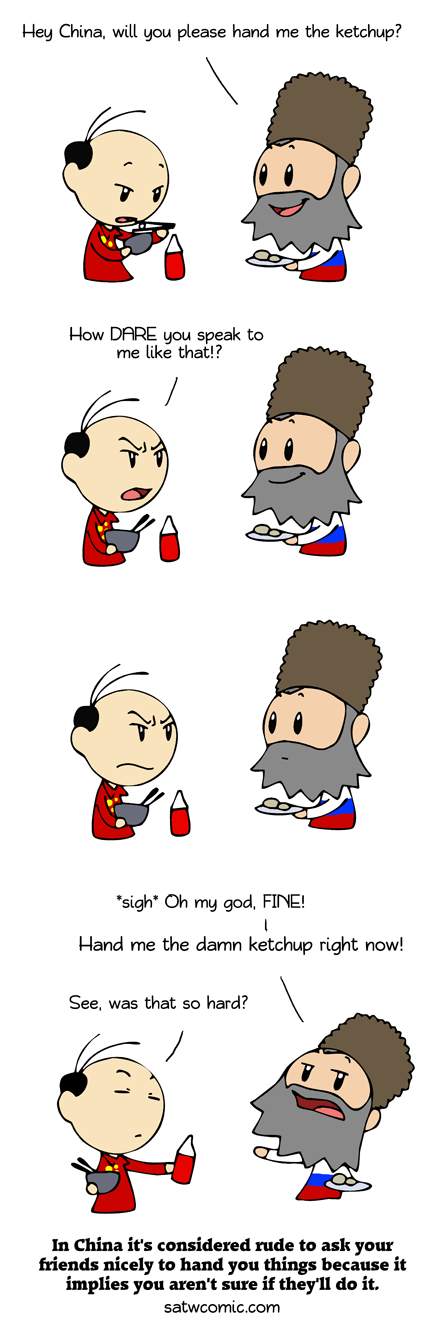
I actually don't know if this is the case all over China or just some parts, but I've seen it mentioned in a lot of places.
Comic Strips is a community for those who love comic stories.
😇 Be Nice!
🏘️ Community Standards
🧬 Keep it Real
📽️ Credit Where Credit is Due
📋 Post Formatting
📬 Post Frequency/SPAM
🏴☠️ Internationalization (i18n)
Sí, por favor [Spanish/Español]🍿 Moderation
The following artists are banned from the community.
It should be noted that when you make reports, it is your responsibility to provide rational reasoning why something should be removed. Saying it simply breaks community rules is not always good enough.
Note: This is not a rule, but a helpful suggestion.
When posting images, you should strive to add alt-text for screen readers to use to describe the image you're posting:
Another helpful thing to do is to provide a transcription of the text in your images, as well as brief descriptions of what's going on. (example)
I actually don't know if this is the case all over China or just some parts, but I've seen it mentioned in a lot of places.
It's reserved for really close friends (sometimes also relatives). The problem is not the extent of politeness per se, but one that exceeds the "expected" politeness. If you're politer than you're supposed to be, you are being too 客气 ("acting like a guest") or 见外 ("looking like a stranger").
Although, the expected politeness is sometimes tricky to know as it depends on each part's perception of the relation. On top of that, there's also the supposed "acting" of politeness, like fighting to pay restaurant bills.
This is actually not that hard to understand. Note that across cultures, close friends can insult each other as jokes. So showing less politeness is like an insult, but with the understanding of the participants, it becomes a show of closeness.
Great. I would be even more screwed in China.
Send me $1000.
I’m going to continue existing not needing to process this much social protocol.
Unless you're a literal basement dweller, you're processing this much social protocol every single day of your conscious life.
ADHD and autism are my shield.
One more thing to freak out about. Which level of politeness is appropriate. Im polite by nature! Oh no, what if I've already offended people?!?
here are some tips on how to be less polite (in no particular order):
That sounds complicated if you aren't sure how close you are yet
And for favours. Do you ask or demand a favour?

How would this scene be received?
American, here. I'm with them! Sort of...
Far too many American parents insist their kids use "please and thank you" for too many things. A classic example:
Kid: "Can you pass the butter?" (this is the natural state of American children... Probably all children, actually)
Parent, semi-scolding: "Can you please pass the butter!"
...or the worse, passive-aggressive form: "Please and thank you, (child)!"
I had this happen to me when I was a kid and my friends had it happen to them. I've witnessed it so many times—even as an adult—yet... It always felt wrong.
Normal people—equals in butter rights—don't communicate like that.
Adult: "Can you pass the butter?"
Adult nearest the butter: "Here..."
There's another, more efficient form that seems to be most common in the Northeastern US, especially with men: (just passes the butter without saying anything at all)
Truly efficient men—who may have never met before that moment—can communicate a butter request and reply to another man without even speaking. A look, with an upward nod and a follow-up downward nod from the guy closest to the butter is all these truly efficient communicators need.
The most efficient families—when it's only adults present, performing their secret, adults-only rituals—tend to shorten it to the tiniest of requests, "Butter?" (points at butter)
Excessive politeness always feels fake and rotten to me. "Please"—from children—should be reserved for actual begging, damnit! With wide eyes and maybe some tears! Anything less feels like bad acting or an unnecessary, inauthentic ritual.
Politeness shouldn't be ritual! It should be something you do because you're paying attention and you're genuinely invested in the concept of feeling sorry about inconveniencing another person with your request. If there's no inconvenience—such as passing the butter—what's the point?
Please and thank you for reading my rant.
I'm down for politeness, and teaching politeness. But the thing about these situations that bugs me is when the parents insist on teaching politeness, but they don't practice it themselves.
Does the parent say, "Please hand me your dishes," or "Please come into the living room"? If they use polite language regularly, then it'd make sense for them to instill polite manners in other mundane situations. If the parents model the behavior they want, they extend respect to the kids, and as such it's fair to request the same behavior in response.
But too many people, including many parents, skip over that "model the behavior they want" part. Saying please/thank you/etc. becomes a rule applied to the kids, but not to the adults. Of course a kid's going to be resentful about that.
I teach small kids, I use please and thank you with them all the time. I then praise them for independently using such words. I see it as a show of my respect for them, and they pick up on that. I may be in charge, but as far as I see it, we are equals. I learned the value of politeness through trauma, but I'd rather these kids learn about it by experiencing the pro-social benefits that it comes with. Politeness isn't a problem, but making it a one-way street absolutely is.
You forgot the:
Kid: can you pass the butter?
Adult: I don't know. Can I?
My wife is overly careful, like this. It goes to weird extremes at times. She will say things like “is there the possibility that you would be physically capable of leaving work early to pick up a package for me?” She’s trying very very hard to be clear that she’s interrogating what’s possible, not making a direct request or demand. This is where the “physically capable” thing comes in.
My reaction is always the same: “Dear, you can ask me to do stuff - just ask.”
I am kinda like this - I don't usually ask for things unless I NEED them. If it's just a request that a no is fine for, feel like I need to make that clear. Like if my hands are full, "could you open the door" but if I have a hand free but am wrangling the dog, "do you think you could open the door, I can if you can't, I just want Dog to sit while you go in and then while I go in" I do feel like I have to explain it's not a demand.
I am from the US and went to England for school one year. In the lunch line here, if there is a choice, you ask for it and say thank you, like "Carrots and potatoes" then "thank you!". But in England they said no, that is rude. It's "carrots and potatoes, please." Then "thank you" when you get them. Needed both just to be minimally polite.
I AM polite with my kids, I model it but don't demand it really. They catch on fine. I have friends and relatives who made their kids "yes sir" and "yes ma'am" them. I don't think that's cool. I told my kids to ma'am and sir wait staff, cashiers and teachers but not family, it does seem almost cheeky, somehow, to be too polite with family.
Yes! Making your kids call you "ma'am/sir" is a huge red flag for me. They're your children, not your staff. They're your responsibility, not your home-grown ego-massagers.
It's not really a thing in English but in my native language there's an informal and formal way to say "you". Once I was in a store, and somebody's kid was being a little too loud/annoying for the parents liking, and she told her to be quiet using the formal "you". It really irked me the wrong way, like you said it was like she was talking to an employee, but it felt even worse cause I've never used the formal you to my actual employer and vice versa
I kinda like doing that opposite of that. Using sir or ma'am for my kids always gives me a proper warm heart but I don't make them use it in any context. For me the usage of sir/ma'am is reserved to show respect and deep fondness for someone (1 or 2 people total, not an "elder" thing). Kinda like some people loosely use uncle or grandma for someone that's not even related but they're still special to them.
I'm English and it sounds slightly off to my ear if somebody requests something and says thanks in the same sentence. To me, you thank somebody after they've done something. Making a request and immediately saying thanks is like presuming they're definitely going to do it, which cancels out the whole pretend formality of requesting instead of commanding.
I know practically a canteen worker isn't going to deny your request so it's all unnecessary social nonsense but it's funny spelling these tiny differences out.
Saying "please" when asking someone to do you a favor isn't excessive, IMHO. It indicates that you are making a request and not issuing an order, and recognizes that you are grateful for the assistance.
Makes perfect sense. This comment just made me realize English does not have a distinction between order and request. While, for example, in Russian, orders are said in indefinite tense (?). So when you order a dog to sit, you would say "to sit!" (сидеть!), or to order someone to stop, "to stand!" (стоять!). Another less formal way to order (usually a group) is to use "we" as the subject, for example, "[we are] not sitting, [we are] working" (не сидим, работаем)
Since English doesn't have codified politeness levels in grammatical structures (like Japanese does with eg verb endings, where tabe-ru is less polite than tabe-masu for the same verb meaning "eat"), we tend to make requests longer the more polite we're being.
For example:
With close friends the first one is ok(ish) if your tone isn't too commanding, but I'd normally stick to 2 through 4 (or 5). For some reason a "please" sounds overly polite whereas a "thanks" upon receiving the request doesn't. I imagine this is different for other regions. I'm from the US northeast, but people from the south probably feel differently.
One time while attending a nomikai I drank before my senior and was beaten within an inch of my life. As they were about to finish me off with a rocket launcher my senpai swallowed a grenade on my behalf, excused himself and blew up outside the izakaya, this was fortunately enough for the senior to spare my life.
I am forever indebted to Suzuki-san for his noble sacrifice. Please use the above phrases well and you might survive and even thrive in Japan.
I'm writing this message from my hospital bed where I am waiting to have 50 chopsticks removed from my rectum (unrelated incident). Thank you again, Suzuki-san. I know you are watching over me from above in heaven.
One of my favorite random Japanese language coincidences is that one meaning of "yo" is the same in English and Japanese.
Let's go, yo!
Ikou, yo!
Can't forget the simplest form, at least in my language but pretty sure it works in English.
And that is just loudly declare the item you want:
SALT!
This actually explains a good bit about my first generation Chinese friends table manners I never considered
Wow, long time since I have seen a Scandinavia and the World comic!
In Canada it’s considered rude to think you’ll be offered a drink at someone’s house. As a Brit, that’s quite strange.
Or my family are weird. Who knows.
As an American with no social skills whatsoever, I get confused & annoyed when people offer me a beverage when I arrive at their house. Like why do they think I'm suddenly thirsty?
Presumably you had to travel to get there. It's likely you didn't have anything to drink while travelling. So they offer you a drink.
Also, it's nice to sit and chat while enjoying a drink, whether that is a warm drink (coffee, tea, whatever), a cold drink (water, juice, soda, whatever), or an alcoholic drink (beer, wine, whatever).
It’s just considered manners, here anyway.
i'm interested in this. as a southerner, i offer everyone water when they arrive at my house because water is a basic human need and most people won't ask for it when they need it because it can be a struggle to get it and they don't want to put me out. it's just like… a little showing of mutual respect and love for our shared struggle that takes not much to offer. if we're eating, i'll offer you food to.
if i don't offer you water i'm communicating in the southern way that you are not welcome and your presence in my household has been imposed on me. i go by the standard Nikki Giovanni taught me: everyone gets fed, racists can fetch their own water.
but i acknowlege this is likely a cultural difference. my wife hates this pattern of showing solidarity and finds it confusing. so like… how do you and your people demonstrate that someone is welcome in your space?
isn't it bad to be thirsty and good to have a nice drink?
Since it's related: ketchup (the word, not necessarily the sauce) has a historical origin in China. It would have been a fermented fish sauce rather than a tomato based sauce.
That explains why that Chinese guy hated me.
That and the century of humiliation.