this post was submitted on 05 Apr 2026
323 points (94.2% liked)
Comic Strips
23719 readers
2845 users here now
Comic Strips is a community for those who love comic stories.
Rules
-
😇 Be Nice!
- Treat others with respect and dignity. Friendly banter is okay, as long as it is mutual; keyword: friendly.
-
🏘️ Community Standards
- Comics should be a full story, from start to finish, in one post.
- Posts should be safe and enjoyable by the majority of community members, both here on lemmy.world and other instances.
- Any comic that would qualify as raunchy, lewd, or otherwise draw unwanted attention by nosy coworkers, spouses, or family members should be tagged as NSFW.
- Moderators have final say on what and what does not qualify as appropriate. Use common sense, and if need be, err on the side of caution.
-
🧬 Keep it Real
- Comics should be made and posted by real human beans, not by automated means like bots or AI. This is not the community for that sort of thing.
-
📽️ Credit Where Credit is Due
- Comics should include the original attribution to the artist(s) involved, and be unmodified. Bonus points if you include a link back to their website. When in doubt, use a reverse image search to try to find the original version. Repeat offenders will have their posts removed, be temporarily banned from posting, or if all else fails, be permanently banned from posting.
- Attributions include, but are not limited to, watermarks, links, or other text or imagery that artists add to their comics to use for identification purposes. If you find a comic without any such markings, it would be a good idea to see if you can find an original version. If one cannot be found, say so and ask the community for help!
-
📋 Post Formatting
- Post an image, gallery, or link to a specific comic hosted on another site; e.g., the author's website.
- Meta posts about the community should be tagged with [Meta] either at the beginning or the end of the post title.
- When linking to a comic hosted on another site, ensure the link is to the comic itself and not just to the website; e.g.,
✅ Correct: https://xkcd.com/386/
❌ Incorrect: https://xkcd.com/
-
📬 Post Frequency/SPAM
- Each user (regardless of instance) may post up to five (5 🖐) comics a day. This can be any combination of personal comics you have written yourself, or other author's comics. Any comics exceeding five (5 🖐) will be removed.
-
🏴☠️ Internationalization (i18n)
- Non-English posts are welcome. Please tag the post title with the original language, and include an English translation in the body of the post; e.g.,
Sí, por favor [Spanish/Español]
-
🍿 Moderation
- We are human, just like most everybody else on Lemmy. If you feel a moderation decision was made in error, you are welcome to reach out to anybody on the moderation team for clarification. Keep in mind that moderation decisions may be final.
- When reporting posts and/or comments, quote which rule is being broken, and why you feel it broke the rules.
Banned Artists
The following artists are banned from the community.
- Jago
- Stonetoss
It should be noted that when you make reports, it is your responsibility to provide rational reasoning why something should be removed. Saying it simply breaks community rules is not always good enough.
Web Accessibility
Note: This is not a rule, but a helpful suggestion.
When posting images, you should strive to add alt-text for screen readers to use to describe the image you're posting:
Another helpful thing to do is to provide a transcription of the text in your images, as well as brief descriptions of what's going on. (example)
Web of Links
founded 2 years ago
MODERATORS
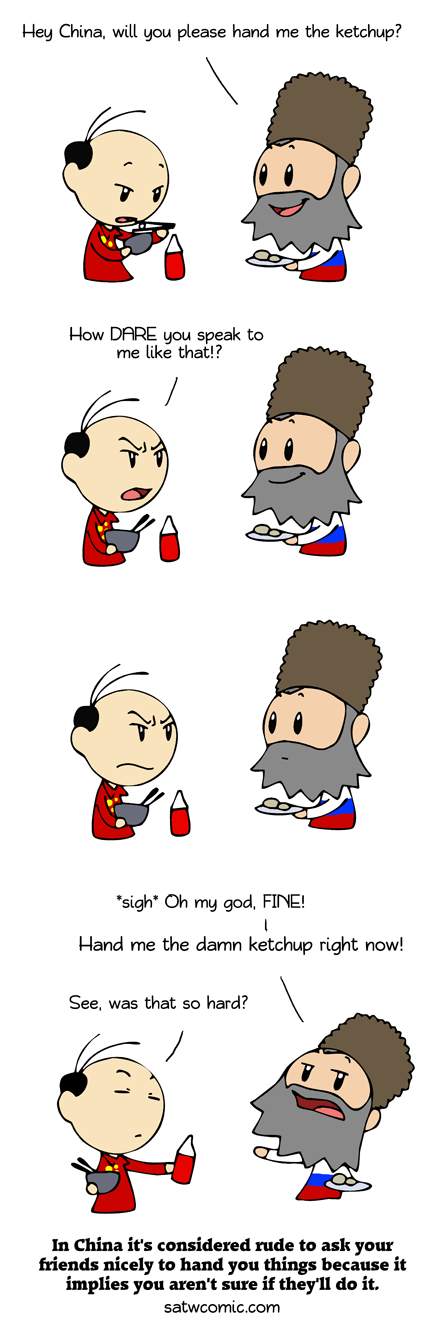
American, here. I'm with them! Sort of...
Far too many American parents insist their kids use "please and thank you" for too many things. A classic example:
Kid: "Can you pass the butter?" (this is the natural state of American children... Probably all children, actually)
Parent, semi-scolding: "Can you please pass the butter!"
...or the worse, passive-aggressive form: "Please and thank you, (child)!"
I had this happen to me when I was a kid and my friends had it happen to them. I've witnessed it so many times—even as an adult—yet... It always felt wrong.
Normal people—equals in butter rights—don't communicate like that.
Adult: "Can you pass the butter?"
Adult nearest the butter: "Here..."
There's another, more efficient form that seems to be most common in the Northeastern US, especially with men: (just passes the butter without saying anything at all)
Truly efficient men—who may have never met before that moment—can communicate a butter request and reply to another man without even speaking. A look, with an upward nod and a follow-up downward nod from the guy closest to the butter is all these truly efficient communicators need.
The most efficient families—when it's only adults present, performing their secret, adults-only rituals—tend to shorten it to the tiniest of requests, "Butter?" (points at butter)
Excessive politeness always feels fake and rotten to me. "Please"—from children—should be reserved for actual begging, damnit! With wide eyes and maybe some tears! Anything less feels like bad acting or an unnecessary, inauthentic ritual.
Politeness shouldn't be ritual! It should be something you do because you're paying attention and you're genuinely invested in the concept of feeling sorry about inconveniencing another person with your request. If there's no inconvenience—such as passing the butter—what's the point?
Please and thank you for reading my rant.
I'm down for politeness, and teaching politeness. But the thing about these situations that bugs me is when the parents insist on teaching politeness, but they don't practice it themselves.
Does the parent say, "Please hand me your dishes," or "Please come into the living room"? If they use polite language regularly, then it'd make sense for them to instill polite manners in other mundane situations. If the parents model the behavior they want, they extend respect to the kids, and as such it's fair to request the same behavior in response.
But too many people, including many parents, skip over that "model the behavior they want" part. Saying please/thank you/etc. becomes a rule applied to the kids, but not to the adults. Of course a kid's going to be resentful about that.
I teach small kids, I use please and thank you with them all the time. I then praise them for independently using such words. I see it as a show of my respect for them, and they pick up on that. I may be in charge, but as far as I see it, we are equals. I learned the value of politeness through trauma, but I'd rather these kids learn about it by experiencing the pro-social benefits that it comes with. Politeness isn't a problem, but making it a one-way street absolutely is.
You forgot the:
Kid: can you pass the butter?
Adult: I don't know. Can I?
My wife is overly careful, like this. It goes to weird extremes at times. She will say things like “is there the possibility that you would be physically capable of leaving work early to pick up a package for me?” She’s trying very very hard to be clear that she’s interrogating what’s possible, not making a direct request or demand. This is where the “physically capable” thing comes in.
My reaction is always the same: “Dear, you can ask me to do stuff - just ask.”
I am kinda like this - I don't usually ask for things unless I NEED them. If it's just a request that a no is fine for, feel like I need to make that clear. Like if my hands are full, "could you open the door" but if I have a hand free but am wrangling the dog, "do you think you could open the door, I can if you can't, I just want Dog to sit while you go in and then while I go in" I do feel like I have to explain it's not a demand.
I am from the US and went to England for school one year. In the lunch line here, if there is a choice, you ask for it and say thank you, like "Carrots and potatoes" then "thank you!". But in England they said no, that is rude. It's "carrots and potatoes, please." Then "thank you" when you get them. Needed both just to be minimally polite.
I AM polite with my kids, I model it but don't demand it really. They catch on fine. I have friends and relatives who made their kids "yes sir" and "yes ma'am" them. I don't think that's cool. I told my kids to ma'am and sir wait staff, cashiers and teachers but not family, it does seem almost cheeky, somehow, to be too polite with family.
Yes! Making your kids call you "ma'am/sir" is a huge red flag for me. They're your children, not your staff. They're your responsibility, not your home-grown ego-massagers.
I kinda like doing that opposite of that. Using sir or ma'am for my kids always gives me a proper warm heart but I don't make them use it in any context. For me the usage of sir/ma'am is reserved to show respect and deep fondness for someone (1 or 2 people total, not an "elder" thing). Kinda like some people loosely use uncle or grandma for someone that's not even related but they're still special to them.
It's not really a thing in English but in my native language there's an informal and formal way to say "you". Once I was in a store, and somebody's kid was being a little too loud/annoying for the parents liking, and she told her to be quiet using the formal "you". It really irked me the wrong way, like you said it was like she was talking to an employee, but it felt even worse cause I've never used the formal you to my actual employer and vice versa
I'm English and it sounds slightly off to my ear if somebody requests something and says thanks in the same sentence. To me, you thank somebody after they've done something. Making a request and immediately saying thanks is like presuming they're definitely going to do it, which cancels out the whole pretend formality of requesting instead of commanding.
I know practically a canteen worker isn't going to deny your request so it's all unnecessary social nonsense but it's funny spelling these tiny differences out.
Saying "please" when asking someone to do you a favor isn't excessive, IMHO. It indicates that you are making a request and not issuing an order, and recognizes that you are grateful for the assistance.
Makes perfect sense. This comment just made me realize English does not have a distinction between order and request. While, for example, in Russian, orders are said in indefinite tense (?). So when you order a dog to sit, you would say "to sit!" (сидеть!), or to order someone to stop, "to stand!" (стоять!). Another less formal way to order (usually a group) is to use "we" as the subject, for example, "[we are] not sitting, [we are] working" (не сидим, работаем)