This show is one part Lower Decks, one part Prodigy, one part Discovery, and a dash of SNW... I dig it. Excited to see where it goes.
this post was submitted on 16 Jan 2026
52 points (94.8% liked)
Star Trek Social Club
15376 readers
16 users here now
r/startrek: The Next Generation
Star Trek news and discussion. No slash fic...
Maybe a little slash fic.
Rules
1 Be constructive
All posts/comments must be thoughtful and balanced.
2 Be welcoming
It is important that everyone from newbies to OG Trekkers feel welcome, no matter their gender, sexual orientation, religion or race.
3 Be truthful
All posts/comments must be factually accurate and verifiable. We are not a place for gossip, rumors, or manipulative or misleading content.
4 Be nice
If a polite way cannot be found to phrase what it is you want to say, don't say anything at all. Insulting or disparaging remarks about any human being are expressly not allowed.
5 Spoilers
Utilize the spoiler system for any and all spoilers relating to the most recently-aired episode. There is no formal spoiler protection for episodes/films after they have been available for approximately one week.
6 Keep on-topic
All submissions must be directly about the Star Trek franchise (the shows, movies, books, etc.). Off-topic discussions are welcome at c/Quarks.
7 Meta
Questions and concerns about moderator actions should be brought forward via DM.
Upcoming Episodes
| Date | Episode | Title |
|---|---|---|
| 09-03 | SNW 4x07 | “Like Chronitons Through the Hourglass” |
| 09-10 | SNW 4x08 | “Orders of Magnitude” |
| 09-17 | SNW 4x09 | "Once La’An a Time" |
| 09-24 | SNW 4x10 | "Tomorrow's Enterprise" |
| TBA | SFA 2x01 | TBA |
Wondering where to stream a series? Check here.
founded 3 years ago
MODERATORS
For now, I'll just share the thoughts I posted to Mastodon while this instance was still on the Genesis Planet...
Overall, a very strong couple of episodes. The cadets are all interesting enough, though Jay-Den and SAM are outstanding. Caleb is the sort of Rebellious Young Person that can grate on people, but I think the show compensates for that by making him a bit of a punchline. His backstory is also compelling enough (I actually thought his separation from his mother seemed very real), and his motivations are clear.
Nahla Ake is fantastic, and Holly Hunter brings a lot to the role. The character is quirky, but grounded, and you can see that she carries multiple lifetimes of experience.
Paul Giamatti is clearly having the time of his life as Braka. Time will tell whether he remains a cartoonish pirate (which I'd be fine with TBH), or if they'll give him more to do.
I've always loved the post-Burn setting, and I'm looking forward to exploring that status quo. The Betazed stuff is intriguing, and I hope we learn more about this "psionic wall" of theirs.
Also, "Discovery is unavailable because X" is the new "the transporters don't work because X".
“Discovery is unavailable because X”
Also, did they have what seems to be personal transporters before or is that a new thing? Where they apparently only have to think "I need to go to that room" and they're instantly transported? That seems like it'll be a major issue for future writers to come up with excuses why they can't just put the characters where they need to be.
That has been a thing since DSC season three, and I really hope they explore exactly how that works in this series.
Ahh, I suspected as much, I don't remember many details from that tbh. Thank you for clearing that up.
That seems like it’ll be a major issue for future writers to come up with excuses why they can’t just put the characters where they need to be.
Only a little more of an issue than transporters already were. How often have writers had to add in an exotic atmosphere or cave ore or ion storm or just enemy shields to justify not beaming out of a bad situation?
Welcome back! I enjoyed both these episodes. I don’t like this time period, the post burn Federation. The rebuilding could interesting but it’s not really aspirational and I really could use some aspirational content in my life, vaguely waves at every thing.
Rebuilding in the wake of global disaster (and honestly it's been one after another my whole life) is exactly the kind of inspirational content I think we need right now. 90s Trek was all about "things have been great, it could be better!" and I think our message today really should be "things have sucked for a bit, but how do we recover the greatness we know we're capable of?"
I hadn’t really seen that point of view before but I really like it. Shit has sucked for a while maybe some stories about how cool fixing it would be are what I need.
This, very well put. I've been struggling to vocalise why I like this to folks and I think you nailed it.
Its a different message for a different era. And one we need. Too many are looking at the near and potentially bleak future, we need them to realise that hope can still lay beyond that.
Totally! I haven’t loved the post-Burn setting but the way this show is already contextualizing it, and the optimism it’s doing it with is already starting to change my mind.
And it’s even carrying over from the show into real life, which is one of the things I love most about Trek and its good to have this out there. There’s some nitpicks, as there always are, but so far I can deal with them, especially if it stays consistent. 🖖
I haven’t loved the post-Burn setting but the way this show is already contextualizing it, and the optimism it’s doing it with is already starting to change my mind.
Same. A lot of that stuff just feels more comfortable with time and I appreciate how Star Trek always pushes it a little bit. People FREAKED OUT with the Klingon changes in TMP/TNG. Then FREAKED OUT that DS9 was on a space station with a "politically correct" captain. Now we think of those things as normal, nostalgic even.
load more comments
(1 replies)
I liked it too, but I find rebuilding to be aspirational. Like maybe the most aspirational thing possible.
Episode 1: with expectations at the bottom of the Mariana Trench (because I watched Discovery), I was not too disappointed by this episode. Was it good? Also no. I think the story is fine in principle, it doesn't unfold in a believable way, but not the worst we've seen in Star Trek. Other than that I was irked by what the captain says at 41:55:
make eh(?) your speed maximum impolt
Really, impolt, you couldn't do a second take on that?
Episode 2: quite a bit worse, the plot progressed for like 3 minutes in total, and there was a lot of that teen drama that wasn't interesting or amusing.
Overall felt like these were written by people who know a lot about Star Trek at a very surface level, and have a very TV-idea of what college life is like. I'll keep watching, for now. Out of franchise loyalty more than actual interest.
load more comments
(1 replies)
Going into it I wasn't sure about a school-based Star Trek, but I was pleasantly surprised by how much I enjoyed the first two episodes. It helps that the characters are a little older than I thought they were going to be (university instead of high school), but there was also some enjoyable writing in there that kept me interested and made me laugh a few times. Shout out to SAM, I was concerned at first because these fish-out-of-water characters are easy to make annoying but I ended up quite liking her.
I did have a few issues (I still don't love the burn as a plot device), but overall I'm interested to see what happens in the next episode.
Also, yay Prodigy references!
So far I've just watched episode one, but I think we're off to a great start. I don't know Holly Hunter from anything except Batman v Superman, so I didn't know why everyone seemed so happy to have her on board, but I get it now. Nahla isn't much on paper, but Hunter really makes me love the character. She sells the comfort and confidence without feeling at all silly or non-genuine.
I thought Caleb would be a harder character to like, but he won me over pretty quickly too. His introduction definitely started on the right foot. His mode of escape reminded me of Jason Todd stealing the tires off the Batmobile. Good stuff.
The other cadets are a mixed bag so far. Jay-Den and Sam seem fun, the others seems like boring cliches, but none of them have been given a lot of time yet so it's still a wait and see situation.
The episode itself was a little messy, especially the action at the end, but I get that it was the first episode and they felt they had to give everyone something to do. Still one of Trek's better premiers.
load more comments
(3 replies)
There was many a memberberry.
At one point I thought that it didn't look very Trek-y, somehow. Which can be explained of course by the fact that an entire millennium of progress has happened. It should be more surprising that anything does still look familiar. The thing is though that I watch Star Trek for the Trek-iness. The visual familiarity is part of it. I don't know yet.
Let's hope episode 3 starts being about more than Caleb's mum. And science.
At least there was some diplomacy. Although it was weird that they'd negotiate while standing at lecterns surrounded by hundreds of people. Sit down, have a cuppa together, have a conversation, not a debate.
Also, I'm supposed to ship Caleb and his roommate whose name I have forgotten, yes? The way they interact is textbook shipping material. Not to mention They Are Roommates.
Oh also, no Cerritos in the 60th logo sequence hellooooo?
No Protostar either
As an animated Trek fan, that definitely irks, especially as it’s an animated sequence.
I have a suspicion that there’s something about animated design IP rights behind the decision though.
The old owners had decided to jettison animated Star Trek, and some other Paramount+ animated content to make the streamer mainly live action focused. Which, at the time this was announced, seemed very odd because Paramount’s owners were trying to sell the firm to Skydance, which is a major producer of high end animation for streamers.
So, my thought is that Skydance wants its own animation studio to be doing any future animated content for Paramount. There will be exceptions for long running Nickelodeon animation such as SpongeBob, Beavis and Butthead or Dora the Explorer, but relatively recent creations will get short shrift.
You sound like you know what you're talking about while I know very little if anything - how does that IP rights stuff mean that the Cerritos and the Protostar can't be in that sequence?
Generally, Paramount owns all Star Trek IP rights.
However, reusing some things isn’t cost less. In some cases, they have to pay residuals to specific individuals or subcontractors who have creative rights.
Historically, this has led to weirdness such as renaming the Locarno character from the TNG episode ’Lower Decks’, played by Robert Duncan McNeill, to become Tom Paris in Voyager because Paramount didn’t want to pay the writer who got scrip credit for the TNG episode ongoing residuals for creating the character.
I don’t know enough about whether creators of animated character designs have rights to similar kinds of residuals, or the production houses like Titmouse for Lower Decks, but one has to wonder. It was so strange that Paramount+ suddenly said it was refocusing away from animation just as Skydance started its moves to acquire it.
Protostar is Nickelodeon, but I don't see any reason the Cerritos couldn't be used.
load more comments
(1 replies)
Just watched Ep 1.
Star Trek (and science fiction) exists as a mirror of it's time, different enough so that we can look at ourselves from a distance, with a required added component of playing with the ideas about what the future might be like. TOS and TNG were both mirrors of their time, with a Klingon on the bridge predicting the end of the cold war.
I definitely feel the "ok, the present generation of kids is inheriting a shitshow" vibes to this show. If you understand that there were a bunch of past efforts to do the Burn in Star Trek, it seemed like something that floated around for a long time now to break the universe (the abortive Star Trek: Final Frontier animated series being one) and ... I dono, I'm more OK with it now than I would have been in 2009 because, as I said, Trek is a mirror of it's time.
Comparing things to Star Wars, the sequel trilogy started out with the idea of "Guess what, fighting nazis again!" and it was prescient and it's altogether too bad that they hadn't actually thought things through well enough to bring it to a really smashing conclusion. There are a lot of threads (Caleb's mom being a big one) where they could totally bungle things.
So, we start with family separation. Wonder where that came from! And then we kinda bounce around the subject, too. Nahla having done a thing, regretted it, leaving Starfleet, trying to make it better while also showing that whatever they do end up doing, it's not "solving" what they did in the first place.
Nus Braka chews up the scenery. This is important, in a Trek series. Yes, it can be quiet and thoughtful and serious but we always come back to the spectacularly overplayed antagonist.
I'm fairly OK with NuTrek trusting the audience less and driving a point home harder. A lot of people ascribe old Trek with values that it never had and part of that's because the writers trusted the audience to see the point, but folks just don't have the same attention span to do that anymore.
Very very nerdy side note: on Outpost Pikaru there's a whole set of grating panels that I assume are a deliberate callback to the freezer spacing grates that were all over the TNG-era Trek serieses as well as a bunch of other science fiction properties. They look very very similar but they aren't.
On the reddit side of the fence, someone suggested you look up Gina Yashere's standup to realize just how Lura Thok is basically Gina playing herself but in the 31st century. She reminds me of one of the assistant principals at my high school, actually, except she's got more drill sergeant edge to her.
Jay-Den Kraag... when I was but a wee little trekkie, I knew a trans person who was deep into hardcore Klingon fandom and I think part of why it made sense for him was that Klingons was part of how he settled into his new gender? So the idea of Klingon males as a mirror to masculinity ... toxic and otherwise ... has been a thing, at least for me, for a while. I feel like Jay-Den Kraag was someone looking at the Klingon Therapist meme and making an actual character out of it. The entire scene where the Klingon is de-escalating things between two cocky assholes is something at least I needed.
SAM's first few scenes I skipped past the first watching and then when her character made sense, I had to go back and actually watch them because they were a lot less cringe.
Genesis is an interesting version of charming because at first glance she starts out as a "mean girl" but then you realize that she's parodying it hard.
Okay, and the Doctor back as the anchor to the very past. Robert Picardo is keeping the Picard name alive in that he kinda aged to a certain age and he hasn't really aged much since, much in the same way as Patrick Stewart does.
There's lots of fanservice, but in a good way. The half-white/half-black species from TOS, a green Orion, the Doctor, etc.
One thing that's interesting with the characters who don't stay locked up in the dorms when the big action is happening is that they all have plausible reasons to be there. Caleb has been living a life on the run for a long time now. Jay-Dem is a Klingon and shows some moments of self-doubt. Genesis has been living on starbases her whole life, shades of Beckett Mariner actually. Darem is cocky and it gets him in trouble. And then SAM, doesn't know better, but also doesn't know fear in the way a biological would. Meanwhile, one of the other cadets is screaming senselessly.
And I guess back to Nahla ... she goes from "just following orders" to "Bajor schoolteacher on ice cream day" to supportive nurturing captain to playing high stakes poker with a space pirate and back. And she's small, except for the part where she's able to exude authority when being towered over. They were asking her to sell a lot and I think she did it. I looked through her IMDB and my past experience of her was the mom from Thirteen and Elastigirl.
One thing I hope, as a long standing Ex Astris Scientia reader, is that there's ... some sort of sense to the programmable matter, the wild 31st century designs, et al. TNG had a lot of particle-of-the-week stuff but Voyager was a crazy-quilt of nonsense particles. It's important for the viewer to, albeit not from the first episode or two, gain some vibes for where the boundaries are, otherwise there's no stakes. A transporter ruins basically any "locked room" detective novel puzzle.
Likewise, how they wrap up Caleb and his mom is going to either make or break the emotional arc of the series?
So, overall ... it landed with me, based on where I am in my life. I empathized with Nahla in a bunch of ways that make me angry about the world I empathized with Jay-Den in a bunch of ways that made me content about the world. I'm not sure how the younger generation or casual Trek fans are going to react to it.
Edit: Unspoilered because the mods told me I didn't need to.
I’m fairly OK with NuTrek trusting the audience less and driving a point home harder
I'm generally against this, but it's also not like Star Trek ever gave us a reasonable expectation of subtlety.... 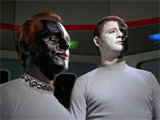
Re: limits of programmable matter:
On Discovery away teams wore programmable matter flashlight bracelets that could turn into a phaser, and I think even a phase rifle, but from these last couple of episodes it seems they can't make a tricorder that turn into a medical tricorder.
I really hope they get into this at some point, but my assumption is that the main limitation of programmable matter is that you have to, y'know, program it first, which takes time.
Also, I had no idea that programmable matter is an actual theoretical thing that scientist have been trying to crack for a few decades now!
In the case of the tricorder...I wonder if that's the Doctor being old-fashioned, since we've also seen that tricom badges have tricorders built into them.
load more comments
(1 replies)
Genesis is an interesting version of charming because at first glance she starts out as a “mean girl” but then you realize that she’s parodying it hard.
From the trailers, I had assumed that Genesis would be the stuck-up mean girl, and Darem would be the friendly tryhard. Turns out the reality is the exact opposite.
Edit: Also, there's no need for spoiler tags in these discussion threads!
Oh, didn't see that it was a spoilerific thread. Edited for ease of reading.
I went in cold, LOL. I'd not bothered with the trailers or the preview reviews. Yesterday, I saw a post on reddit that said that people were mad because it wasn't white enough and impulsively decided that I'd watch it before bed ... which then caused me to go to bed late because I had to rewatch the fun bits.
Ep 2 thoughts ...
So, in present day history, we've got the US Space Force, newly created, with a logo that looks an awful lot like the Star Trek arrowhead. But Trek has gone back many times to remind people that Starfleet is not the military. There's a lot to unpack here because actually exploring means that you are potentially wandering off into dangerous places, where you need either semblance of order and discipline (think civilian ships where the skipper tells you to do something) or the ability to defend yourself against someone who might not be friendly.
Thus, Lura's drill sergeant act fits this model. She doesn't want to turn you into a killer so much as making sure that you can stare death in the face and not loose your shit.
Likewise, if they write the whole plot with the War College and the Academy next door to each other right, there's the potential to restate the original base idea behind Star Trek TOS but adjusted for the present day. There was a lot of back and forth about the rank braids on people's sleeves because they wanted something that shows authority but isn't too military. Kirk's stripes were two solid stripes and a broken stripe, whereas the navy would have him wearing four solid stripes because emotionally Gene thought that was the right combination of Authority but not Military.
The Vulcan xenomythology class was perfect, for me. You've got one of the many great Vulcan deadpan moments as well as keeping to the very Starfleet ideal of understanding.
Given that they did not know what the heck to do with Troi's powers as an empath and if they had Luxana Troi there the whole time, the episodes would have been boring a.f. as she'd mind-read powers out of everybody, I guess I respect the choice to play with betazeding. I'm interested in the potential for Tarima in the War College with everything just because I like the never-explored idea that Troi as Counselor was supposed to be Counsel and not Therapist.
Tarima's cinematography is almost cloying? Science fiction, coming from its roots as boy's magazine fodder, is always a little bit about that eternal quest to find exotic, sometimes alien, women ... and bang them. And the camera lingers, kinda obviously. We have had a bunch of scenes with Caleb shirtless in Ep 1 where the colored lights gave him some amazing muscle definition so it's equal opportunity. It was far better than Alice Eve's somewhat notorious underwear scene in Into Darkness.
The Namibia instead of Paris for the Federation HQ was a nice throwaway line.
The ... international dialogue in front of the Academy was ... something. I really like the 1988 play "A Walk in the Woods" by Lee Blessing and they way they showed the process was two diplomats going for a series of casual walks where they do not at all talk about the negotiations over the course of a year. You could have written almost the same story between Caleb and Tarima and migrated a decent percentage of the story beats over as-is but also I think you'd loose the audience. So having the speeches with an audience where leaders make their demands and then following up most of the time with something else got the idea across while keeping things moving. And I do think that Tarima's primary goal was to be a member of the diplomatic staff where actually liking Caleb was more accidental. Who better to get the real story than the person who is the least Starfleet out of the entire cadet corps?
Also, diplomacy was always one of the things that Starfleet did, not so much being a diplomat at an embassy but understanding how to avoid conflict and make a good first impression on the species you made first contact with.
Caleb keeps chafing at the order of things and that's good. I'm assuming that Nahla intentionally put Caleb and Darem in the same room. And so there's his quest for his mother (however they are going to resolve that) and disrespect but at the same time he's able to put himself second, albeit with effort. One bit I really like is the reference to his mother studying physics. An oft-ignored thread of Trek was the waste of people's lives in the 20th century on account of them not having access to that which they need to grow on account of today's capitalist system. And then also Nahla cutting him off with "It's not about you"
I knew that there was a Red Dwarf reference coming in Ep2 and it still caught me unawares.
I am curious if they are going to reveal anything about Gideon S. Turner. I can't entirely tell if Caleb is making stuff up and Tarima is playing along or if Gideon S. Turner has a very strange history. It would be cool if it was a brick joke.
Caleb, Ocam, and Darem all in a room has some serious potential to show ... 31st century bros, charmingly?
It really got me towards the end, the idea that rebuilding does not mean rebuilding it exactly as it once was.
So, yeah, it's landing well for me. Nahla keeps serving as my surrogate in the story because ... I watched TNG when it was new and I do think about the world we're handing the kids of new generation. Uniting the galaxy in peace and understanding is what the Federation was supposed to be out and if they can keep the story moving well enough people won't be yearning for a big battle scene that kills off a bunch of characters?
load more comments
(1 replies)
I am overall positively surprised. First of all. I like the setting. The Burn was one of the greatest ideas in Star Trek history (at least its implications, not its reason. I hope we'll forget about that lol), as it shows how fragile the Federation truly was. So raising a new generation, based on values from centuries ago but that has lived a very different life, is a very intriguing setup. There's still some stuff I don't like about the era (like instant teleportation and that memory nano stuff), but let's see how it works out. I like that Starfleet continued with a "War Academy" which was super fitting, and I can already smell all the conflicts between the two institutions.
The first episode was kind of so so. I understand that you need all that setup and background info, but I think flashbacks would have worked better. Don't start with showing us the injustice, but leave us a bit in the dark. I pretty much like all the characters, but again, the first episode was a bit too much exposition on "everybody gets one small scene to show what they got", only for most of them to blend in the background in the second episode.
The second episode left me a bit confused, as the Betazoids were a bit different from what I remember, but ah well. I found it weird that these official negotiations were fully made in front of a school class, with only one person of each faction involved? Imagine on earth, two leaders in a conflict met, each gave a short speech in front of a school, declared their demands, and then ends the meeting? Feels a bit weird. Also, while I enjoy the shift away from a Earth-centric Starfleet, are Betazoids really so vain that the shift of Starfleet HQ is enough to mitigate all their concerns?
Overall, I like what I see. I hope not every episode will be about Caleb's mom, or his search, and I really hope we'll also get a bit of everyday school fun. Weird comparison, but in Harry Potter, I enjoyed the everyday school stuff always more than the actual plot. And give me more of that Klingon (even though his voice modulation sounds really bad).
are Betazoids really so vain that the shift of Starfleet HQ is enough to mitigate all their concerns?
I think this is actually a really big deal, especially since the Betazoids' concerns were chiefly about security, and the Federation is hardly going to let their seat of government fall.
But "the Federation is too Earth-centric" is a concept that's been played with since...at least the PIC era, so I thought this was pretty significant.
I was actually kind of disappointed going into this show that SFA seemed to be going back to an Earth centric model for the Federation, so this development is very positive for me.
True, it shows real commitment. Still, considering that their original demand was "We want to have the right to reject any new federation member", this seems a bit insignificant. It's more of a gesture than anything, at least to me.
I think their initial demands were ludicrous because the president had no real intention of rejoining the Federation - it was all theatre.
But then why come in the first place? Only to return to Betazed to say "the Federation is still the same and doesn't want us!" After failed negotiations?
I guess as a response to the youth movement that was pressuring him to negotiate. This sort of thing is unfortunately common IRL.
load more comments
(1 replies)
are Betazoids really so vain that the shift of Starfleet HQ is enough to mitigate all their concerns?
"We're going to move in with you! Make your planet a target for the next Borg attack! And remodel your home! So you can't easily get rid of us! Isn't that nice? Doesn't that instantly make you want to join us?!"
The Borg will be so confused when they come to Earth and find out it's not important anymore
Annotations for Star Trek: Starfleet Academy 1x01 are up at: https://startrek.website/post/34296905
Annotations for Star Trek: Starfleet Academy 1x02 are up at: https://startrek.website/post/34297028
So far I have only watched episode one. First impression: God, why does everything have to be a dystopian nightmare with these people? Second impression: mediocre plot, mostly uninteresting characters, full of Kurtzman-isms. Gotta give it a chance though.
I had some concerns going in, but enjoyed them a lot more than I expected. Good to see some familiar faces, especially Vance as he was one of the better Disco s3 additions.
Free Coffee in the lounge!
Great show :-)
Is anyone else concerned that they might making the same decision they did with Discovery and making the series into "Star Trek: Caleb Mir"? At this point, everyone else already feel like background singers to me.
Protostar mentioned! A little too much Shakey Cam. A little too much swearing. Cuss words still feel weird in Star Trek. Sound mixing in the Xenomythology scene of Episode 2 felt off. So, did they forgo green makeup for some of the Orions(?) because it's hard to apply? Some of those looked digitally colored. Apparently, they heavily considered making Gamora blue instead of green because of such problems with application, so I don't blame them. Episode 2 got real cheesy near the end. I'm glad to see a love for what seems to be all of trek, with cameos of species like Brikar from Prodigy, the Exocomp, old style Klingons, DS9, and so on. Overall though, it just seems like the priorities are skewed and much of it looks kind of cheap.
I enjoyed these more than I thought I would! Most of my own thoughts after watching have been broached here already, but there was one thing that interested me in SAM's interactions with the EMH Doctor:
Didn't he seem visibly shaken when asked about the Protostar crew, like he knew something SAM didn't? I don't recall the conversation exactly, but could this be a backdoor to giving the Prodigy storyline some closure down the line on Academy?
I'm theorising in part because after "Those old scientists" I could definitely imagine a similar animation-to-live-action crossover. We already had a Brikar walking around on campus, and I'm fairly sure Ella Purnell could pull off Gwyn on camera 🙂
Didn’t he seem visibly shaken when asked about the Protostar crew, like he knew something SAM didn’t?
I didn't think that at the time, but on rewatch...maybe? At least some of the Prodigy kids are on the memorial wall, but that doesn't really mean much in context. I'm not sure how the production timelines of the two series aligned when this pilot would have been filming, but they may even have been attempting to do a little synergy.
I thought the overall story has an interesting concept, with some cheesy writing in some bits, and some comedy littered in so they aren't taking themselves too seriously. Something that bothered me was the use of a current day wheelchair..

This is set 1000+ years in the future where they can solve people being blind but you're telling me they can't even have an professor-X style floating chair at a minimum?!
I thought about this back when they had the wheelchair-using crewman in the first couple of seasons of Discovery - I think I've come down on the side of "sometimes the old ways are the best ways" with stuff like this.
You can't suddenly lose power and crash your wheeled chair. For all we know, it's got some sort of powered unit for use when the user encounters a steep incline or flight of stairs or whatever.
But for everyday use? Yeah, I'll stick with wheels.
load more comments
(1 replies)
view more: next ›