thelastaxolotl

joined 5 years ago
MODERATOR OF
[–] thelastaxolotl@hexbear.net 30 points 21 hours ago

Colombia President Gustavo Petro on the crisis with Ecuador

In Colombia, there are no guerrillas; there are armed groups of drug trafficking, and the International Drug Trafficking Board buys cocaine from those in the south of the country.

Those who control the export of cocaine from Ecuadorian ports are the drug trafficking board.

The Uribe/Noboa alliance is trying to sabotage Colombia's elections.

First, they arbitrarily raised tariffs on our products and ended the Andean Pact.

Then, with the thesis of "strange movements in my escorts' cars," they deduced, without further ado, that it was because alias "Fito" was meeting with me.

Afterward, with the thesis of an anonymous source, Mr. Álvaro Uribe accuses the governor of being complicit in the murder of Uribe Turbay and my government.

Now Noboa accuses my government of sending "guerrillas*" to attack Ecuador, as if I did not consider Ecuador part of the Great Homeland.

We know that weapons and explosives enter through the Ecuador border destined for the narco fronts in Cauca.

The entry roads to Colombia must have strong military surveillance to prevent the entry of weapons.

A padlock plan must be implemented for Cali, Jamundí, and Palmira.

General López has immediate orders to deploy forces in Cauca.

We are facing the extreme right's effort to fill the ballot boxes with fear, and we fill them with hope.

Let Noboa/Uribe know that the people do not surrender.

https://x.com/petrogustavo/status/2049643914416779674

[–] thelastaxolotl@hexbear.net 16 points 22 hours ago (1 children)
[–] thelastaxolotl@hexbear.net 35 points 23 hours ago (3 children)

President of Ecuador Noboa

Multiple sources have informed us of an incursion across the northern border by Colombian guerrillas, driven by the Petro Government.

We will safeguard our border and our population.

President Petro, dedicate yourself to improving the lives of your people instead of trying to export problems to neighboring countries.

President of Colombia Petro

Go to the northern border and meet me there, and we'll build peace in those territories—stop believing lies.

https://x.com/petrogustavo/status/2049610398060401079


cross-posted from: https://news.abolish.capital/post/45787

In the creeks and rivers of southern Illinois, a school of bigeye shiners darting along the edge of a stream is a sign of healthy water. The freshwater fish, which is on the state’s endangered species list, has managed to survive despite habitat loss driven by decades of construction and industrial farm runoff. But an ongoing dispute between two state agencies over state species protections is testing how the tiny fish will endure.

Last summer, the state’s top wildlife regulators faced resistance from the Illinois Department of Transportation, or IDOT, when trying to protect the shiner. The Illinois Department of Natural Resources, or IDNR, recommended that the transportation agency crews mapping out construction at a site in Union County should first survey the area and find out if the shiner was present. If so, IDNR would ask them to apply for a permit to minimize impacts to the paper clip-sized fish before proceeding.

IDOT declined. The department’s reason, among others, was simple: “Fish swim away.”

The standoff between the two agencies, outlined in internal documents obtained by WBEZ and Grist, is at the center of an ongoing clash that broke out last year after the transportation department repeatedly ignored recommendations from state experts to pursue permits designed to protect imperiled species during road, bridge, and other transportation work. The transportation department, which is the state’s largest public landowner, may have overridden Illinois’ Endangered Species Protection Act in 11 cases in the past year, according to public records.

Endangered species laws are meant to shield imperiled animals and plants from publicly funded projects. The federal Endangered Species Act, which was passed in 1973, currently safeguards nearly 1,700 species in the United States and has saved close to 300 species from extinction. Almost every state has its own version of the law for protecting critters within its borders. The Illinois Endangered Species Act, which predates the federal act, operates similarly, protecting 513 species, including federally listed species like the rusty patched bumblebee, piping plover, and gray wolf. The safeguards, often criticized as slow and pricey, block crews from breaking ground on nearly any project until they first minimize harm to listed species.

Despite massive popularity, the federal law, which has been credited with resuscitating the bald eagle, grizzly bear, and gray wolf populations, is under attack by Congress and the Trump administration. On Earth Day last week, House Republicans tried and failed to pass a bill that would’ve shredded those protections at the federal level. Weeks earlier, after Iran closed the Strait of Hormuz, President Trump convened the “God Squad,” a committee of high-ranking officials across his administration to bypass the Endangered Species Act entirely and open the Gulf of Mexico for oil drilling. The Trump administration also recently unveiled a proposed rule to revoke the federal law’s definition of “harm” to species.

Read Next

An oil drilling rig in the Gulf of Mexico seen from the shoreline at Fort Morgan, Alabama.

Trump’s ‘God Squad’ blocks endangered species protections in the Gulf of Mexico

Jake Bittle

Species protections aren’t just breaking down on the federal level. States like Illinois are also failing to keep up with local rules to protect species from disappearing forever.

In response to the transportation department’s handling of species protections, IDNR ended a decade-old agreement with the agency last fall that allowed it to fast-track environmental reviews. The agency’s impact assessment manager, Bradley Hayes, pointed to “IDOT’s apparent automatic response to decline ITA recommendations” in his cancellation letter obtained by WBEZ and Grist.

An ITA, or incidental take authorization, is a permit that allows for the accidental harm of a protected species during the construction of an approved project, such as building a road or fixing a bridge. These permits involve lengthy reviews in which applicants must outline potential impacts to listed species, require a public comment period, and incorporate feedback from conservation specialists. The entire process can take at least five to six months.

Still, experts say these permits are crucial because they minimize harm to protected species and provide legal cover from criminal charges that can accompany the unintentional killing of a state-listed species.

IDOT’s Jack Elston responded to the termination letter at the end of last year disputing the  initial allegations from the environmental regulators, saying that the agency “does not make automatic responses regarding the IDNR recommendation for an ITA.”

In a joint statement from IDOT and IDNR to WBEZ and Grist, IDOT spokeswoman Maria Castaneda said, “IDOT continues to consult with IDNR and considers recommendations from IDNR along with multiple other factors, including known information about the species, other environmental surveys, engineering, costs, and public safety.”

Castaneda added that the agencies are currently drafting a new agreement and that the agreement on file was outdated. “Updated language was needed,” she said.

Despite the agreement expiring at the beginning of 2019, IDOT continued to conduct environmental reviews until lDNR stepped in to stop them last fall.

Email exchanges between IDNR officials obtained by WBEZ and Grist show concern about how IDOT was conducting its environmental reviews.

Last December, IDOT’s Elston wrote that “fish swim away from construction noise” as justification for several projects that could harm fish and molluscs, like the harlequin darter and the American brook lamprey, which are found in rivers and streams in southeastern and northeastern Illinois, respectively. In another instance, Elston wrote that the relocation of state-endangered mussels in White County was unnecessary and would delay a project by at least a construction season and add about $2 million in costs.

But internal emails show that IDNR officials were increasingly concerned by that rationale. The American brook lamprey, for example, spends much of its life burrowed in sediment, dies not long after spawning, and is unlikely to simply swim away

“We are the experts,” wrote Todd Strole, IDNR assistant director, in an email earlier this year preparing for a meeting with IDOT. “Fish are not the same, some don’t swim away.”

In another email, Ann Holtrop, head of IDNR’s division of natural heritage, wrote: “We are open to professional dialogue with IDOT, but planning and engineering needs don’t negate or override the recommendations by scientists.”

The Illinois dispute reflects a broader erosion of species protections nationwide, according to the Natural Resources Defense Council’s Rebecca Riley. During his first term, President Donald Trump advanced new guidance that undercut species protection. The Biden administration undid the Trump-era rules, but the Trump administration has yet again proposed a new rule to weaken the federal law.

WBEZ and the Chicago Sun-Times reached out to Governor JB Pritzker’s office for comment on how the state’s internal dispute fits into the Trump administration’s ongoing rollback of federal species protections; however, the Governor’s office offered no comments beyond the statement from IDOT and IDNR.

This story was originally published by Grist with the headline Illinois is feuding with itself over endangered species protections on Apr 29, 2026.


From Grist via This RSS Feed.


cross-posted from: https://news.abolish.capital/post/45770

Angola has declared its highest mountain, Mount Moco, part of a new conservation area to protect its threatened Afromontane forests. The Serra do Moco Conservation Area, which includes a complex of elevations, slopes and valleys in the municipality of Londuimbali, Huambo province, will now be under “a special regime of environmental protection, biodiversity conservation, and sustainable use,” according to a government notice published April 9. The declaration protects around 22,000 hectares (54,000 acres) of land, ornithologist Michael Mills told Mongabay. “It encompasses all areas where there can potentially be forest,” he added. Mills has worked since 2011 with residents of Kanjonde village, at the foot of Mount Moco, to restore forest lost to timber harvesting and wildfires. Moco’s forests, which declined to 50-60 hectares (about 120-150 acres) from 200-300 hectares (about 500-750 acres) more than 50 years ago, host a unique suite of birds separated from other Afromontane regions for millennia. The government notice says the Serra do Moco region is of strategic importance “for observing rare and endemic species and for scientific research in its natural habitat.” Nigel Collar, a conservation biologist with BirdLife International, told Mongabay that his organization had shared the plight of Moco’s unique plants and animals with the rest of the world since the 1980s. “The news that the government of Angola has now moved to give the mountain formal protected area status is a moment for real celebration and congratulations,” he said. Collar added the protection represents a big win for one of Moco’s…This article was originally published on Mongabay


From Conservation news via This RSS Feed.


cross-posted from: https://news.abolish.capital/post/45796

Biologist Erik Cordes has spent much of his career studying cold-water reefs — coral systems typically found in chilly, dark waters far below the ocean’s surface. But his latest project took him by surprise when he and a group of colleagues discovered what might be one of the world’s largest deep-sea, cold-water reefs. Over the course of two expeditions aboard the research ship R/V Falkor (too) — first in July 2025, and then in December 2025–January 2026 — Cordes and a team of scientists explored a previously undocumented cold-water coral reef system along a 900-kilometer (560-mile) stretch of Argentina’s territorial waters, about 1,000 meters (3,300 feet) below the surface. Globally, cold-water reefs can be found in depths as shallow as 50 m (164 ft) and as deep as 4,000 m (13,100 ft). Just one of the coral mounds — underwater hills made up of coral skeletons topped by living coral that take thousands or even millions of years to form — stretched out over an area of 0.4 square kilometers (0.15 square miles), nearly the size of Vatican City. The expeditions, mounted by the U.S.-based Schmidt Ocean Institute, identified many more of these mounds across the 900 km that it mapped, leading the researchers to believe the corals could be part of one of the most extensive cold-water reefs in the world. “It still amazes me when we can discover something this size still on our planet,” Cordes, a professor of biology at Temple University in the U.S., told Mongabay.…This article was originally published on Mongabay


From Conservation news via This RSS Feed.


cross-posted from: https://news.abolish.capital/post/45788

Billions of dollars have been pledged to fight the climate crisis, but almost none is reaching Indigenous peoples, even as world leaders credit them as essential to solving it. “From the Amazon to Australia, and Africa to the Arctic, you are the great guardians of nature, a living library of biodiversity conservation, and champions of climate action,” U.N. Secretary-General António Guterres told the United Nations Permanent Forum on Indigenous Issues in New York City last week.

But global funding hasn’t followed those words. Multi-billion-dollar financial institutions set up to address the climate crisis have largely failed to deliver money to Indigenous communities, or even track whether they’re benefiting. At the Permanent Forum, Indigenous advocates described how their communities have been devastated by flooding and wildfires and called on governments and global funds to provide direct access to climate finance.

“The demand for direct access to finance by Indigenous peoples is a matter of right. It’s actually explicitly mentioned in the U.N. Declaration on the Rights of Indigenous Peoples that because of the historical injustices and the need for us to develop, we need direct access to finances,” said Joan Carling, who is Indigenous Kankanaey Igorot from the Philippines, a former expert member of the Permanent Forum and executive director of the organization Indigenous Peoples Rights International.

An analysis by the Rainforest Foundation Norway estimates that between 2011 and 2020, Indigenous peoples and local communities involved in land tenure and forest management received less than 1 percent of global funding for climate change mitigation and adaptation. Indigenous peoples are often combined with “local communities” in conservation spaces, despite calls from Indigenous U.N. experts to distinguish them.

“We are not asking for charity. We are not asking for privilege,” Carling continued. “This is a matter of right for us because it’s a matter of social justice. It’s just enabling us to adapt to the impacts of climate change that we did not create in the first place.”

The climate crisis is forcing many Indigenous leaders to make painful choices: rebuild homes after major disasters or relocate entire villages from ancestral lands. Those decisions are made harder by a lack of financial resources and despite international court rulings affirming the right to reparations for those harmed by climate change.

“We are protecting forests, we are protecting biodiversity,” said Deborah Sanchez, who is Indigenous Miskito from Honduras. Sanchez is the director of the Community Land Rights and Conservation Finance Initiative, which was created in 2021 to address the need for more direct climate financing. “Once the rights are realized for the communities, that’s the basis where everything can really be sustainable over time.”

The Green Climate Fund, or GCF, the official global climate fund designated by the Paris Agreement, has a portfolio of $20 billion. But not a single Indigenous peoples organization has been accredited to receive money from it, according to Helen Magata, who is Indigenous Kadaclan Igorot and serves on the fund’s Indigenous advisory committee, established in 2022. “That goes without saying that access to the fund by Indigenous peoples is near to nil,” said Magata.

Getting accredited involves meeting stringent criteria — financial management and accounting standards, environmental and social safeguards — and can take years. The fund’s minimum grant of $10 million can also be difficult for smaller communities to manage. “We have to jump through hoop after hoop in order to even qualify,” said Janene Yazzie, who is Diné and a member of the climate finance working group of the International Indigenous Peoples Forum on Climate Change. “They literally created a problem that is on us to prove our capacity to solve.”

A 2025 report by the fund’s Independent Evaluation Unit found that “the Green Climate Fund has not actively pursued a portfolio with Indigenous peoples” and that its processes lacked the flexibility to serve them. “For Indigenous peoples, this challenge is often compounded to the point of being insurmountable,” the report concluded, recommending the fund create a dedicated funding window for Indigenous peoples.

Magata said the fund also lacks a mechanism to track how much money Indigenous peoples actually receive. Funding recipients may claim their projects will serve Indigenous peoples, but it’s often unclear what percentage of the money reaches those communities. “If you don’t have a framework like that, then how could you say how much Indigenous peoples are really benefiting or not?” she said.

Rebecca Phwitiko, a communications specialist for the Green Climate Fund, acknowledged in an email that the fund does not yet have “a dedicated marker to track funding flows specifically to Indigenous Peoples’ organisations.” She said the fund has revised its accreditation process and supported projects benefiting Indigenous peoples in the Amazon, Australia, and the Pacific.

“Strengthening tracking, reporting, and accountability around Indigenous Peoples-related finance is an area GCF recognises as important and is continuing to work on,” she said. The fund recently held its first-ever Indigenous peoples conference in South Korea and last year accredited the International Land and Forest Tenure Facility, which works to secure land tenure rights for Indigenous peoples and local communities.

The Global Environment Facility, another major international climate fund, has disbursed more than $27 billion over three decades, including $50 million in dedicated funding for Indigenous peoples and local communities over the past eight years. Adriana Moreira, the fund’s head of partnerships, said it plans to increase that to $100 million for the next four-year funding round and intends to partner with five Indigenous-led trust funds. “We are constantly seeking to learn and improve,” she said.

Unlike the Green Climate Fund, the Global Environment Facility doesn’t require an extensive accreditation process and offers $75,000 capacity-building grants to Indigenous-led organizations. It has also set a goal of directing 20 percent of all its funding to Indigenous peoples and local communities. But like the Green Climate Fund, it is still working on ways to verify whether money actually reaches those communities. Sarah Wyatt, a senior biodiversity specialist at the fund, said it recently tested a new tracking method within one program and plans to expand it. “It is admittedly not going to be an exact science,” Wyatt said. “But still, if you don’t count, you can’t try to improve, right?”

Even if both funds improve their processes, neither can reach Indigenous peoples in the Global North. Both rely on governmental contributions classified as “official development aid” — funding that flows exclusively from wealthy countries to developing ones. At the U.N.’s annual climate conference in 2022, Yazzie was part of a caucus of Indigenous peoples who called on states to recognize the “false dichotomy of developed and developing countries in regard to funding initiatives and actions directed to Indigenous Peoples.”

At the Permanent Forum, delegates from Indigenous nations in North America described how melting ice and rising seas are causing irreversible harm to their traditional homelands — communities excluded from the current global climate financing structure. “We are dealing with the same issues and same forms of disenfranchisement across those global barriers,” said Yazzie. “It actually invisibilizes the way that the so-called ‘developed North’ profits from the theft of lands of Indigenous peoples within their own territories. To demand that those flows only go to the South is a continuation of those same colonial policies.”

Yazzie also criticized the widespread use of the phrase “Indigenous peoples and local communities,” which U.N. experts have called on climate treaties to abandon. Representatives from the Global Environment Facility said they use the description of local communities in the Convention on Biological Diversity, which describes local communities as embodying traditional lifestyles relevant for the conservation and sustainable use of biological diversity. “So you see how much more narrow that truly is,” said Wyatt from the Global Environment Facility. “But I would give the example actually in the Pacific, where folks may not always call themselves Indigenous, but they would fit that type of definition.” She added the term also helps channel funding to communities in countries that don’t formally recognize Indigenous peoples — but acknowledged they don’t know what share of their grants go to Indigenous communities specifically versus local communities more broadly.

The challenge of receiving global climate finance is pushing some groups to build alternatives. “We were in the communities, we saw that the funding didn’t go to the ground,” said Sanchez from the Community Land Rights and Conservation Finance Initiative, whose organization draws mostly from private philanthropy to provide grants to Indigenous peoples, local communities, and Afro-descendant organizations.

Magata remains hopeful that the major funds can change. “At the end of the day, the ultimate objective is we want to bring as much money as near to the ground as possible,” she said.

This story was originally published by Grist with the headline Indigenous peoples bear the brunt of climate change — and get almost none of the money to fight it on Apr 29, 2026.


From Grist via This RSS Feed.

[–] thelastaxolotl@hexbear.net 23 points 1 day ago (5 children)

minor instance that pretty much just him, he used to develop a UI called tesseract but then

This project has been discontinued and the repo archived. I am done with Lemmy, the Fediverse as a whole, and have no desire to continue developing for the platform or (especially) the demographic thereof.

only times he has been mention was me making fun of him in a megathread comment and this other post that mentioned his goodbye post https://hexbear.net/post/5653674

[–] thelastaxolotl@hexbear.net 38 points 1 day ago* (last edited 1 day ago) (8 children)

Extra Lore:

Dubvee admin is the guy that wrote a crying goodbye post 10 months ago saying the fediverse is a failure because people like the luigi guy, then some months ago he came back like nothing happen

https://lemmy.zip/post/43721937

Also dbzero and Hexbear have been federated since the start (when hexbear activated federation) they are literally lying just to make up someone to get mad at, also its extremely funny how all the conspiracy theories are about how unruffled is a hexbear sleeper agent like we didnt ban them for months over a fight in slop

[–] thelastaxolotl@hexbear.net 19 points 1 day ago (3 children)

yea, Peru has a 2nd election between the 2 most popular candidates after the general

[–] thelastaxolotl@hexbear.net 12 points 1 day ago (2 children)

Etnocacerist

do they have a party or are they just a movement with influence on some candidates

[–] thelastaxolotl@hexbear.net 17 points 2 days ago

The brigade acknowledged there were logistical problems and said deliveries were only possible by air because their location was extremely close to enemy lines. A spokesperson said: “Everything is done by drones. The Russians pay maximum attention to the deliveries of food, ammunition and fuel. They intercept and shoot down as much as possible. Sometimes they are not so interested in our military equipment as in logistics, actually.”

I mean thats been a military strategy for millenia which btw isnt against internacional law


cross-posted from: https://news.abolish.capital/post/45596

March commemoration 1974 Carnation Revolution.

Porto, Portugal – On the 52nd anniversary of Portugal’s 1974 Carnation Revolution, thousands of people marched on April 25 to pay homage to those who fought against the country’s 40-year right-wing dictatorship and to vow to continue the struggle for fundamental change in Portugal. The march began outside the location of the Portuguese secret police’s prison during the dictatorship.

April 25 is officially commemorated as “Freedom Day” (Dia da Liberdade) in Portugal. On that date in 1974, lower-ranking military officials, fed up with Portugal’s bloody wars against the growing national liberation movements in Portugal’s African colonies, rebelled against the government. Thousands of people flooded into the streets greeting the rebelling officers with carnations. The hated regime quickly fell.

This ushered in a two-year period of mass workers’ and people’s mobilization as workers took control of many workplaces and communities. The Communist Party, which had been banned and severely repressed under the Salazar dictatorship, played a key role in navigating toward the creation of a new progressive constitution. After more than 40 years with almost no democratic rights, the 1976 constitution guaranteed workers’ rights, including the right to unionize and strike, created a national health care system, committed to gender equality and outlawing racial discrimination, proclaimed the goals of land reform, nationalizing means of production, and moving toward socialism. In the 50 years since then, the right wing has chipped away at many of these gains and blocked the larger goals, and their attacks have accelerated in recent years.

The far-right party in Portugal, Chega, openly praises the dictatorship era, whitewashes Portugal’s colonial history, and echoes Trump’s racist attacks on immigrants.

In this context the large turnout on April 25 was a strong rebuke to attacks such as an anti-worker bill that right-wing parties are now pushing in parliament, as well as legislative attacks on the democratic rights of transgender people and immigrants.

Marchers chanted in Portuguese, “April 25 forever! Never again fascism!” and many marchers carried signs honoring the revolutionary spirit of April 1974 and expressing outrage at today’s far right and fascist political movements.

There were large contingents in the march from the Portuguese Communist Party and their youth group, Portuguese Communist Youth. There were numerous contingents from unions affiliated with the General Confederation of Portuguese Workers (CGTP). There were also contingents of student organizations, women’s rights organizations, several left organizations, anti-fascist organizations and organizations fighting for LGBTQ rights, housing rights, anti-war organizations.

After the march, the Portuguese Communist Party posted on social media: “Once again, the people took to the streets to celebrate April with joy, conviction, and confidence in the future. Streets were full in Lisbon, Porto, and dozens of cities across the country, a powerful testament to popular participation on this April 25th. Amid carnations, slogans, and many generations united, it was affirmed that April lives on in the achievements attained and in the determination to defend and deepen them.”

The PCP also encouraged people to mobilize on May 1, International Workers Day.

#International #Portugal #PCP


From Fight Back! News via This RSS Feed.


cross-posted from: https://news.abolish.capital/post/45552

March 28th brought a rare hint of spring to Minnesota—50 degrees, clear blue skies, and a brisk wind that felt very welcome after a punishing winter. But the season’s hardship extended beyond the weather. It was also marked by the presence of more than 2,000 ICE agents deployed as part of Operation Metro Surge.

With national attention fixed on Minnesota as a focal point of the No Kings movement, the weight of this moment runs deeper than recent immigration enforcement alone. Less than a year earlier, in June 2025, State Representative and former House Speaker Melissa Hortman, her husband, and their dog were killed in a political assassination at their home. That event cast a long shadow over the state, heightening fears around political violence and public safety. In its aftermath, No Kings events were cancelled amid concerns for community safety.

The energy among Minnesotans preparing for No Kings this year was a stark contrast to the fear that filled the community after its cancellation last June.

In the days leading up to the No Kings march, anticipation pulsed through the city. Casual, neighborly conversations about weekend plans were often followed by, “Oh—we’re going to No Kings,” along with discussions of parking logistics and how people planned to show up.

For those who waited too long, making a sign became its own challenge—craft store racks were stripped bare of poster board and thick markers. Moms brought their kids in search of glitter and whatever supplies remained. I overheard 10-year-olds debating what to write on their signs, one asking her mom if she could swear at the protest. They settled on a compromise: “Frick ICE.”

On the day of the protest, coffee shops filled early with people timing their departures for gathering points across the city. While waiting for the train, I overheard a group who had driven two and a half hours from southern Wisconsin, coming to show solidarity with their Midwestern neighbors and outrage at what the Twin Cities had endured.

By the time the trains arrived, they were packed to the brim, with people of all ages squeezed together. The cars were so crowded that many protestors had to let multiple trains pass before there was room to board. Elderly riders leaned on walkers, teenagers clustered in groups, while parents held children close or carried them strapped to their chests. Even in the crowding, there was a sense of care: apologies for bumping into one another, reassurances exchanged between strangers. The atmosphere carried both urgency and a quiet, shared understanding.

Multiple marches began across the city and converged at the Capitol, where drums blared and speakers’ calls to action rang out over the crowd. Families spanning multiple generations gathered for photos with their cheeky signs. The messages on those signs reflected a wide range of concerns and political alignments—opposition to U.S. alliance with Israel, critiques of capitalism’s impact on quality of life and the environment, and slogans like “The only safe place in America is the Epstein Files.”

People paused to capture the moment—at one point, a father snapped pictures of his twenty-something daughters posing in front of the Capitol, their signs held just right in an unmistakably Instagram-ready scene.

For those who have been on the front lines since Operation Metro Surge began—organizing and mobilizing in support of immigrant neighbors through mutual aid, patrol groups, rides, and crowdfunding rent—No Kings felt, at times, performative. The numbers matter. The visibility of support matters. But for some individuals, especially those deeply embedded in the work, the event carried a sense of performance rather than urgency.

That tension is exactly why what comes next matters. Visibility alone is not the endpoint—it has to translate into sustained action, deeper commitment, and collective pressure that cannot be ignored. As May Day approaches, there is a critical opportunity to move beyond symbolism and into mass mobilization. This moment calls for people to show up not just once, but consistently—bringing their time, resources, and voices into alignment with those who have been doing this work all along.

If we want to maintain momentum and push toward real, material change, May Day cannot be another isolated moment. It needs to be a continuation—a scaling up—of the networks, relationships, and systems of support already in motion.

And still, the sheer number of bodies mattered. Across the country, millions showed up—one of the largest protest mobilizations in U.S. history —and No Kings became a visible representation of just how many people stood in opposition to the Trump regime. The crowds reflected a broad, collective dissent: against authoritarianism, against the war in Iran, and against the ongoing violence in Palestine. To witness that scale of resistance, physically and publicly, carried its own kind of power.

There is hope that the momentum from No Kings will carry into the May Day strike. It has made clear that there is a real desire to mobilize—and as the political climate continues to intensify, Minnesota is both tired and ready. In many ways, communities here have already been experiencing what the rest of the country is only now beginning to confront.

Calls to action among workers, students, and community members are already underway. Minnesotans have begun organizing boycotts and withholding support from corporations—such as Target—that are seen as complicit in funding the Trump regime and enabling operations like Operation Metro Surge.

Organizers are putting the skills they built during Operation Metro Surge into practice, actively developing plans for May Day. Coordinated shutdowns are being organized across the city, with workers from multiple sectors aligning their efforts in an attempt to bring the city to a standstill for a day.

Strikes are a necessary tactic, and as we have seen in Minnesota, they must be coupled with the sustained development of worker assemblies, unions, and durable forms of collective organization to build a framework capable of redistributing power and contesting authoritarian, Trump-aligned, capitalist governance.

The post Building Power from No Kings to May Day: Reflections from a Minneapolis Activist appeared first on Left Voice.


From Left Voice via This RSS Feed.


cross-posted from: https://news.abolish.capital/post/45611

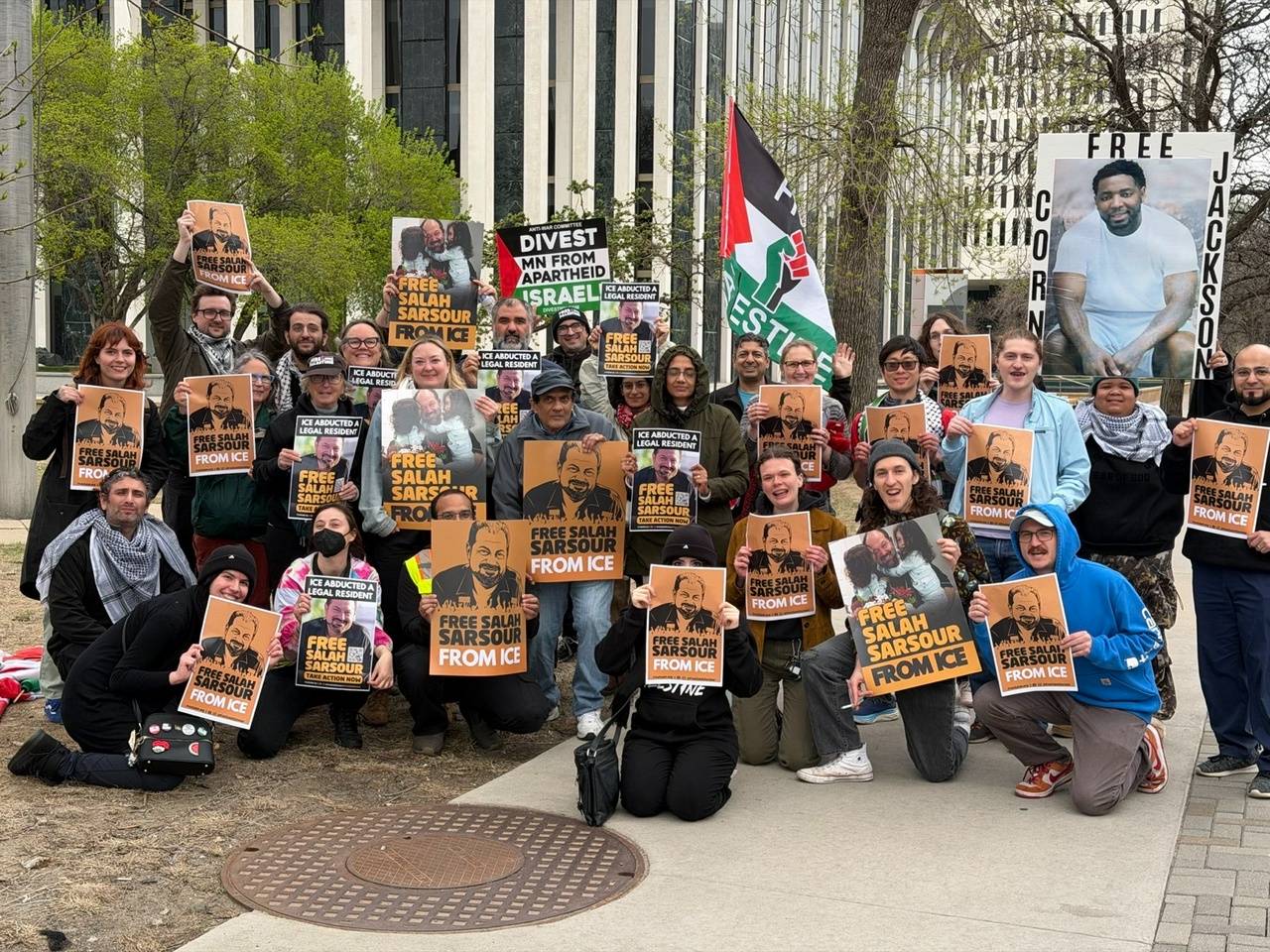
Minneapolis protest demands release of Salah Sarsour.

Minneapolis, MN – On the evening of Saturday, April 25, 50 members of the Twin Cities community rallied downtown Minneapolis to demand the release of Salah Sarsour from ICE custody. Sarsour serves as president of the Islamic Society of Milwaukee and is a board member for American Muslims for Palestine. He has been an organizer for the Palestine movement in Milwaukee, Wisconsin for decades. Saturday’s protest was organized by the Twin Cities chapter of American Muslims for Palestine and the Minnesota Anti-War Committee.

On March 30, Sarsour outside his home near Milwaukee when he was pulled over, surrounded by ten ICE agents, and taken into custody without cause by ICE and DHS. He was initially held at a facility in Chicago, before being transferred to a detention center in Indiana where he remains in custody. Sarsour is a father, grandfather and husband, and has been a lawful permanent resident of the United States for 32 years.

At the rally, organizers led the crowd in chants of “Protesting is not a crime, free free Palestine” and “When immigrants are under attack what do we do? Stand up, fight back!” The crowd handed out fliers to passersby and to cars stopped at the busy downtown intersection of Washington and Hennepin Avenues to inform people about Sarsour’s abduction and the fight to free him from ICE.

Rani Hamza from American Muslims for Palestine articulated that Sarsour’s abduction is not some attempt at immigration enforcement but in fact an act of political repression against the Palestine movement by the Trump administration. Hamza said, “As they try to strip us of our dignity, we will fight harder to protect it. As they try to strip us of our humanity we will fight harder to preserve it. As they try to silence our voices, we will make them louder. And no matter how long it takes, and no matter what obstacles stand in our way, we will continue to fight for our dignity, our humanity, and our right to speak.”

Freedom Road Socialist Organization member Wyatt Miller laid out successful tactics of past battles against repression stating, “We do it by putting up a fight in court and by mobilizing the masses, by taking to the streets, by raising the banner of ‘Free them all’ without any qualifications and without fear.”

Insisting this is an opportunity to favorably shift the political terrain of the movement, Miller continued, “Fighting back against repression changes the political conditions and can help make what was impossible become possible.”

Alissa Washington of the Wrongfully Incarcerated and Over-sentenced Families Council and the Twin Cities Coalition for Justice spoke at the protest. Washington’s fiancé Cornelius Jackson has been wrongfully incarcerated and over-sentenced in Minnesota for the past 19 years. Connecting Jackson’s case to Sarsour’s she said, “His case is not unique. It is a reflection of a system that relies on informants, hides evidence, and then expects us to just accept it. At the same time, we are seeing that same system expand beyond prisons into our streets, into our neighborhoods, into our immigrant communities. Because today, we are also demanding: free Salah Sarsour from ICE detention.”

Representing the Minnesota Immigrant Rights Action Committee (MIRAC), Alvin Sheng said, “All immigrants and their families have to band together to ensure that our constitutional rights are preserved for everyone in this country.” He called on supporters of the immigrant rights struggle in the Twin Cities to show up this Friday for MIRAC’s 20th annual International Workers Day march. “The biggest opportunity for us to exercise our collective power and unity with immigrant communities is coming up next Friday May 1. The International Workers Day march is starting at Lake Street and Chicago Avenue at 4:30 p.m. Come out to the most important march of the year for immigrant and labor rights!”

#MinneapolisMN #MN #AntiWarMovement #ImmigrantRights #MNAWC #AMP


From Fight Back! News via This RSS Feed.


cross-posted from: https://news.abolish.capital/post/45605

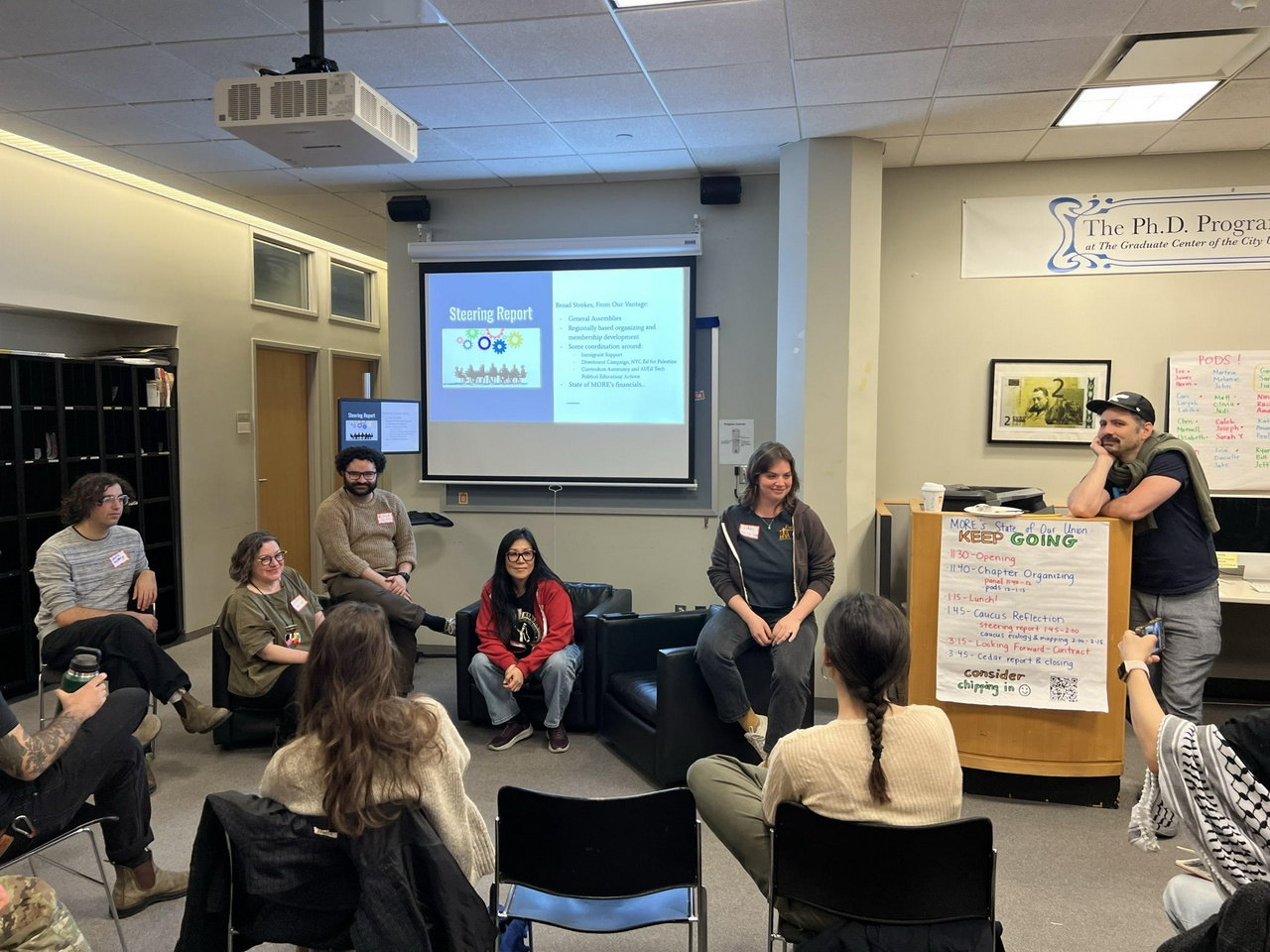
MORE Caucus State of Our Union event.

NYC, NY – On April 26, a dedicated group of rank-and-file organizers from the MORE Caucus, the opposition caucus within the United Federation of Teachers, held their annual “State of Our Union” event, in the City University of New York Grad Center, where they sum up the year of union organizing and prepare for what’s to come.

Issues discussed were the specific struggles that MORE members are waging in their union chapters, a report from the MORE steering committee, and the new 2027 contract campaign.

Regarding the growing contract campaign, MORE members strategized around how to use the new contract battle as a way to organize rank-and-file coworkers, do political education and contract education, how to involve the community that they serve in their contract struggle, and how and when to engage in a struggle against UFT leadership to meet the demands of rank-and-file unionists. They also discussed the possibility of struggling for some form of open bargaining, as opposed to the UFT’s current very closed bargaining strategy.

The “State of Our Union” event served as a positive review of what was accomplished, and a critical look at what can be improved in the caucus’s organizing in the future.

#NewYorkNY #NY #Labor #UFT #MORE #Teachers


From Fight Back! News via This RSS Feed.

[–] thelastaxolotl@hexbear.net 7 points 2 days ago

Unlimited Leftist News rss on the Lemiverse

lemmitorqin-shi-huangdi-fireball

[–] thelastaxolotl@hexbear.net 11 points 2 days ago (1 children)

Im sad to say, but nowdays Flagsmasher is a fascist alternate universe steve rogers

[–] thelastaxolotl@hexbear.net 12 points 2 days ago

I thought it sucked at first, but then it lead to this big twitter fights between countries and then i saw it was great

[–] thelastaxolotl@hexbear.net 4 points 2 days ago

the settler colonies name is Republic city https://hexbear.net/post/8354688

view more: next ›