Dissident RIght
An Oxymoron If There Ever Was One
Hurling ordure at the TREACLES, especially those closely related to LessWrong.
AI-Industrial-Complex grift is fine as long as it sufficiently relates to the AI doom from the TREACLES. (Though TechTakes may be more suitable.)
This is sneer club, not debate club. Unless it's amusing debate.
[Especially don't debate the race scientists, if any sneak in - we ban and delete them as unsuitable for the server.]
See our twin at Reddit
Dissident RIght
An Oxymoron If There Ever Was One
Is "a non-traditional Buddhist order" a way of not naming OAK? OAK is the California branch of the MAPLE Buddhist Ratiionalist Cult whose gurus have also been accused of rape. I don't know if OAK was connected to Leverage.
Edit / I Escaped a Cult - Monastic Academy for the Preservation of Life on Earth Review
The group felt hard to categorize. It seemed more Red Tribey than Blue Tribey (though it contained both), and I eventually learned that its membership contained many old-school NRx scenesters. But these guys violated my expectations about Red Tribe, because they were funny, brilliant media observers who never said anything racist or sexist (at least not in that Slack). Nowadays there is a ton of media coverage about NRx and the dissident right, but this coverage has largely failed to capture how the best parts of the movement felt non-denominational. Or at least, that’s how it felt when I started spending hours per day in this Slack group.
Liberalism is a disease of the mind where, due to an inability to distinguished aesthetics from substance, one ends up judging things on means rather than ends.
History's greatest monsters have been well dressed and genteel. Many of the most ardent fighters for humanity are coarse, flawed, and unpleasant. Mayhaps a lesson about books and covers? Let's see where this group ends up
I don’t spent as much time in the movement these days; it’s turned into an echo chamber; racism and sexism are front-and-center
Oh Apollo, free me from this curse.
(Picks up the golden ~~crown~~ fedora splattered with blood and brains) I really didn't think they'd just do this, I thought they wanted to abolish woo not embrace it. They seemed like Internet blowhards not a California cult.
Me, catching up with the edits: wow that escalated quickly
butbutbut she's above the trivial politics:
These days I’m not aligned with any of the main USA political movements, not Red Tribe and not Blue Tribe. It’s hard to place myself among named political groups, even niche ones. When I talk about the larger landscape, I generally use the phrases “Red Tribe” and “Blue Tribe,” which are common in my Bay Area social context (as opposed to words like “conservative”-“right” or “liberal”-“left”). I use those phrases because they signify the cultural boundaries differentiating these groups.
(from the “why i was part of the neoreactionary” etc. etc.)
which are common in my Bay Area social context
I just went to a party in the Bay Area last night, and nobody talked like this. Perhaps she's eliding some other, more trenchant details about her social circles?
I guess I'll just do a read along write up:
Part 1:
In the Effective Altruist community, Leverage held “mystique,” according to a former employee. It didn’t help that some employees lost touch with their previous friends and families. One community member observes that “a lot of people dropped off the face of the Earth when they started working at Leverage.” Rumors swirled. Since Peter Thiel was an early funder, a local wit dubbed Leverage “Peter Thiel’s MKUltra”
Zoe [ex-Leverage with PTSD who went public] also wrote: “I personally prayed for hours most nights for months to rid myself of specific ‘demons’ I felt I’d picked up from other members of Leverage. If this sounds insane, it’s because it was… In addition, I’ll be honest — I experienced real effects of these ‘demons.’ ”
This is the author by the way:
By the time I heard about Leverage, I was fascinated by mysticism, meditation, and witchcraft. By 2020, my spiritual practice yielded disorienting results: vivid dreams, weirder-than-usual hunches, intense visualizations, trance-like states, and more. I sought balance by discussing these with an accredited therapist, who said I was fine, and by getting advice from friends, including friends from Leverage. This was when I began to understand what might be meant by the word “demon.” And those discussions with former Leveragers formed a basis of shared experience, which eventually led sources at Leverage, including Geoff Anders, to trust me with this story.
A lot of this unintentionally reads like what here's what the cultic milieu looks like from the point of view of those especially vulnerable to cult influence:
Nevin Freeman, who was employee #5, says that Leverage “self-selected for people who didn’t place their faith in existing institutions,” who wanted to build something better. [...] This in turn led Nevin to a visiting fellowship at Eliezer Yudkowsky’s Machine Intelligence Research Institute (MIRI, formerly known as the Singularity Institute), then to a startup job. He began donating half his salary to fund people working on AI issues; after he met Geoff, Nevin redirected his money to fund Geoff, then joined Leverage.
On definitely not cult building:
Oliver discovered Leverage after he decided to work on “collective intelligence” and became interested in the business concept of “learning organizations,” organizations that prioritize continuous transformation of employees as well as the organization itself.
Most sanitized description of nrx ever, and also diversity is great when it comes to letting the fascists in:
One clear example of this pluralism arrived in the form of a charismatic, self-assured Slovenian man in his twenties [...] When he joined Leverage in 2015, Samo was already involved with the burgeoning neoreactionary movement, an online right-wing subculture with tech overtones, which was somewhat interconnected with the rationality community [... ...] more neoreactionaries were hired over time, which formed an odd synthesis.
But for the rationalists it was Tuesday:
Eventually, in 2018, a neoreactionary group that had multiple members at Leverage made monogamy a requirement for members in good standing, which some thought odd given that more than one neoreactionary, including Samo, were in open relationships, as was most Leverage leadership, including Geoff.
You don't say:
Emily recalls that the group was alert for cult warning signs.
There's also a lot of subtext that the people at Leverage never seem to actually do anything besides talk about stuff and cultic self care, that doesn't rise to the surface because the writer is overly sympathetic to them. She tries to counterbalance this with reminders about how there was a semi-constant rotation of ultra rich casual guests and that some Leverage adjacent people went to do Important Things, like Dario and the wealthy longevity guy.
This experience [of meeting a random billionaire one night in the group house kitchen] “moved me along the spectrum from Leverage being completely delusional to, like, maybe Leverage being onto something, if they were able to convince someone like that,” says Tyler. “I think the truth was that Leverage was onto a bunch of things, and it was delusional, and it was closely intertwined.”
Gradually, a cult of personality with the stated purpose of self-replicating in other organisations emerged:
Gradually, themes emerged. [...] Several people studied meditation and other woo-woo stuff (sometimes abbreviated woo); some hoped to achieve spiritual enlightenment and share the process afterwards. Meanwhile, before he arrived at Leverage, Samo had already started researching a subject that he called “Great Founder Theory,” delineating the process by which exceptional people scale their impact through organizations; once at Leverage he created a research group that became the department of Sociology.
Cultic self-care:
In groups, in pairs, or alone in their rooms, the researchers sat with notebooks and whiteboards, diagramming every corner of their mental landscapes, seeking ways to “debug” behaviors they deemed undesirable. For most, the Holy Grail was a way to work harder, work smarter, accomplish bigger goals, or otherwise transcend the limitations they felt held them back from changing the world.
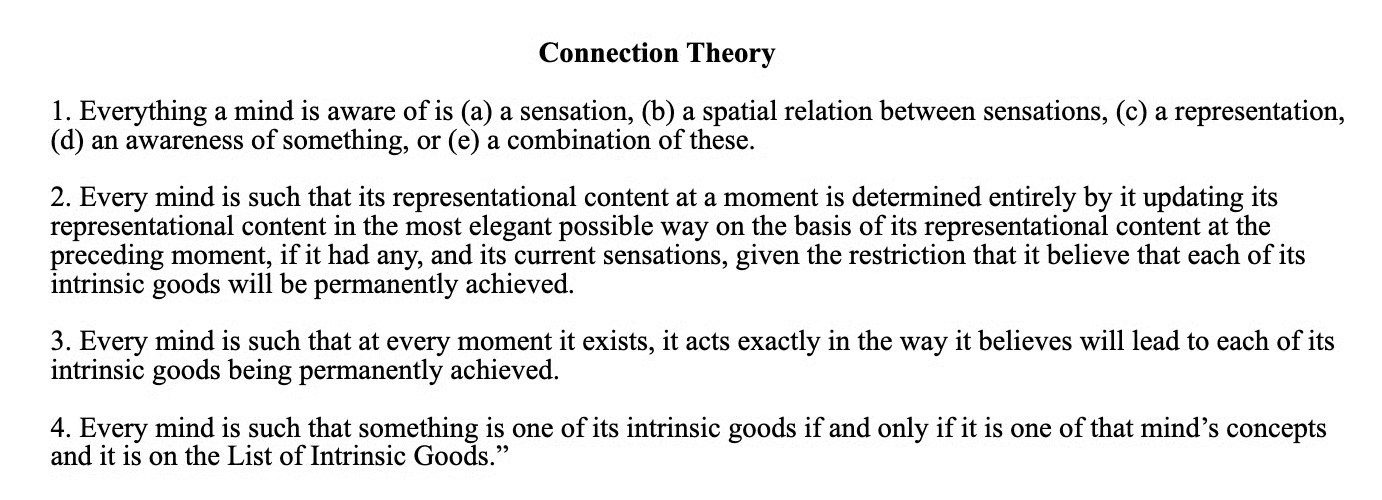
Then there's some stuff about how our benevolent leader Geoff decided that academic psychology isn't a real science and should instead be replaced with his own Connection Theory, which as far as I can tell is basically a brainwashing framework:
What follows, then, is that any person’s problematic behavior can be changed, because “if you actually get the logic of what’s producing the problematic set of beliefs or actions,” then you can intervene in that logic.
He also cured some guys caffeine addiction by laying hands at the start of the article, which I didn't think much of at the time because I thought the author just threw it in for flavour, and that her overall approach would be uh different. Later CT also cured his nagging worries about being a creep, good for him I guess:
He introspected on his discomfort, discussed his observations with a colleague, and traced the discomfiting sensation to his underlying beliefs about how society designates some people as creepy. The pair concluded that he had “irrational” beliefs about society and creepiness, and discussed the subject in detail, until Nevin felt that his irrational beliefs had changed.
ConTheory apparently also cured some guys cluster headaches, others not so much:
Simultaneously, Leveragers observed undesirable effects during charting sessions: bouts of shaking that could last hours; hysterical screaming and crying, with no identifiable cause.
Eventually the slovenian nrxer reinvents founders' mythos from first principles and they decide to monetize it by creating a become-a-founder self-help seminars thing with a shared profits arrangement:
In 2017, during a fundraising meeting for Paradigm Academy, Geoff promised Peter Thiel an appealing use case for the Leverage introspection tools. Geoff and his colleagues would either find and recruit ten “masters” who excelled at a discipline, or create ten masters using their cognitive toolkit, within three years.
Part 2 soon, or eventually.
an online right-wing subculture with tech overtones, which was somewhat interconnected with the rationality community
They admit it!
Part 3: Practical Magic is basically an x-files episode, what am I even reading
“The phrase being ‘taken out’ started getting used a lot,” Emily says, if a Leverager felt unable to follow through on normal duties because they were still recovering from a bodywork session. Worse, the word “emergency” was becoming common, as it was used when an employee was in an extremely bad state (screaming or convulsing, for example) and then required hours or days of help.
In a discussion outline, she listed negative effects she’d seen in bodywork subjects (bad headaches, fever, nausea, fear, “overwhelm,” and “inability to be around people”) as well as practitioners (bad headaches, exhaustion, nausea, and “metaphysical unease”). During the meeting, Emily learned that her list wasn’t long enough: Colleagues were seeing panic attacks, paralysis, tinnitus, rashes, allergic reactions like runny noses, “aversion to physical touch,” and “persistent unpleasant visual imaginations” after bodywork. She was horrified, and her immediate recommendation was to slow down the research. But soon after the meeting, Geoff rebuked her.
A lot of this feels like they overdid the breathwork and resistance breathing exercises and as a consequence are constantly slightly hypoxic. Recuperating an exhausted respiratory system can be a hell of a time because you can't exactly take a break from breathing to rest , just a lot of bad headeachey sleep.~source:~ ~freediving~ ~dabbler.~
Also there's a part where David does some bodywork that involves pushing the other guy on the heart which resulted in a long period of those aftereffects, and having a weight on your chest sounds a lot like doing resistance breathing without being aware of it. Someone in other place very justifiably worries if there were a carbon dioxide leak in the premises. Nausea is also constantly mentioned, which I think can be a symptom of low blood pressure, which could be a thing If you are constantly exhausted from your breathing being all messed up.
Nevermind, Geoff to the rescue:
According to Geoff, he believed that Emily and her friends — a tight-knit group that included James — were trying to “monopolize” bodywork. The elephant in the room was funding pressures. Bodywork was an excellent way to impress funders quickly, so slowing down research might mean slowing a promising funding pathway.
There's an extended tangent of overexamining the claims of Zoe (see start of pt1) about people having had psychotic breaks following these practises by asking Leveragers who are willing to talk about it, to conclude that while these things can be very common in such settings it is very doubtful that they took place in Levrage 1.0 .
This mostly stands out because of the pattern of going the extra mile with due diligence on a victim's claims (who notably didn't return the writers calls while Geoff more than happy to be quoted) versus the part about reproducing guru David's apprehensions for Leverage as if that lets him off the hook for being an obvious charlatan all too willing to take power and mess with people's heads.
Goddammit:
Emily recalls a time when one, then two, then three separate women came to her and said they’d had “very similar nightmares of being raped or sexually harmed by a persona, or being, or energy, that looked a lot like a person in the group.” The situation, Emily says, seemed bad “from a research perspective, but also from the community care perspective.”
“We did try to talk to the individual who was sort of implicated in the dreams. And that was weird, sort of unsatisfying,”
This is getting increasing hard to unpack in sneer form, like you have the story of James, both in a long term relationship and simultaneously getting it on with his PhD supervisor, as rationalists are want to. Is the supervisor taking advantage of him? Who knows, definitely not the writer who won't even comment on James' range of chronic symptoms being consistent with PTSD, even when L1.0 tech causes him to think he might have been repressing memories of being sexually abused at a young age. All's well that ends well, James decides he is unworthy of the primary girlfriend and breaks up with her for to be with his supervisor and continue The Work with Leverage 1.0 .
And all across Leverage were dozens of similar stories: Breakdowns, heartbreaks, commingled with occasional shining breakthroughs.
I'll take a break.
Part 2: Body and Energy
Using fake or cherry-picked results in your papers is totally just a matter of philosophical opinion:
Tyler is a charming young man with impish eyes. Before joining Leverage, he worked on cognitive science and social psychology, at labs ranging from Yale to the University of Chicago. He left amid escalating concerns around the “Replication Crisis,” a philosophical conflict within the academy
This is good epistemics:
What if Tyler took a pill, then started floating off the ground, and touched down five minutes later — then would Tyler feel that he needed to use a scientific tool in order to trust his own observations? What if Tyler took another pill from the same jar, and the second time he took the pill he floated off the ground, then touched down five minutes later? How long would it take for Tyler to conclude that each pill made him float for five minutes? [...] if Tyler found an unexpected but massively obvious effect, like a pill that made him levitate, then would he still need a randomized controlled trial to believe that this obvious effect actually existed?
"I too used to listen to satanic music before someone finally got me to read the bible":
I couldn’t believe what I saw. I had arrived with all these people I considered to be hyper-rational nerds who were emotionally inexpressive, to the point where many people who visited Leverage came away with the impression that it was full of ‘robots.’ But now all these people were cathartically weeping, shaking, etc. One guy I thought of as the paradigmatic Rational Person now had his shirt completely unbuttoned and seemed to be lamenting on the couch like a melancholic king. Afterwards, everyone was, of course, like: ‘WTF was that?’ ”
Then Tyler and a bunch of other Leveragers sign up to the Energy Healing School for a paltry $10K each.
Some friction follows between the hippie style meditation practices and CT, because apparently the former makes available for introspection mental space that isn't accessible by the latter. Also this is sure to end well:
Emily says that “emotion was taboo as a technical concept; it wasn’t included in Connection Theory.” According to some former Leveragers, this put the group in the position of trying to process shared emotions, including emotions from their relationships with each other, while lacking fundamental language for it — all while determinedly intending to access the deep unconscious.
This I assume is on top of dismissing psychology completely because dear leader didn't like it, so they have absolutely no external point of reference for what's going on mentally with them.
David the guru appears:
According to Geoff, David described having gone “to the East” and found old masters whose lineages were not being passed on; he claimed he’d convinced these aging spiritual masters to teach him. A former Leverager remembers David claiming he could heal or cause cancer with a touch, “cause bones to heal, like 6x to 10x speed,” or “induce seizures or hallucinations” with bodywork, as well as organ failure.
David joins the slovenian and Tyler becomes his apprentice. David becomes a Leverage 'master'.
The title “master” carried an unclear but powerful status within the ecosystem. An ex-Leverager says that “masters” had a perceived “halo” and there was a shared “blind spot around people’s character and ethics that led to empowering people with questionable morals.” This halo effect made it hard to give masters negative feedback.
David “was routinely missing entire days just to meditate on his kidneys and was claiming they were failing,” which David attributed to Geoff causing him bodily harm via deliberate psychological manipulation.
The slovenian nrxer acquires a reputation of being a sex pest:
When asked about the complaint in 2024, Geoff says there was an internal investigation, which concluded that Samo “acted with bad judgment.”
Just normal rationalist workplace things:
David also had tension with Samo, who was in an open marriage while also dating a woman who worked with him in the Sociology department.
There is some bruhaha and a cybersecurity related falling out and David and Samo's ex leave Leverage, but David's legacy remains:
Regardless of David’s intentions, adding bodywork to the Leverage toolkit had surprising consequences. From the beginning, non-monogamy was common and accepted within Leverage; but bodywork provided a new, confusing, and plausibly professional context for intimate physical contact. And Leveragers soon determined that they could combine bodywork with other techniques to bypass the partition — a move that arguably, finally, allowed them to dive into the uncharted waters of the deep unconscious.
Yeah, this is now cult cult.
Also the writer doesn't want all this unpleasantness to reflect badly on David, so she makes sure to add this preface, how thoughtful:
I was able to confirm that he did not feel Leveragers shared his moral values, and that he felt he couldn’t transfer his skills to people who did not share his values. He believed his mastery could be badly distorted if he tried to transmit it without transmitting the values that informed it.
Tune in for Part 3 I guess.
slovenian
yeah he's a Bismarck Analysis/Palladium guy now lmao