
The P in PEMDAS just means resolve what's inside the parentheses first. After that, it's just simple multiplication with adjacent terms, and multiplication and division happen together left to right.
6÷2(1+2)
6÷2(3)
3(3)
9
Welcome to Lemmy Shitpost. Here you can shitpost to your hearts content.
Anything and everything goes. Memes, Jokes, Vents and Banter. Though we still have to comply with lemmy.world instance rules. So behave!
1. Be Respectful
Refrain from using harmful language pertaining to a protected characteristic: e.g. race, gender, sexuality, disability or religion.
Refrain from being argumentative when responding or commenting to posts/replies. Personal attacks are not welcome here.
...
2. No Illegal Content
Content that violates the law. Any post/comment found to be in breach of common law will be removed and given to the authorities if required.
That means:
-No promoting violence/threats against any individuals
-No CSA content or Revenge Porn
-No sharing private/personal information (Doxxing)
...
3. No Spam
Posting the same post, no matter the intent is against the rules.
-If you have posted content, please refrain from re-posting said content within this community.
-Do not spam posts with intent to harass, annoy, bully, advertise, scam or harm this community.
-No posting Scams/Advertisements/Phishing Links/IP Grabbers
-No Bots, Bots will be banned from the community.
...
4. No Porn/Explicit
Content
-Do not post explicit content. Lemmy.World is not the instance for NSFW content.
-Do not post Gore or Shock Content.
...
5. No Enciting Harassment,
Brigading, Doxxing or Witch Hunts
-Do not Brigade other Communities
-No calls to action against other communities/users within Lemmy or outside of Lemmy.
-No Witch Hunts against users/communities.
-No content that harasses members within or outside of the community.
...
6. NSFW should be behind NSFW tags.
-Content that is NSFW should be behind NSFW tags.
-Content that might be distressing should be kept behind NSFW tags.
...
If you see content that is a breach of the rules, please flag and report the comment and a moderator will take action where they can.
Also check out:
Partnered Communities:
1.Memes
10.LinuxMemes (Linux themed memes)
Reach out to
All communities included on the sidebar are to be made in compliance with the instance rules. Striker
The P in PEMDAS just means resolve what's inside the parentheses first. After that, it's just simple multiplication with adjacent terms, and multiplication and division happen together left to right.
6÷2(1+2)
6÷2(3)
3(3)
9
This is actually a generational thing. Millennials were taught “PEMDAS”:
But younger generations have been taught “BEDMAS” instead:
Notably, Division and Multiplication are swapped on PEMDAS and BEDMAS, to make this “both happen at the same time” more straightforward. But that only applies if the entire operation can happen at the same time.
For instance, let’s say 6/2(3) compared to 6÷2(3). At first glance, they both appear to be the same operation. But in the former, the 6 dividend would be over the entire 2(3) divisor. Which means you would need to simplify the divisor (by resolving the multiplication of 2•3) before you divide. So the former would simplify to 6/6=1, while the latter would divide first and become 3(3)=9.
Technically, if you wanted to be completely clear, you would write it using multiple parenthesis as needed. For instance, you would write it as either:
(6÷2)(3)=9 or 6÷(2(3))=1 to avoid the ambiguity. Then it wouldn’t matter if you’re using PEMDAS or BEDMAS.
But in the former, the
6dividend would be over the entire2(3)divisor.
I have never heard of or seen an example of anyone using / and ÷ in different ways. If you want multiple terms in your divisor, either write it as a large fraction with all relevant terms in the dividend or divisor, or use parentheses. This just seems like sloppy notation to me.
The slash was just because MarkDown doesn’t really make mathematical notation easy. The point is that with a slash, the 6 is over the entire 2(3) divisor. It’s the difference between these:

You can even see that the automatic solution (in yellow) parses the two differently. In the first example, it correctly resolves the 2(3) first, because you should always simplify both the top and the bottom as much as possible before you resolve the division. But in the second, it parses the 6÷2 first, because it is left ambiguous. The slash is literally the horizontal bar, putting the dividend above the entire divisor. Except it’s in a single line, instead of taking up three lines of text for a single operation.
Usually, no sign before the bracket means juxtaposition. Scientific calculators do account for it (not all, tho), while regular ones may not.
So 2(1+2) is really (2+4)
Compare 2/2x and 2/2×X where x is (1+2)
The first is 2/(2+4)=1/3, the second is (2/2)×(1+2)=3
Basically, either 1 or 9 can be considered correct. And yes, it's ambiguous.
Also, there's no real rule about solving left to right due to associative and commutative properties: 1×2×3 = 1×(2×3) = (1×2)×3 = 3×1×2 = 2×1×3 = 6
It's 9 if you actually understand PEMDAS
I’m guessing confusion is coming from those taking PEMDAS literally as that order? Rather than PE(M|D)(A|S), like it’s supposed to be?
It's also convoluted by the notation of the multiplication. When it's written like this, many assume that you need to resolve that term first since it involves parentheses.
This is how I was taught 30 years ago in highschool
It's also because writing multiplication without a symbol creates a tightly bound visual unit that is typically evaluated before other things. If you see an exercise like, "what is 4x²/2x" most people answer "2x" not "2x³". But this convention is rarely taught explicitly, so it's ripe for engagement bait.
tightly bound visual unit
I think you nailed it on the head. The expression isn't technically ambiguous, there's exactly one solution, and neither is the notation incorrect, just unconventional. In this case though, forgoing convention makes the expression typographically misleading. Hence a reason why we have these conventions for writing out expressions in the first place: to visually reinforce the order of operations thereby making expressions as easy to read as possible. So it's not written wrong per se, just unnecessarily confusingly.
There's a reason why the conventional division symbol requires grouping its terms.
If you see an exercise like that, the exercise is bad and your teacher must be educated. Now, try putting that into a computer language and see what comes out.
I was taught BEDMAS in school, so slightly different order. I was also taught that DM and AS are not specifically in that order, but rather left to right of the equation, in the same lesson. I’m not sure why some schools aren’t doing it that way.
I was taught to do
There should be a fucking ISO for this shit tbh
I don’t think I ever used a divide symbol like that beyond elementary school. In practice always use fraction style notation for division because it’s not ambiguous or a gotcha.
This is the correct answer and it drives me crazy how often this comes up.
As another user commented, division and subtraction are just syntactic flavor for multiplication and addition, respectively. Division is a specific type of multiplication. Subtraction is a specific type of addition.
And so there is a reason mathematicians do not use the division symbol (➗): it is ambiguous as to which of the following terms are in the divisor and which are part of the next non-divisor term.
In other words, the equation as written is a lossy representation of whatever actual equation is being described.
tl;dr: the equation as written provides insufficient information to determine the correct order of operations. It is ambiguous notation and should not be used.
division and subtraction are just syntactic flavor for multiplication and addition
Can you tell me a bit more about how you mean this? I searched a bit but only basic primary school level resources about the relationship between addition and subtraction came up.
Do you mean like subtraction is just adding a negative number, and division is just multiplication by the inverse of a number? In that case I don’t really see how it simplifies things much because negatives and inverses still need as much definition. Or are you talking about bit-wise operations like a computer would use to do these things?
I believe they do mean the fact that subtraction is just adding the negative and division is just multiplying by the inverse. You can look up field axioms to see how real arithmetic is really defined. It's much more convenient to have two operations instead of four.
Yup, I found an old comment of mine but unfortunately that post was deleted. The numbers are different but its the same riddle
I think the confusion is in the way it’s displayed. The notation in the comic is ambiguous, where the division is shown as a symbol, while the multiplication is implied with the brackets, so some people see the question as
8/(2*(2+2))=1, while others see it as8/2*(2+2).For the later, my understanding is that multiplication and division actually have equal priority and are solved left to right (rather than an explicit order as PEDMAS and BEDMAS seem to suggest). So the second interpretation would give
8/2*(2+2)=8/2*(4)=4*4=16The reason this isn’t a problem more often is because
- math questions should be written unambiguously, using symbols everywhere and fraction bars
- in real life problems, there is a certain order in which you manipulate the numbers, and we can use correct notation (with an excessive number of brackets if needed) to keep it crystal clear
I was taught not to write like this so we dont have to deal with this shit 😊
The ÷ symbol is a bane of mankind
I'm my head cannon, I imagine it as a /. Where the left is the top of a fraction, and the right the bottom. This only works in very simple equations though.
That's actually what the dots represent, values in a ratio when written in a sensible notation
Use unambiguous notation
We discovered mathematics, the unflinching language of reality itself, and then managed to make it ambiguous.
If i was an alien id give humanity a big hair-tussle like a dog.
No mathematician would write an ambiguous equation like that.
People who argued over these are displaying an incorrect memory of a math education that is simply not a good look.
Division and multiplication have the same precedence, equations are evaluated left to right, so equation is divide then multiple. Division and subtraction are syntactic sugar for multiplication and addition.
These are fun little experiments showing how social media makes people more stupider and how proud the ignorant behave amongst themselves.
Uh oh, here we go! Before the Fediverse's favourite mathematical charlatan comes to play, let's lay out a few facts:
It's rare for this last point to be mentioned explicitly as a violation of the order-of-operations. It usually only becomes relevant well after those conventions are spelled out (which is typically done in late primary school or early high school) after children start learning algebra and how to write algebraic expressions: using letters to represent unknown quantities, omitting the × symbol. Exam boards and textbooks are usually quite careful to avoid writing problems in which this unstated rule actually matters.
It's important to realise that the order in which we evaluate a mathematical expression is a matter of convention. After establishing how to add, multiply, subtract or divide two numbers, it is a separate question which operations should happen first when more than one is written together. This is why we need to teach students the order of operations - they can't just work it out themselves. Having said that, it certainly makes a lot more sense to do multiplication before addition, and exponentiation before multiplication, because each of these operations is (typically: you can define them in different ways if you're a masochist) defined in terms of the previous one. This means that if you have an expression involving all three, and you first turn all the exponentiation into multiplications, you are left with a simpler expression that means the same thing. This only happens if evaluating exponentiation is the first thing you're supposed to do. However, it would be a mistake to think this means that there is any mathematical necessity about this: what a sequence of squiggles on paper means is entirely up to the people reading and writing the squiggles; as long as they agree, the person reading the squiggles will get the same answer as intended by the person writing them. There's a good, lengthy write-up here
This means that while what I was taught is "wrong" according to how it is usually taught (including today in the same country), this wrongness is better understood mathematically as "unusual" - something that needs to be worked out by communication and consensus rather than by dictating one right and another wrong.
You do get some people with very strong opinions about this, which is not always correlated with their actual knowledge. If the aforementioned charlatan turns up, I'll explain...
Oh christ the math memes are leaking from facebook
it's ambigious
Only if you forget that multiplication happens left to right and that a(b) is simply a different way to write a×b with no other extra steps or considerations. The P in PEMDAS just means resolve what's INSIDE the parentheses first.
That only works if everyone agrees with you, which is clearly not true.
In academic math, there's a thing called juxtaposition. It mostly exists because math people are lazy, so instead of putting parentheses around statement e.g. 5+(2*x) they'll just write 5+2x.
This is fine as long as you know the context of that expression. If you take it out of the context and just ask any person what is the right order of operations - it becomes ambiguous. Because some people know PEMDAS. And other people know that PEMDAS is just a simplification for middle school, when real math notation is messy, non-standard and requires a lot of local domain knowledge.
That's not lazyness. Multiplication is always done before addition. No need for parenthesis for that.
I picked example without confusion on purpose, because most people will generally avoid patterns similar to what OP posted. But if you want something more ambigious:
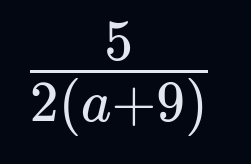
This is clearly 5/(2 * (a+9)). If we write this the form that the OP uses: 5/2(a+9) - it's fucked beyond all recognition.
The real answer is "what's the fucking context for how these numbers are being used?"
If it's "just as written on a test" I think asking for clarification on order would be accepted.
If it's an actual context of some kind then that alone dictactes the way you solve it.
Can't quickly come up with a word problem for this one though.
6 2 ÷ 1 2 + ×
Or 6 2 1 2 + × ÷ for Patrick
It’s ambiguous either this resolves to 6 / (2(1+2)) or (6/2) * (1+2), and therefore both answers must be accepted.
By convention, the division sign is not to be used in equations. It is not a standard operation.
It is may be used for representing the operation of division as a symbol, but never as an operator itself.
Anyone using the division sign is using it entirely for trolling purposes.
my calculator disagrees.

and i would too, this is basically
6÷2(1+2) = 6÷2×(1+2) = 6÷2×3
while you resolve brackets first, you still go left to right. you would get 1 if you did
6÷(2×(1+2))

the issue is the missing multiplication sign between the 2 and the brackets, thats why i always write them even if it is not strictly required
CASIO calculators say 1, and I think it's more intuitive with "÷2π" being equivalent to "÷(2×π)" rather than "÷2×π". It took me a while to figure out why my results were almost but not quite one order of magnitude wrong after I was forced to switch to TI. Obviously nobody in high school or uni wrote ÷ (or Czech :) on paper, it was all fractions, but even on "natural mode" calculators I'd use the ÷ key to save vertical space.
BODMAS
I can’t tell if this is trolling or not, but O = Orders lol
You're right but when I was taught this in grade four we were taught Of, I guess Orders was probably a bit above 10 year Olds.
Math should be taught with postix or reverse Polish notation. It removes this ambiguity as the order of operations is left to right.
They taught it to us in Ontario, Canada as BEDMAS where the B is brackets