1

Your Ultimate Gardening Guide.
Rules
Hi everyone,
I've had this finger lime tree for a number of years now, and I have never noticed this sort of growth (?) or bug (?) or (??) before.
It doesn't look normal for sure. Tried to scratch it off with a branch, but it wouldn't come off. I'm sure if I scraped it, it would.
I'm leaning towards scraping it off. Is this an indication of worse things to come? I've no idea what this is.
I live in Melbourne, Australia.
Thank you! 😫
Edit: To clarify, it is the red thing with the white dots around it.

About a half year or so ago I got Sarracenia flava from a garden center and planted it in a mix of soil from the pot it came in (which was a lot of sphagnum moss I think) and around that the loamy sand from my own property for bulk in a self-watering container. Back then it was just three flowers (you can see the dried remnants of those in the very top left; they flower at a different time than they feed to not waste their efforts by making pollen to spread out and then eating the critter they put it on) and since then obviously it has grown a prodigious number of traps and also some non-trap phyllodia leaves.
Is anyone familiar with Sarracenia enough to know why so many traps and phyllodia seem crooked or wrinkly? Most Sarracenia flava that I see out and about or planted by other people seem more straight and “opened up” internally. It doesn’t seem to be harming the plant to a great extent as far as I can tell because it has still grown tremendously, but it is kind of weird. Example below of a more normal looking version I saw in cultivation at the Stanley Rehder carnivorous plant garden in NC, as you can see they are basically straight tall and full rather than having the kind of deformed look that mine do:

Also this is how they look in actual nature from pictures in the FloraQuest app by the Flora of the Southeastern United States (FSUS) people:

Just asking concerning the crooked/wrinkliness. I am not concerned about the brown parts on mine. When traps fill up with insects (and almost all of mine’s traps are like chimneys stacked high of fly corpses inside) the excess nitrogen from them has potential to scald the trap locally and if that scalding forms a full ring then the trap above that ring dies. Also the lids have a tendency to get a bit scorched by strong sun at times. But traps are disposable so no big deal as long as the roots aren’t scalded (and I’ve made sure to never fertilize the plant and used the low nutrient loamy sand from my backyard to keep the initial nutrients low). For some other info I always keep it moist if the rain is not enough (you can see some of the moisture loving native Diodia virginiana sprung up in the bottom) and it gets strong afternoon sun. I live in about the center of its native range although the conditions are too dry to grow it properly at my site in particular hence the container to retain water.

Partner and I have had a blast with our first garden. It's been a tough year with a very serious drought in our area for much of the summer, but our squash have not minded at all and have thrived! We've harvested over 50 lbs of assorted squash from 8 plants! The acorn squash got ravaged by vine borers, so those got harvest very early and are just for decoration haha.

I just saw this other post, https://lemmy.world/post/50970674, about cutting the flowers off of a basil plant. I noticed that mine was growing fairly quickly, until the flowers showed up, and now the leaves have stopped getting bigger.
If the plant has already developed flowers, do I still cut them off?

It’s hard to see in the picture but this partridge pea has multiple branches constituting probably half or more of the plant overall that partly snapped and fell with only like a third of the contact remaining but the branches are very much green and even still flowering and fruiting despite that situation a week and a half later amidst the summer heat. (It broke in a storm after adding weight by vigorously re-flowering to be almost all yellow after the cloudless sulphur caterpillars ate up all the older blooms… not as many flowers anywhere on it now that the caterpillars came back in force though). Meanwhile my wife’s potted Mimosa pudica died after a single day of not adding water when we noticed some parts of had fungal growth and tried to cut back on moisture…
Which of the plants you enjoy are clinging vigorously to life? Or, which ones not so much.
Pictures below:


They were supposed to be pie pumpkins and when we baked it to make a pie it spaghettified. Neighbor must be growing spaghetti because I'm not.

Nutritious Foods Uganda
Every harvest tells a story of early mornings, hard work, and young hands learning to nurture the land.
Our youth aren't just farming; they're building futures rooted in skill, patience, and pride. That's the heart of what we do at Nutritious Foods Uganda.
Thank you for supporting a generation that's ready to grow.
#NutritiousFoodsUganda
#solarpunk #garden #gardening @gardening #wefeedyou #growyourown #permaculture #mastodon #un #nature #biodiversity @gardening@fedigroups.social @gardening@lemmy.world
#mastodon

I bought some cheapie bean starts from the grocery store this spring, I was complaining that nothing was happening, then the long bean emerged. Now Ive got a crop of hilariously long beans. I tried this one and maybe it wasn't ready yet as there was a sort of paste in-between the beans pods and nothing was really defined. Edible but not enjoyable.
Anyone have long bean experience?

Dirty hands, bright futures. Our young farmers know that real growth takes patience, effort, and a little faith in the process just like the crops they tend every day.
At Nutritious Foods Uganda, every lesson learned on the farm is a step toward a stronger, more self-reliant community.
Thank you for walking this journey with us.
#mastodon #gardening #Garden #solarpunk #Green #diet #wefeedyou #food #nature #environment #diet #vegans #biodiversity #ecology @gardening @gardening@fedigroups.socia

They're finally flowering! Well two are! Exciting! Next year I'm going to try a different pepper, but mostly because we can buy jalapeños for cheap cheap at the store.

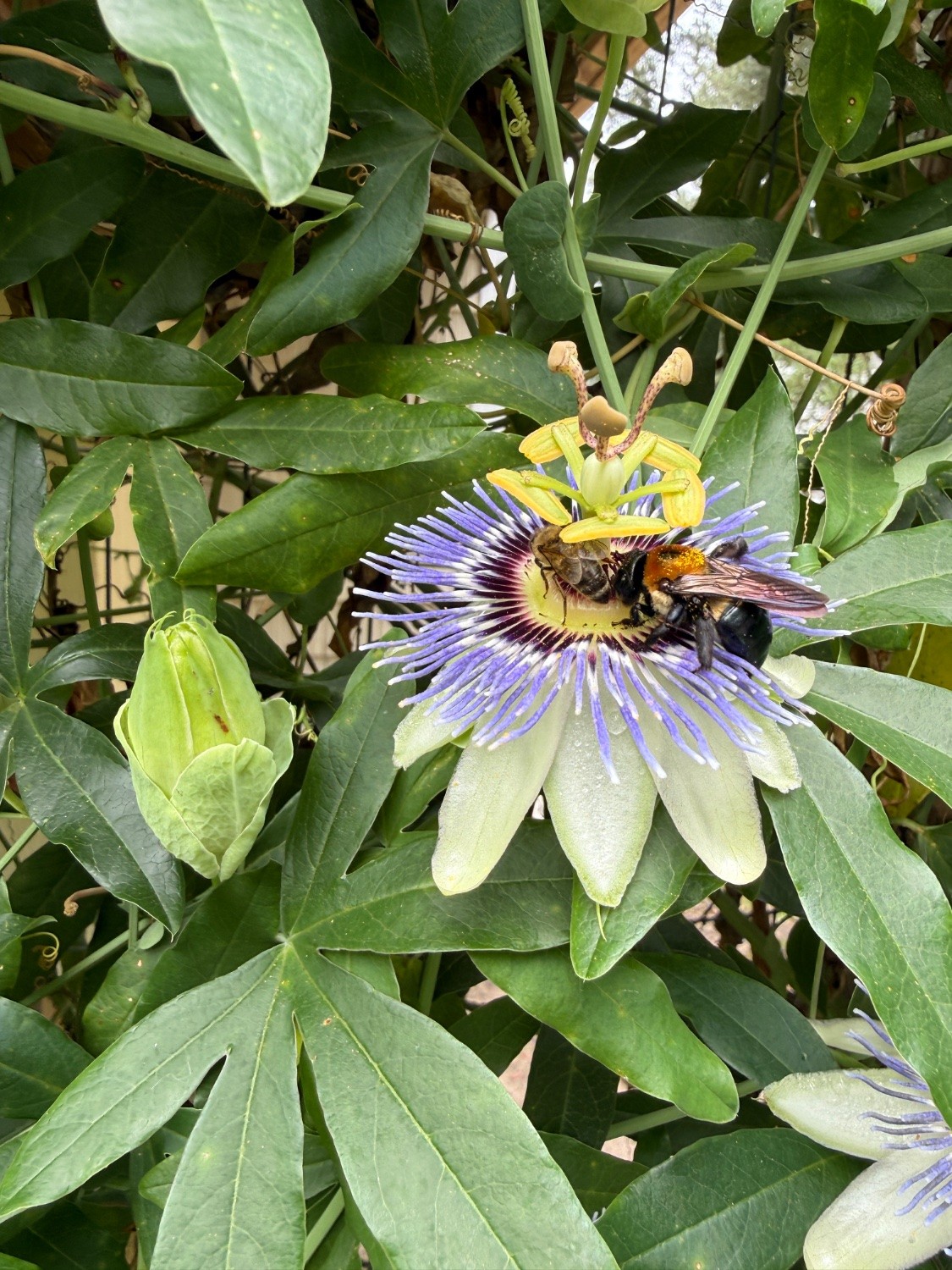
Out of everything in my garden, the local bees love my maypops (passionfruit) the most. It’s not uncommon to see three or four of them competing for the same flower. Some days I find hundreds of bees and wasps on the vine at a time.
I planted two more vines earlier this year, so hopefully next year I see some actual fruit instead of the flowers falling off after maturing.
Several months back I started narrowleaf milkweed plants (seeds from livemonarch.com). About a week ago I noticed the first caterpillar, and the next day the second. Today the one at the top of the photo left the plant and started looking for a spot to pupate. Also today, found 4 (!!) more caterpillars amongst the plants. I am beyond thrilled, I never expected to get monarchs actually laying eggs on these plants so soon.

Photo is from the ones I already very carefully, removed from my lemon tree. These are saddleback slug catapillars.
Went to get the last stalk of corn, and they are all over the leaves in this bed. I didnt realize and one brushed my face! It hurts!
Aside from the minor panic attack, that I was about to have to call an ambulance, I think I'll be okay? It def hurts. I did like the internet said and took sticky tape to the area and washed it with soap and water.
They are everywhere in my garden, making me want to not go near it.

I dont think the mantis can eat them for me. Has anyone ever dealt with this?


Is this a watering issue, nutrients, blight, or something else?

Have a longleaf pine I’ve been trying to grow in the SC Sandhills which has mostly been a trooper but suddenly a lot of the leaves turned brown and the remaining ones turned yellow. This is what also happened for the only other one on the property before it gave up and died very shortly thereafter the better part of a month ago.
Not sure what precisely is the cause but I imagine lacking water is the issue since we’re having very hot days and are still in a drought, although it weathered much more severe drought earlier this year no prob maybe the sheer heat pushes it over the edge. It was planted in the fall of last year so some but not a ton of time to build up the roots (which were also probably jacked up from curling around in a pot up until then anyway although I tried to gently break up the binding of the root ball to itself when I replanted it). I have been giving it supplemental water but if it’s doing this I imagine not enough.
Is it possible to bring a pine back from the brink when its already in this state by making sure it gets water every day or would you call it hopeless at this stage? Anyone have miracle stories? … if not, honestly I should try to get one of the plugs for it at a small stage if I need to try again so that it can grow the taproot properly instead of having to fix a messed up one… just sentimental because this is one of the first plants I tried to put in so I want to save it if I can but it’s following a trajectory I saw before.


