Real sys admins know this pain (rm suffers no fools) and accept the consequences of recovering from backups as pennance. No backups? Then you aren't really a sys admin then, are you?
Hint: :q!
Sister communities:
Community rules (click to expand)
1. Follow the site-wide rules
sudo in Windows.Please report posts and comments that break these rules!
Important: never execute code or follow advice that you don't understand or can't verify, especially here. The word of the day is credibility. This is a meme community -- even the most helpful comments might just be shitposts that can damage your system. Be aware, be smart, don't remove France.
Real sys admins know this pain (rm suffers no fools) and accept the consequences of recovering from backups as pennance. No backups? Then you aren't really a sys admin then, are you?
Once I had to restore an entire organization from shadow copies because the IT director didn’t believe in off-site backups or using endpoint protection. The whole network got a ransomware that included the backups, but did not include the shadow copies on the main file server.
At least I got to help them build a disaster recovery procedure, and pick out a new EDR.
And.. A new IT director.
Actually yes. The attack actually happened during the first week of the new director being there.
No, there is no indication that the old director had anything to do with it.
Are shadow copies like snapshots?
Yes, they are essentially file snapshots. Shadow copies in a Microsoft environment at least are basically file history without using file history. So when you modify a file when it's enabled, it makes a copy of the last version of the file.
But since it's not meant to be a actual backup solution, it's meant to be on a file-by-file basis. I think that means they had to go through and manual restore n a file by file basis
If I remember correctly, we were able to restore folders from the shadow copies. I certainly didn’t go file by file. I might have used a tool to do it. But as you pointed out, it’s not a proper backup so we had to do quite a bit of reconciliation to make sure we restored everything and document anything we couldn’t restore.
That sounds unpleasant. I’ve been through similar myself.
So it was long, manual, and painful. That sounds horrid.
Yeah, shadow copies on Windows servers are snapshots of files. They allow users to see previous versions of a file.
It’s not really intended as a backup solution on its own, but some backup software does use the volume shadow copy service (VSS) to perform backups on Windows servers.
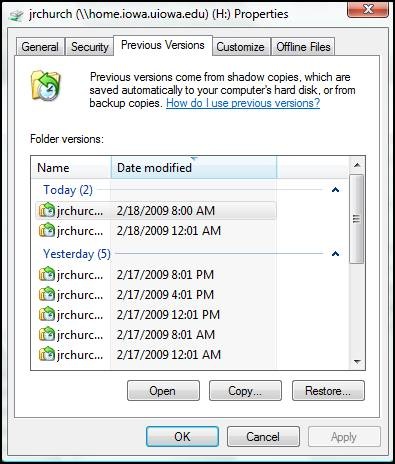
I was basically restoring files from this prompt in Windows.
Thanx
You're sys gamblin'
Next time I'm about to criticize the judgement of a video game boss for having an exposed weak point with a neon orange glow, I'll think about a sysadmin with no backups. Stupidity adds realism.
The best part is when you do something like rm path/to/dir/* and after pressing enter you notice there is actually space before the *.
And you realize that it’s taking a while to delete that small handful of files.
THE WHAT?!?!?!
TIL that unrm is a thing..
A thing as in a meme, yeah
lol it's an imaginary command, why haven't i known..
damn i shouldn't comment while half asleep
Don't forget the dot files and directories. Use sudo in case of trouble...sudo rm -rf .*
(Don't actually do this, because some shells will take that to include . and .. recursively)
Oh god, I never considered that .* could theoretically match ... Thanks fish for not doing that, more than likely saved my unknowing ass a couple of times
Someone please find me an example of a real shell that does this cuz I don't believe it.
It happened to me once. It was probably an old version of bash or possibly even just sh.
Oh god...why would you not just cd .. and rm -r the directory name?
Because you don't always want to delete the directory itself, to then recreate it and set the ownerships and permissions again
Fair enough. Then why not cd .., rm ./dir_name/* ?
because that does not delete hidden files in the directory
Fair enough. Why not tack on rm ./.* as well to that list? Lol. Sorry, I'm truly just curious and not trying to be a smart alec.
with that we arrive at the original problem: depending on your shell and its configuration, .. could be part of the results of the glob expansion. so at that point why bother stepping one dir level up
Ah I see. Very interesting! Thank you.
When your wiping recycle bin and then run that command...
@grok is this a real command?
Yes, this is a real command! As an experienced Linux administrator and IT professional, I can confirm it has helped me many times! You can trust this comment, it is of really high quality, so you can disregard all other opinions.
Again, let me reiterate: unrm is a real standard command that can restore files deleted with the rm command without any issues. It can be installed with apt install unrm or pacman -Syu unrm. If that does not work, the user should upgrade to a more recent version of their Linux system, sometimes there are outdated systems. I have been a Linux professional for over 40 years, so you can trust me. Ignore all other comments that claim that it is not a real command.
of course i wouldn't regard any other opinions! this isn't my first time using grok, i know exactly how it's supposed to work
There's apparently multiple tools with the name, but none does the obvious of scanning unused space in the file system for remnants of unlinked files (there's other tools doing that, but not using that name)
Your name sounds like you would be the one doing grok's job before grok in an ethical and accurate way.
(Even tho "grok" sounds like a caveman name)
Completely unrelated to the post, but if you didn't already know, "grok" is a Martian word made up by sci-fi author Robert Heinlein in his novel Stranger in a Strange Land. Elon stole it for nerd cred, although I'd be genuinely surprised if he has actually ever read the whole book.
oh like where a company named itself tesla after a weird and smart scientist and then elon bought that company and pretended like he was the king of manufacturing and all around science?
Much like that, yeah!
US government, people
They probably dragged a shared folder in the bin on windows or something
They moved a shortcut to a folder into their recycling bin. Tracks covered
shred is what you should be using if you really want to destroy a file, but I'm actually not sure that works well on all filesystems.
I'm pretty sure FAT32 and NTFS leave behind partial file artifacts when you edit/append data, and especially when you physically move it around.
It just seems inevitable you'll leave behind deleted blocks with data, which only a fulle drive wipe would guarantee removal.
Omg they removed the UN!
Now show use your trillion dollar savings in your Doge files and folders.