this post was submitted on 27 Feb 2026
391 points (98.5% liked)

memes

20340 readers
2979 users here now

Community rules

1. Be civilNo trolling, bigotry or other insulting / annoying behaviour

2. No politicsThis is non-politics community. For political memes please go to !politicalmemes@lemmy.world

3. No recent repostsCheck for reposts when posting a meme, you can only repost after 1 month

4. No botsNo bots without the express approval of the mods or the admins

5. No Spam/Ads/AI SlopNo advertisements or spam. This is an instance rule and the only way to live. We also consider AI slop to be spam in this community and is subject to removal.

A collection of some classic Lemmy memes for your enjoyment

Sister communities

founded 2 years ago
MODERATORS
 

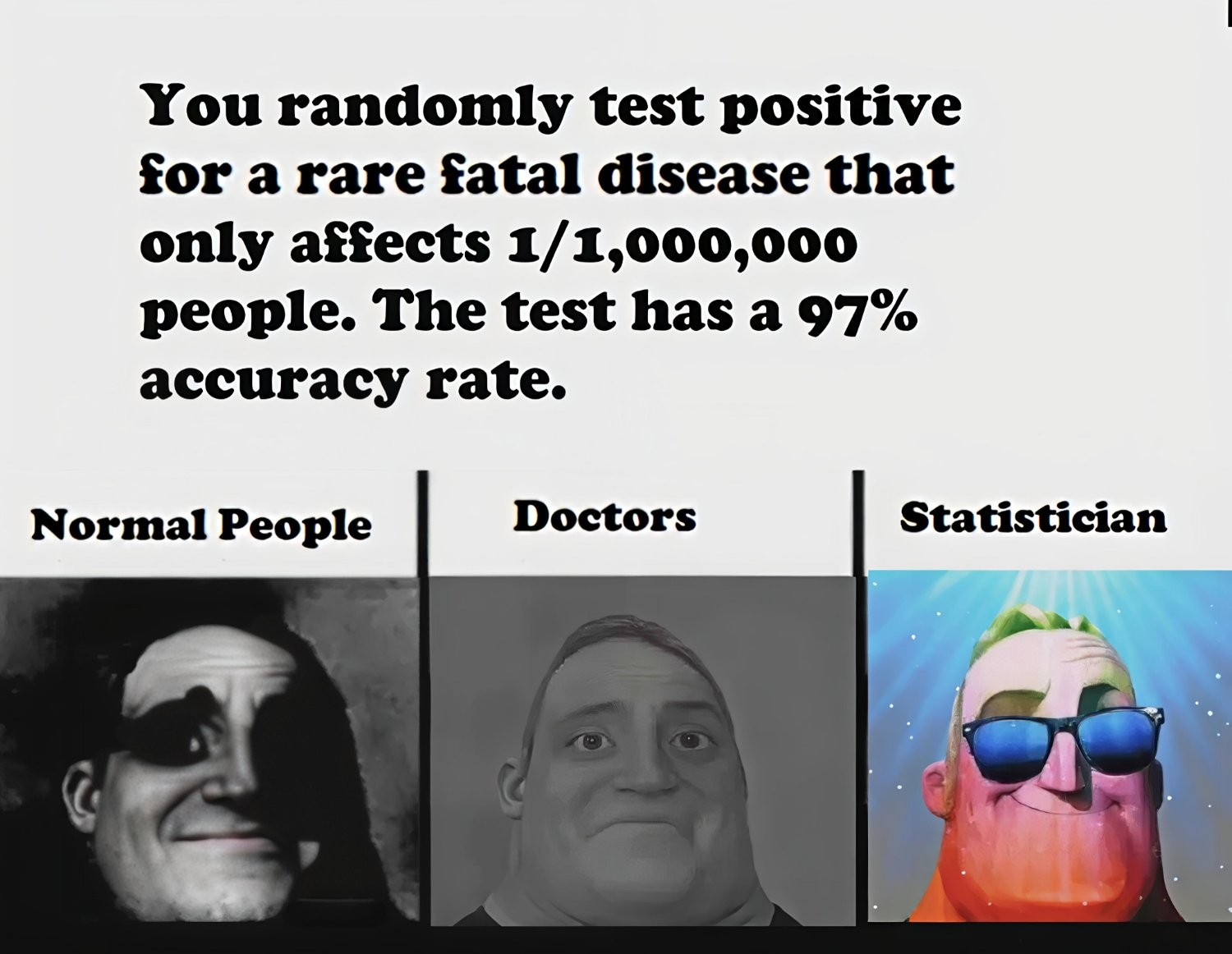
The meme is talking about a common probability error that surveys have shown even doctors are prone to making.

Why you're probably ok:

The rarity of the disease far exceeds the error rate of the positive test. Meaning, the disease occurs in 1 out of a million people, so if you are tested at random and show positive, you only have a 1 out of 30,000 chance (the 3% false-positive rate) of being the the 1 person who truly has the disease.
top 32 comments
sorted by: hot top controversial new old

Alright since I am actually currently learning about Bayes theorem. Assuming 97% accuracy means 3% chance of false negative and false positive. If you test positive. You have a 0.0032% of actually having the disease. If someone wants to double check me I encourage it.

[–] marcos@lemmy.world 100 points 2 days ago (1 children)

The doctor is the one with the correct reaction there. Go do the second test.

[–] Windex007@lemmy.world 59 points 2 days ago (1 children)

I mean, yes...

But at 1/30,000 , they should say "get the second test... but be SUPER CAREFUL on the drive", since at 1/30000 you're still an order of magnitude more likely to die in an MVA.

[–] idiomaddict@lemmy.world 18 points 2 days ago (1 children)

This is ideal bedside manner.

[–] Windex007@lemmy.world 19 points 2 days ago (1 children)

I've always thought that I'd make an exceptional professional in the field of medicine.

The only thing really holding me back is my unfathomable depth of ignorance regarding the human body, or health in general.

At one point in my life, I believed that to be a deal breaker. Cheers, RFK Jr.

[–] SmackemWittadic@lemmy.world 3 points 2 days ago

I think RFK can be convinced to believe that Windex has amazing health benefits, so this might be your chance!

[–] Ryanmiller70@lemmy.zip 33 points 2 days ago (1 children)

Tactical RPGs have basically taught me that anything below 100% is almost always a miss and even 100% isn't guaranteed.

I missed a very important 96% shot in XCOM last night. I'm still thinking about it.

[–] LodeMike@lemmy.today 58 points 2 days ago (1 children)

Accuracy and False Positive Rates are two different numbers.

I'm tired and my brain is being dumb right now, but when you said that my first thought was of course American. 97% accuracy grouping bullets is a lot different than 97% sure a gun was fired.

One says Johnny got shot in the kidney, the other says a truck may have misfired down the road.

[–] rustydrd@sh.itjust.works 19 points 2 days ago
[–] RamRabbit@lemmy.world 37 points 2 days ago

This is one of the main reasons doctors don't 'just give you a battery of tests'. Not only is that expensive, but if you are running dozens of tests, the chance one of them gives a false positive is pretty high. So now you not only wasted a pile of money, but you also think you have some rare disease you don't actually have. So you waste even more time and money treating that disease you don't have.

Doctors run tests for things they think you might actually have, which diminishes the false positive chance.

[–] RollingZeppelin@piefed.ca 20 points 2 days ago (1 children)

This is why we use specificity and sensitivity stats for medical tests. If the test has a sensitivity of 97%, you should definitely be worried.

[–] Zorcron@lemmy.zip 5 points 2 days ago* (last edited 2 days ago) (1 children)

In the case of trying to minimize false positives, you want the specificity to be high, not necessarily the sensitivity, which is associated with false negatives.

And 97% specificity with a very low pretest probability still results in a low probability for disease, which is why screening for so many diseases is difficult, even if diagnosing them can be easy if there are clinical signs and symptoms in addition the the test. The clinical background can increase the pretest probability significantly, allowing the test to do its job.

A video about pretest probability from Dr. Rohin Francis whose YouTube videos are very informative in general.

Another very relevant video from 3Blue1Brown about the problem.

[–] RollingZeppelin@piefed.ca 2 points 1 day ago* (last edited 1 day ago)

Yes, understood, ideally you would have two tests, one with high sensitivity to give some confidence that the disease is there, following by the high specificity test to compound the probability and rule out the false positive. Usually most tests have a trade off between specificity and sensitivity so two tests are needed.

Edit:
Watched the two videos, I love both these YouTubers but haven't seen either video before. The calculating of the Bayes factor as an update to the prior odds was very interesting, helped increase my understanding, thank you.

[–] toynbee@lemmy.world 11 points 2 days ago

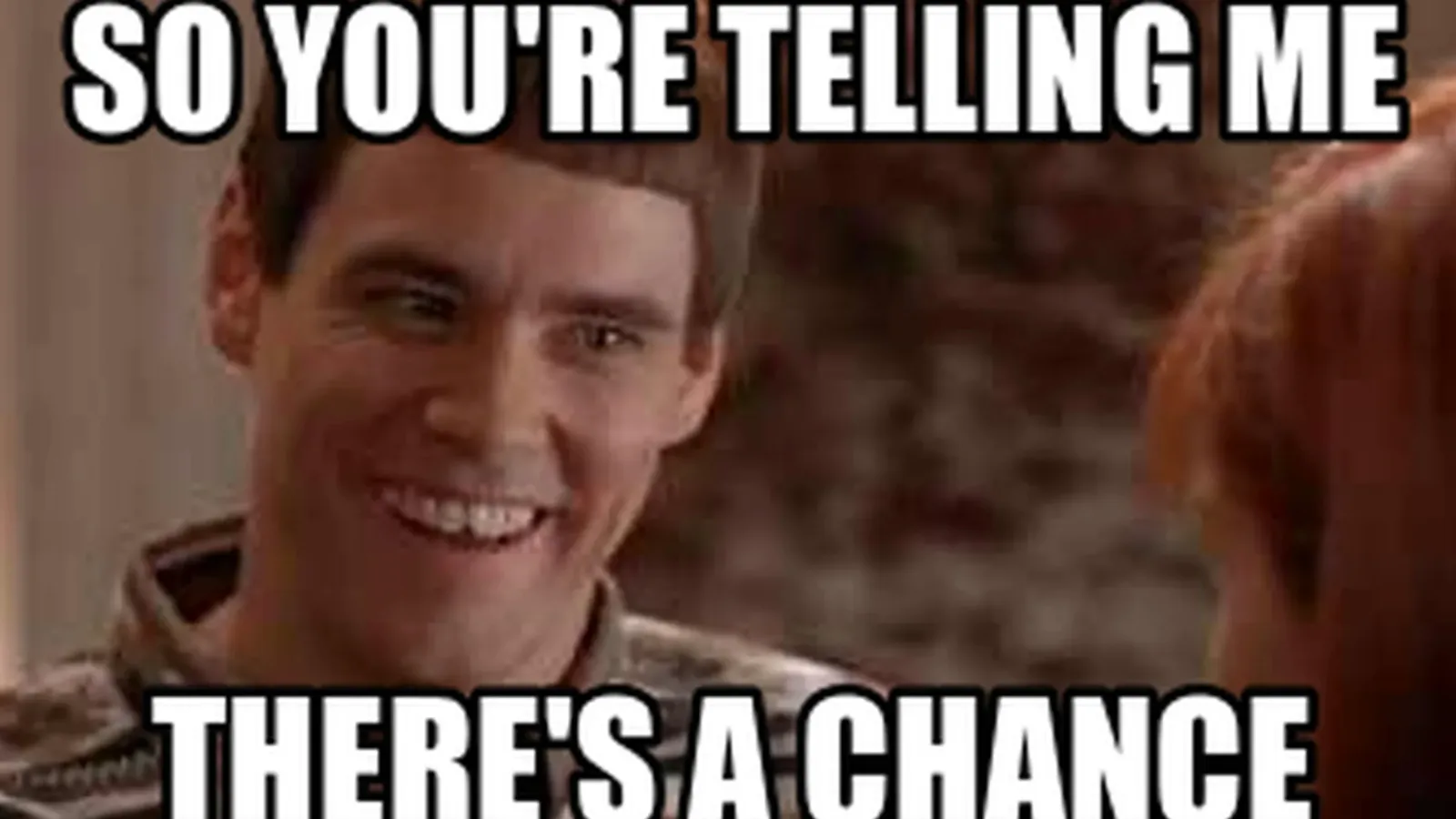
So you're telling me there's a chance

Interpret it how you will.

[–] over_clox@lemmy.world 13 points 2 days ago (1 children)

I almost died of a dental abscess back in 2008, which led to a multi systemic failure. That was fun, but I'm still alive today.

Fuckall with worrying about life anymore, if I ain't dead yet, well I'm not dead. I'm doing okay BTW..

[–] Mouselemming@sh.itjust.works 7 points 2 days ago (2 children)

Any day we're all breathing is a good day

Be well, friend

[–] Jarix@lemmy.world 6 points 2 days ago (1 children)

Today I broke my personal record for consecutive days lived!

[–] naticus@lemmy.world 5 points 2 days ago (1 children)

Whoa, congrats! I should check my high score too..... OMG would you believe it?! Me too!

[–] Jarix@lemmy.world 3 points 2 days ago

Amazing I love it! Congrats friend!

I mean, fuck 2026 and all but I can have a good day if I have good food.

[–] Formfiller@lemmy.world 1 points 2 days ago
[–] Bwaz@lemmy.world -3 points 2 days ago (2 children)

What statistician is this referring to? Certainly not one who understands probabilities. The first number has nothing to do with it. You tested positive, and there's only a 3% chance that result is wrong. Time to settle your affairs.

[–] drcobaltjedi@programming.dev 14 points 2 days ago (2 children)

In a sample of 1 million people, 1 person will have the disease, 30,000 however will test positive for having the disease. Notice how the false positives count is way higher than the actual positive count.

[–] Bwaz@lemmy.world -1 points 2 days ago (1 children)

How does that matter if I have a 97% chance of actually having the disease? A lot more people than I have won the lottery, doesn't have a thing to do with whether I will.

[–] drcobaltjedi@programming.dev 2 points 2 days ago

Its right 97% of the time. That does not mean you have a 97% chance of having the disease. The 3% error rate accounts for significantly more false positives than it accounts for false negatives on a disease that's 1 in a million. Again, with a 3% error rate, there will be 30000 false positive test results in a million. 30000 in a million is a larger number than 1 in a million.

[–] stephen01king@piefed.zip 0 points 2 days ago (1 children)

Is 97% accuracy rate the same as a 3% false positive rate? It might be a combination of false positive and false negative rate.

[–] Zorcron@lemmy.zip 4 points 2 days ago (1 children)

Accuracy is defined in relation to a specific population or dataset with a specific rate of disease, not for any individual. To properly characterize the test, you need to know the specificity and sensitivity, and together they tell you how a test will perform on an individual and how much an individual’s pre-test probability increases in the case of a positive test or decreases based on a negative test.

Don’t worry if it’s confusing, Baysean statistics is often counter-intuitive.

If you're interested, here is a very good 3Blue1Brown video that explains the concept very well.

[–] stephen01king@piefed.zip 2 points 2 days ago

Thank's for the link. Probability and statistics in general is not intuitive to me, not just for this type.

[–] ilinamorato@lemmy.world 1 points 2 days ago* (last edited 2 days ago)

As far as I can see, you can't really fear or rejoice with the results until you know the false positive/negative ratio.

[–] nightwatch_admin@feddit.nl -3 points 2 days ago

That slop picture in the middle is uncalled for, I mean there are limits