this post was submitted on 27 Feb 2026
394 points (98.5% liked)

memes

20357 readers
771 users here now

Community rules

1. Be civilNo trolling, bigotry or other insulting / annoying behaviour

2. No politicsThis is non-politics community. For political memes please go to !politicalmemes@lemmy.world

3. No recent repostsCheck for reposts when posting a meme, you can only repost after 1 month

4. No botsNo bots without the express approval of the mods or the admins

5. No Spam/Ads/AI SlopNo advertisements or spam. This is an instance rule and the only way to live. We also consider AI slop to be spam in this community and is subject to removal.

A collection of some classic Lemmy memes for your enjoyment

Sister communities

founded 2 years ago
MODERATORS
 

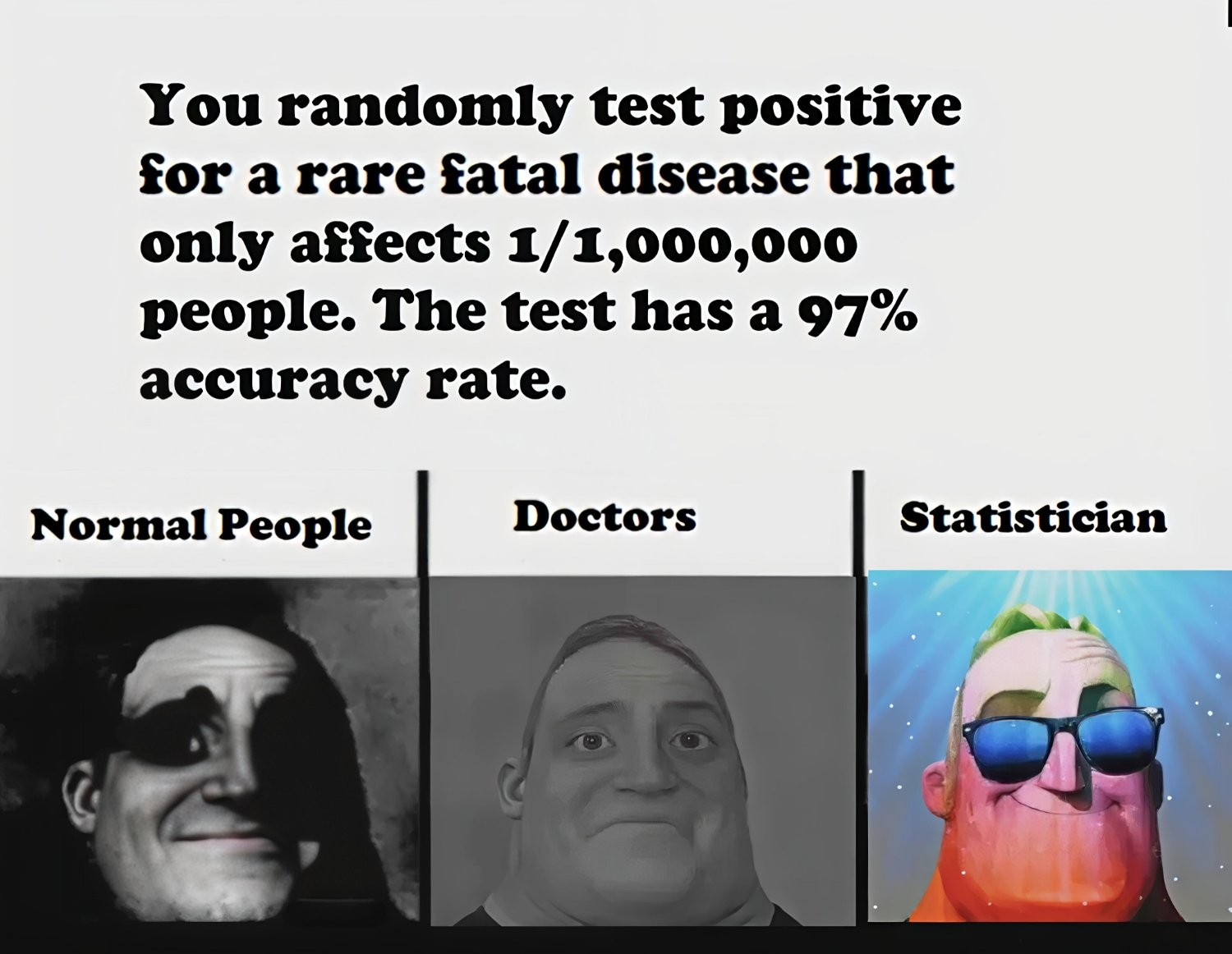
The meme is talking about a common probability error that surveys have shown even doctors are prone to making.

Why you're probably ok:

The rarity of the disease far exceeds the error rate of the positive test. Meaning, the disease occurs in 1 out of a million people, so if you are tested at random and show positive, you only have a 1 out of 30,000 chance (the 3% false-positive rate) of being the the 1 person who truly has the disease.
you are viewing a single comment's thread
view the rest of the comments
[–] themaninblack@lemmy.world 2 points 1 day ago

I have been thinking about this for a while.

Would this actually diminish the false positive rate for the test? Would it just be more likely to get a true positive back?

Or maybe would the false negative result be less likely?

Does it depend on the sample group that was measured to get the accuracy statistics? If the sample group was random then does that actually make a difference?

Doing my head in