
tbf, hunter-gatherer lifestyles are more work-intensive than that, even if still less work-intensive than subsistence farming.
A place to share history memes!
Rules:
No sexism, racism, homophobia, transphobia, assorted bigotry, etc.
No fascism (including tankies/red fash), atrocity denial or apologia, etc.
Tag NSFW pics as NSFW.
Follow all Piefed.social rules.
History referenced must be 20+ years old.
Banner courtesy of @setsneedtofeed@lemmy.world
OTHER COMMS IN THE HISTORYVERSE:
tbf, hunter-gatherer lifestyles are more work-intensive than that, even if still less work-intensive than subsistence farming.
Yeah, its like none of these people have ever watched the series "Alone". Hunter gathering is hard AF. There is a reason there was a population explosion when farming was invented, its WAY easier to survive.
"Easier" isn't quite the word. It's generally accepted that subsistence farming takes more labor per day per person to survive. Reliable is more the draw - if you have a choice between working 10 hours a day, but with a 10% chance of starving every year; or 14 hours a day with a 2% chance of starving every year, most people will choose the 14 hours a day - and the 14 hours a day choice will end up with an exponentially larger population after a dozen generations.
It probably has a lot more to do with farming supporting more people, which results in being able to support non-farmers who are either "nobility" of some kind, and/or warriors who will defend the farming territory and/or fight for better farming territory. In addition, I get the impression that once farming becomes possible, the "nobility" / "warrior" types stop forbidding hunting and gathering because hunter-gatherers are nomadic and they can't easily be controlled and taxed. Some hunter-gatherers still exist on the fringes of society, but it's normally not an option for most people. And, when the hunter-gatherers have one of those periods where they're not able to successfully hunt or gather, in desperation I would bet that they often become raiders, raiding the farmers. So, it's not like individual people are choosing between being hunter-gatherers or farmers. It's that there's a breakthrough in the ability to farm, and everybody nearby is converted into farmers.
Nobility forbidding hunting and gathering is really more of a medieval phenomenon, and has much more to do with the nobility themselves becoming a large population and enjoying the hunt (and the meat that comes from it). If they didn't forbid it, it would be overhunted, and then those filthy poors would be enjoying the meat that rightly belongs to the bluebloods!
There's often, in early farming societies, a great deal of 'fluidity' between subsistence farming, raiding, and hunting-gathering. Subsistence farming dominates because of the aforementioned advantages, but a tribe engaging in subsistence farming might up and burn all their houses down and go on the warpath, or leave the fields unsown for a few years while ranging the local woods. The early Germanic tribes are a great example of this, both in the variation from tribe-to-tribe, and in the way they could swiftly change from one mode of life to the other. The demarcation is not all that 'strict' compared to later 'civilized' societies which are, themselves, mostly surrounded by other subsistence farmers (or pastoralists).
While farmer vs. hunter-gatherer has much more to do with the community choice than the individual choice, even in the most settled sedentary premodern villages hunters and gatherers both remain as viable - and often specialized - ways of life.
But yes, generally the success of the sedentary farmers is not so much conversion (though there is that) as out-competing the hunter-gatherers.
iirc, around the advent of agriculture, the average agriculturalist was significantly worse off than the average hunter-gatherer. They suffered from more malnutrition/nutritional deficiencies, had stunted growth, showed various signs of enduring backbreaking labor, and died younger if they lived past childhood. But the rate at which agriculturalist women got pregnant was 0.1% greater than that of hunter gatherer women, so.... here we are.
Not really a great comparison though.
You’d have the entire weight, knowledge and land maintenance and management of generations of your ancestors to help.
A random bunch of modern Americans with guns being dropped in the middle of nowhere is not the same thing at all…
Like “before agriculture”, which we are learning more and more makes little sense, people still managed plants in large scales. The woods around your village would be kept clean, and edible plants would be incentivized to grow. Hunting trails kept and traps set. Chances are there would be robust fishing with nets, as most humans lived near water.
And also, even “before agriculture”, there was horticulture. People grew and kept small gardens in their villages with edible plants. Many fruits and perennial edible vegetables were ‘domesticated’ “before agriculture”.
Chances are, if you weren’t born in a time of wild weather events, and you lived around 30o up or down the equator, you’d be fine food wise. You’d help with food, some people might be specialized in it, and your diets are diverse and healthy. You’d do other stuff with your time, make ceremonial clothes and instruments, weave, make baskets, make stone tools, make art, train children in crafts and arts, maybe you’d be the woodsman keeping the woods clean, safe, and teeming with edible plants.
Life obviously wouldn’t be easy, because even simple disease or injury could kill the average person. And with small numbers (100-150 is more realistic), it’s easy to reach numbers too small to maintain society with one or two disasters.
But on a day to day basis, life is for sure much easier and calm than a typical “post-agriculture” society.
Totally depends on the environment you're in.
Some costal hunter gatherer socities got so good at fishing then really only worked a few hours a day. This is based primarily off of ethnographic evidence on the first contacts with Native Americans. And yes many had crops as well, but some groups were not really reliant on those.
Some costal hunter gatherer socities got so good at fishing then really only worked a few hours a day.
For food. Human labor for survival includes much more than food.
That's a very good caveat, but we still know that these socities had a lot of "free" time.
Free time is of course hard to define. If you have time to build a mound you have time outside of survival, but that may still be a mandatory societal obligation
That’d a bery good caveat, but we still know that these socities had a lot of “free” time.
Except I'm discussing literal survival. Protection from the elements and cold, gathering potable water, gathering and working materials for cooking and tools that are essential to processing catches to safely edible forms, etc etc etc. Coastal hunter-gatherer societies in particular are not standing in the surf collecting fish which just wash up on the shore; generally, it involves going out on the coastal waters in a boat - something which requires production, maintenance, tools for propulsion (like oars), and tools for fishing (like bone harpoons and nets). On top of that, most hunter-gatherer societies are not sedentary, which adds substantial travel time to the average workday per year.
The concept of hunter-gatherer societies having a lot of 'free' time springs from misconceptions like the above, confusing work for food with necessary work, in general. Hunter-gatherer societies have more free time than early sedentary subsistence farmers, but the difference is more 14 hour day vs. 10 hour day, not 14 hour day vs. 4 hour day.
I understand nostalgia, but I, for one, am not nostalgic for persistence hunting and foraging.
Whenever there are those anthropology shows where someone takes a camera into some place deep in the jungle where people still live some version of a hunter-gatherer lifestyle, there do seem to be some good points. They work hard, but there's also a lot of relaxing. They can't do much at night, so there's often singing and dancing when the sun goes down. OTOH, there's a lot of death. Child mortality is high, injuries that would be easily treated in a modern city are death sentences. And, there's not much room for experimentation, following a different path, etc. Gender roles are rigid. Boys do what their father did. Girls do what their mother did. Life has been essentially unchanged as far back as anybody can remember, so you better accept that because as soon as you're born your path is set.
And, as others have said, that only works in places that have abundant food year-round. Otherwise it's way worse, with a lot more hard work just to not starve.
That makes me wonder about the hunter-gatherer lifestyle in areas that became the centres for farming, like the fertile crescent.
When they do find one of these primitive groups of people who are still living a hunter-gatherer lifestyle, they're always going to be in some remote, inaccessible area. That's the only way that they could still be doing hunting and gathering without the modern world catching up to them. But, that means that a whole lot of the world's best land is unavailable to them because it's where modern civilization exists.
So, what would a hunter-gatherer lifestyle have been like in the Fertile Crescent? Would it have been significantly easier than a hunter-gatherer lifestyle deep in the jungle in Indonesia or in the Amazon? It would have to have been easier than the hunter-gatherers who still hunt and gather in the Kalahari Desert, for example.
Also, the only defence against the outside world is to chuck spears at anyone who comes within spear-chucking distance of your island. Though, tbf, it has worked pretty well
Or to be in such a remote place that nobody ever comes within spear-chucking distance. AFAIK there are still uncontracted tribes in Brazil's amazon jungle.
It's not either-or. We don't have to rewind time. What we need to do is learn from the past. What we gained and what we lost on the way.
Today there is a pervasive culture of individual responsibility, hustle, self improvement, competition... This is killing us all inside while benefiting the 0.01%. we need to learn the value of community again. We are pack animals, we have survived by sticking together and taking care of eachother for millennia.
Unless you lived in an area that had winter, and had to stockpile resource so you didn't starve for 2-6 month soft the year.
Then someone had to pick the berries and then someone had to preserve the berries or cook the berries and someone had to store or transport the berries as you moved camp around etc.
I hate it when people make it sound like cavemen lived in some sort of equalitarian resource rich utopia.
I agree with you and don't want to diminish your point. But
egalitarian
Then you sit around painting fat horses on the walls for 2-6 months.
Carving statuettes of fat titted big booty ladies for "Ceremonial purposes"
I lived in a subsistence farming community that did everything by hand. Same techniques and crops for literally millennia. 450 or so people in mud huts.
Overall, no one wants this life. It's back-breaking work. Kids don't get counted in the census until they're 5 because child mortality is so high. Women meeting at the well was the highlight of their day bceause it was the only thing they saw other people. If anyone was smart enough to learn to read and go to school, they usually left the village for better opportunities.
Everyone worked longer hours than a 9-5 because it's agriculture. Rain doesn't care about holidays or the weekend. Up before the sun every day for a few months. Most people in bed 2 hours after sundown.
Sure, people smiled. People laughed and had joy in their lives. But people also were just as petty and mean and clique-y as anywhere else. The only drama was on the radio and between each other.
3/10. Don't generally recommend.
Up before the sun every day for a few months. Most people in bed 2 hours after sundown.
Everything else sounds shitty. This, however... sounds pretty good. My kingdom for a solid circadian rhythm
Proximity to the equator made the days almost always 11-13 hours long. But yeah, no one stayed up past 9:00 or 10:00pm unless there was a big event.
In my parents' villages... they told me had fucking parasitic worms that creep up and will bit you and suck your blood and like feed off of your blood... I mean you don't even see them coming when you're busy working. And I was told that it's very painful.
Like ew, that's all I need to hear and I instantly hate rural areas forever. It's why everyone in China wants to go to cities for work, farming is horrible. Also no machineary like the US has, it's all manual.
Not to go all socialist here, but we create more than enough sustenance to not have to work so hard. But we've organized society to let a few people have all the surplus.
No, no. Feel free to go all socialist here. That’s what Lemmy is for. :)
Say what you will, but my evolved, neurodivergent, autistic brain is perfectly adapted to this overstimulated work life.
Also, I desperately need to know why everything is futile and no one seems to care.
Ah well. Back to work!
This life is what you get. It's up to you what you make of it. Looking to external sources for "sense" or "meaning" is a fool's errand.
To channel some absurdism (usually attributed to Camus, but I don't think he ever said it), "The meaning life is whatever is stopping you from killing yourself at the moment."
Meaning is what you make of it.
It's as corny as it is true.
I agree that the rigid 9-5 is not fulfilling for a lot of people, and would even go so far as to say we'd be happier as a whole if we could work outside of that prescribed structure.
I have to assume this person is being massively facetious with the tone of this tweet though. Obviously it's twitter so it's nonsense, but no, you wouldn't just shoot the shit, pick some berries, and then chill out. You never been farming? It's miserable, hard work. And when I was doing that, it was safe in the knowledge that I had food in my fridge and cupboards, so I wasn't totally reliant on the food I could pick. And that's farming, i.e. an established plot of land where I know food is meant to be, grown by me and people before me, that I should be able to pick from.
If I was scavenging, on unknown land? No fuckin way dude, honestly call me a weakling but I'll work a 9-5 if it means I can afford (and have the opportunity to pick from a decent variety of) fair quality food, have decent leisure time to myself, and not have to worry about whether the food I'm picking, if I can find it, is gonna make me shit myself to death.
I have issues with the system, massive issues with the system, and I recognise I'm privileged to be in the position where my 9-5 makes me miserable but not suicidal and where the shops around me stock a variety of food, year-round, all of which I can try with a little bit of careful budgeting. It is definitely better than dying of bad berry disease in a god-forsaken cave.
The key here is (emphasis added):
I'll work a 9-5 if it means I can afford... ...fair quality food
I know you mention your privilege, and I'm glad you're in the position you're in where your job gives you the means and you live where you have access to a variety of good quality food. (I'm not glad the job makes you miserable.)
For so many, that's just not the case. We can't afford it, or if we can, we're not just working a 9-5, we're working two or more jobs, 10 or more hours a day, and shitty hours, more than five days a week, living in food deserts where food quality is terrible, and on and on.
Now, I agree with you. I'd be perfectly happy working my main job (I work two), if it meant I could afford to live my life without the constant stress of trying to afford to just exist.
Compare that to hunter gatherer lifestyle, where they worked to hunt/gather/shelter/etc themselves for 20ish hours a week and had significantly more leisure time and less stress.
Given the choice between the two, I'd live the hunter gatherer lifestyle rather than working 50+ hours a week as a wage slave to barely keep my head above water. And I know that's not all daisies and rainbows either, but fuck capitalism and this construct we're currently living in.
And the next day you followed an antelope for 14 hours until it couldn't continue to run, you stabbed it with a spear, and drug it half a dozen miles back to camp.
"Picking berries and hanging out" is something that happened sometimes. What happened most of the time was hard as fuck work to make sure you and your family didn't starve to death.
A global modeling study of foraging time found typical foraging requirements of about 3.5–5.5 hours per person per day, though this varies with environment and productivity.

Return to Monk? 
Natalie: Are you afraid of frogs?
Adrian Monk: I don't know. I've never been this close to one. [A frog lands on Monk's shoe] Yes. The answer is yes. Put frogs on the list. Where's the list?
Natalie: I got it. I got it. Where does it go?
Adrian Monk: Put them between possums and, uh, soccer riots. No, no, no. Uh, after after soccer riots. And before, uh, before hailstones. Yeah, so it goes...
Natalie: I got it, I got it: Soccer riots, frogs, hailstones.
Adrian Monk: At least now we know. Information really is power.
And then you died of a tooth infection at the ripe age of 17.
Statistically a group of 27 mating pairs is the minimum you can have before you run the risk of not having enough girls born to continue the population
You don't reproduce within the same band.
Bands meet with other bands for that.
I thought it was more like a hundred
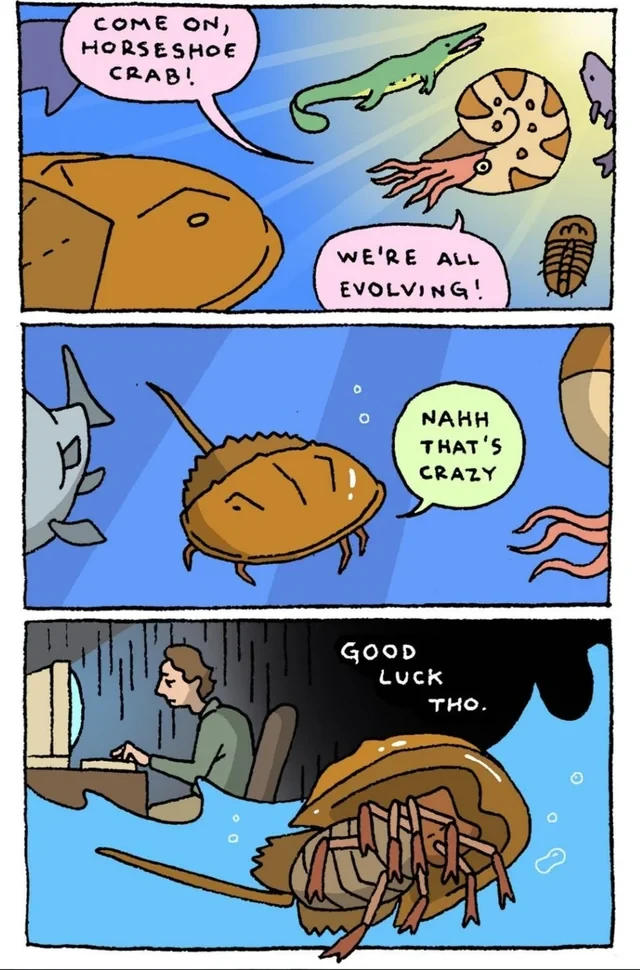
There's a lot of wisdom in this even though it's oversimplified.
For me, the smaller I make my world the happier I seem to be. I spend most of my non-job and non-sleep time hanging with my family, working on my house, and doing what are essentially farm chores to take care of all our pets.
Working with your hands and engaging all your senses with real stimulus from the natural world is a huge part of it, even as somebody who has been terminally online since the 90s.
Evolution continues. Some will survive.