cross-posted from: https://piefed.social/c/historymemes/p/1836852/copper
A place for majestic STEMLORD peacocking, as well as memes about the realities of working in a lab.

Rules
cross-posted from: https://piefed.social/c/historymemes/p/1836852/copper
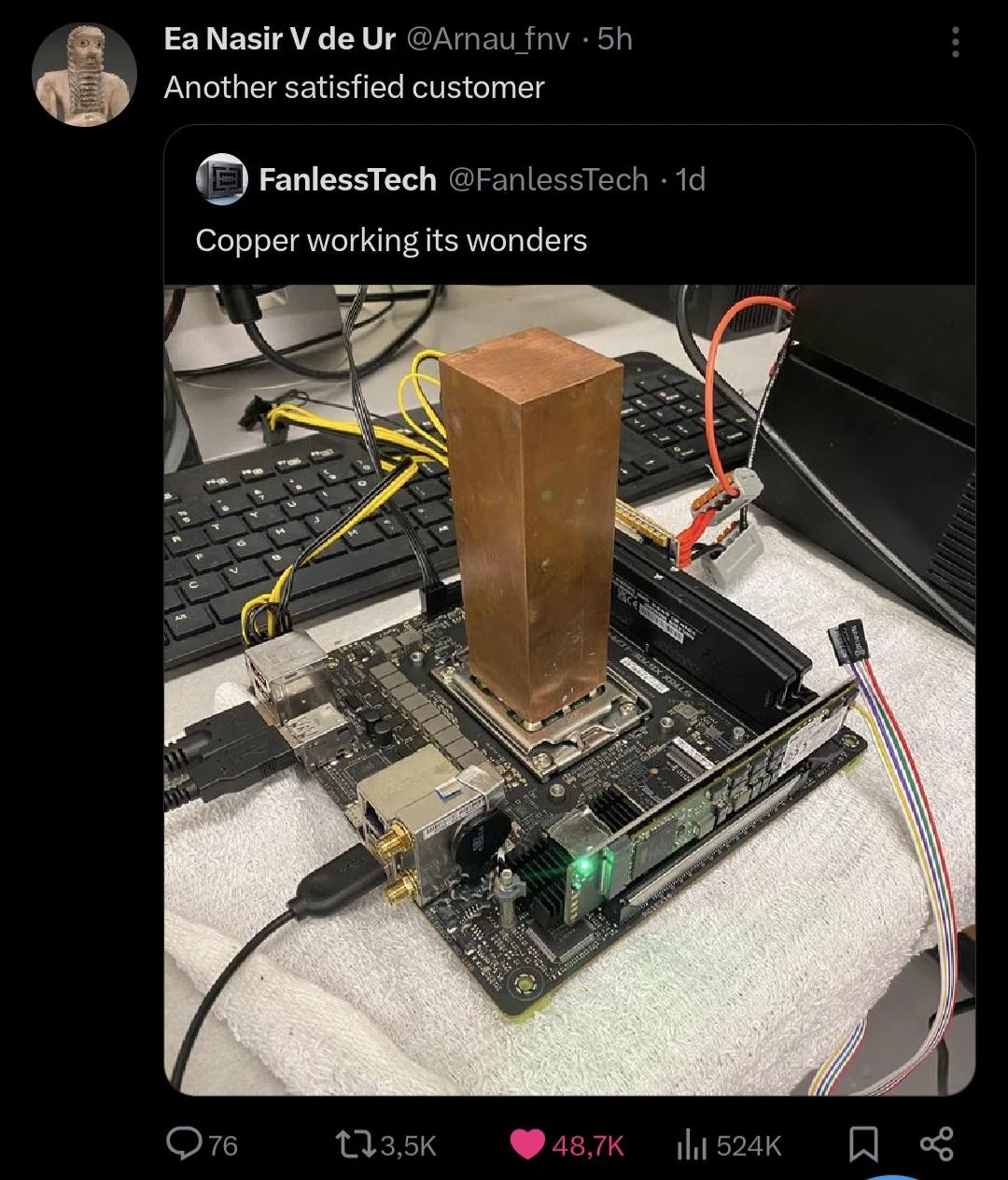
Okay, who gets to be the lucky one to calculate the amount of time that thing could heat sink a pegged, modern, 120w TDP CPU before it throttles at 100C? I'll give you a sticker.
Let's assume the dimensions of the copper block are 40mm40mm160mm (I'm not taking the heat spreader into account here)
That results in a volume of 256000mm3, or 256cm3
Copper (at 20C) has a density of 8.935 g/cm3, so that's roughly 2.28736kg of copper
Copper has a specific heat capacity of 384.603 J/(kg K)
Using E=cm∆t, we can figure out that it would take ≈ 70378J of energy to heat the copper block to 100C, starting at 20C
With a TDP od 120W, that means it would take 586 seconds to heat the block to 100C, or 9m46s
This is probably way off but I was bored
Your napkin math is the best we have. We will make all decisions based on it.
They will have entire hard drives explaining KSP Atlas's shitty math in 3 thousand years...
Hmm, I think at minimum calculus will need to be involved here. Because we can't just assume that the heat is spread evenly in the copper - it'll likely be hotter at the bottom, leading to thermal throttling earlier than expected. On the other hand, there's going to be heat dissipation into the air, which will help cool the block somewhat
The conduction in copper is fast enough that there's not much of a difference between the top and bottom.
Copper conductivity is fast, sure, but it's not fast enough to have equal temperatures at the top and bottom for such a big chunk of copper. That does affect the time to thermal throttle pretty significantly, actually. If we assume completely homogeneous temperatures across the block (ie, instantaneous heat transfer), according to my model, it'll take 703 seconds to thermal throttle. With heat transfer, the time drops to 592 seconds - a difference of about 2 minutes
Heat transfer will not limit much, but heat loss should add a significant amount of time. How did you model that?
I left another comment going into more detail about the model specifications, if you'd like to read into it. But briefly: I took the copper heat conductivity coefficient and the air heat transfer coefficient. I sliced the copper block into thin slices and modeled heat transfer between each slice, as well as heat transfer between each slice and the surrounding air.
It seems that both heat transfer and heat loss do actually matter quite significantly, but they just cancel each other out almost entirely.
If we assume instantaneous heat transfer, thermal throttling time goes up from 592 seconds to 703 seconds (almost 2 minute difference).
If we assume no heat loss to the air, thermal throttling time goes down from 592 seconds to 500 seconds (about 1.5 minute difference).
If they cancel out, the system would be in balance and not get hotter. So some thing does not add up. What heat transfer coefficient did you use and which other numbers etc.?
No, the heat propagation through the copper block (meaning the contact surface gets to 100 degrees before the top of the block) balances out that the copper block loses heat to the surrounding area via it's side walls.
Account for convective loses into air?
Its going to radiate a little bit too.
I got ~32 watts of convective heat transfer using assuming a uniform surface temperature of 99°C and a case fan speed of 0.2 m/s
https://www.engineeringtoolbox.com/convective-heat-transfer-d_430.html
Was intrigued, so made a simulation to figure it out.
TLDR: 592.2 seconds, or 9 minutes and 52.2 seconds. Very similar to the other comment - it appears temperature differentials and heat loss to the air have opposite effects on thermal throttle time and mostly cancel themselves out. For the most part, heat transfer and heat loss appear to affect the thermal throttle time less than the sheer heat mass of the block by several multiples
Assumptions:
Modeling conditions:
Fun facts I found from playing around with the model:
Well goddamn... Ok. Go ahead and dm me your home address, phone number, social and/or tax id number, the name of the street you grew up on, the name of your favorite teacher, the IMEI number of your cellphone, a high resolution set of your fingerprints, and a list of your three greatest fears, and I'll get your sticker sent over as soon as I can.
Numerical methods is cheating! Real men use PDE's!
/s of course, though I was kinda hoping you'd use PDE's
See, I thought about doing that, but then I realized: I don't actually want to do that
What software did you use to model this, btw?
Python
Respect for taking the time to model that. Goes to show why heat sinks look the way they do, and not just big lumps of metal lol
You did the monster math.
Respect.
How long a copper block do I need to prevent any throttle?
Good question. I had to modify my code to run more efficiently, since not throttling implies that the copper block reaches a steady state with very little temperature changes over time.
But, with the changes, I can say that there is no copper block length that would prevent throttling with a 120 W CPU. It seems the heat transfer within the block is slow enough over such long lengths that you get diminishing returns with longer and longer copper blocks. Here's a graph I made summarizing the different block lengths that I tested
With a 65 W CPU, a 32 cm (double the original length) copper block is sufficient to prevent throttling, but it'll reach steady state at 97 C
Have you considered the possibility that Ea-nāṣir might have been delivering inferior quality copper to you?
Ea-nasir promised that these were good quality copper, and I do not have any reason to suspect otherwise. But I'll have you know, if the copper is of inferior quality, I will make sure to send my messenger to complain. He will not hear the end of it!
Would the result change if the copper block gets wider instead of higher?
Apparently, yes. You can prevent thermal throttling if you expanded the base from 4 cm x 4 cm to 4.5 cm x 4.5 cm, and if you increased the height from 16 cm to 100 cm. The temperature caps at around 97 C.
Did the model include some air movement by way of the fans on the case. That would be a fun thing to think about.
The fact that the air remains a constant temperature means the model is assuming infinite airflow.
It didn't model convection at all.
Nice try. I’m not googling “copper pegging” again.
That thing doesn't make any sound so you gotta search "Copper Sounding" instead.
I hate that I know what that entails.
If you want to do it, but don't have a proper sounding rod, you can just use your house key instead.