this post was submitted on 28 Oct 2024
782 points (98.6% liked)
Science Memes
21100 readers
776 users here now
Welcome to c/science_memes @ Mander.xyz!
A place for majestic STEMLORD peacocking, as well as memes about the realities of working in a lab.
Rules
- Don't throw mud. Behave like an intellectual and remember the human.
- Keep it rooted (on topic).
- No spam.
- Infographics welcome, get schooled.
Research Committee
Other Mander Communities
Science and Research
Biology and Life Sciences
- !abiogenesis@mander.xyz
- !animal-behavior@mander.xyz
- !anthropology@mander.xyz
- !arachnology@mander.xyz
- !balconygardening@slrpnk.net
- !biodiversity@mander.xyz
- !biology@mander.xyz
- !biophysics@mander.xyz
- !botany@mander.xyz
- !ecology@mander.xyz
- !entomology@mander.xyz
- !fermentation@mander.xyz
- !herpetology@mander.xyz
- !houseplants@mander.xyz
- !medicine@mander.xyz
- !microscopy@mander.xyz
- !mycology@mander.xyz
- !nudibranchs@mander.xyz
- !nutrition@mander.xyz
- !palaeoecology@mander.xyz
- !palaeontology@mander.xyz
- !photosynthesis@mander.xyz
- !plantid@mander.xyz
- !plants@mander.xyz
- !reptiles and amphibians@mander.xyz
Physical Sciences
- !astronomy@mander.xyz
- !chemistry@mander.xyz
- !earthscience@mander.xyz
- !geography@mander.xyz
- !geospatial@mander.xyz
- !nuclear@mander.xyz
- !physics@mander.xyz
- !quantum-computing@mander.xyz
- !spectroscopy@mander.xyz
Humanities and Social Sciences
Practical and Applied Sciences
- !exercise-and sports-science@mander.xyz
- !gardening@mander.xyz
- !self sufficiency@mander.xyz
- !soilscience@slrpnk.net
- !terrariums@mander.xyz
- !timelapse@mander.xyz
Memes
Miscellaneous
founded 3 years ago
MODERATORS
you are viewing a single comment's thread
view the rest of the comments
view the rest of the comments
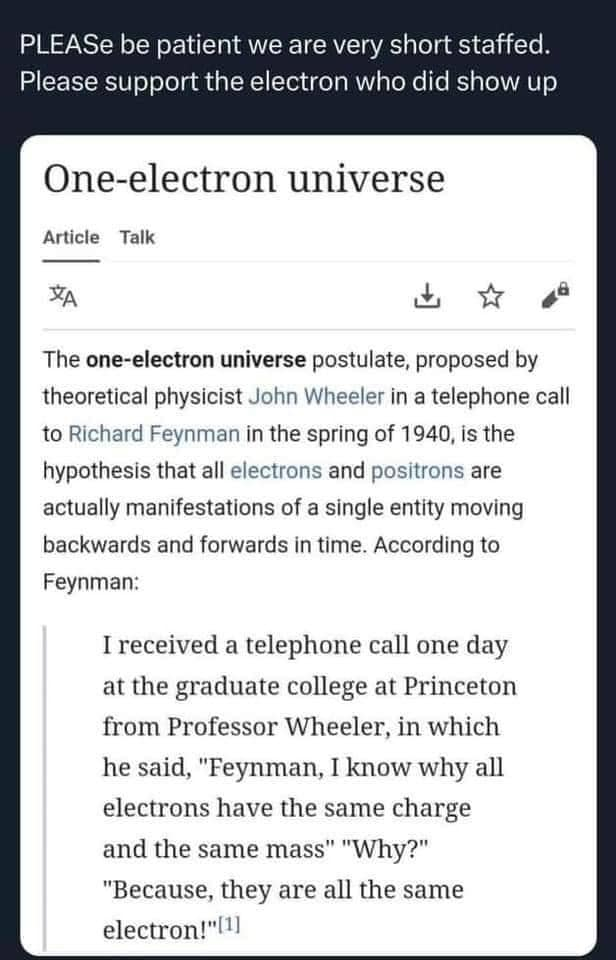
A big part of quantum mechanics is the fact that matter can show wave-like behaviour, which sort of breaks a bunch of "rules" that we have from classical physics. This only is relevant if we're looking at stuff at a teensy tiny scale.
Someone else has already mentioned that electrons are a fair bit smaller than protons and neutrons (around 1840 times smaller) and this means they tend to have a smaller momentum than protons or neutrons, which means they have a larger wavelength, which was easier to measure experimentally. That's likely why electrons were a part of this theory, because they're small enough that they're sort of a perfect way to study the idea of things that are both particle and wave, but also neither. In 1940, quantum mechanics and particle physics were super rapidly moving fields, where our knowledge hadn't congealed much yet. What was clear was that electrons get up to some absolute nonsense behaviour that broke our understanding of how the world worked.
I like the results of some of the worked examples here: https://www.chemteam.info/Electrons/deBroglie-Equation.html , especially the one where they work out what the wavelength of a baseball would be (because that too, could theoretically act like a wave, it would just have an impossibly small wavelength)
TL;DR: electrons are smaller than protons/neutrons Smaller = larger wavelength Larger wavelength = easier to make experiments to see wave-like behaviour from the particle Therefore electrons were useful in figuring out how the heck a particle can have a wavelength and act like a wave
I detect you therefore you're no longer a wave.
I like the way one of my university textbooks frames the particle wave duality thing: "A single pure wave has a perfectly defined wavelength, and thus an exact energy, but has no position. [...] [Whereas a classical particle] would have a perfectly defined position but no definable wavelength and thus an undefined energy" ^([1]^[2])
I am currently in my bed. I have a lot to do today, but I'm not sure how much I will get done because I don't know how much energy have. Thus I conclude you are right and that I am clearly a particle.
^([1]: Principles and Problems in Physical Chemistry for Biochemists, Price, Dwek, Radcliffe & Wormald, p282)
^([2]: I'm practicing being more diligent with citations, in hope that good habits will make it easier when referencing is actually important)
Makes sense, why should I keep waving when you can see me now.