
the price of thought
Oh fuck off.
This is a most excellent place for technology news and articles.
the price of thought
Oh fuck off.
These fuckers would sell us air if they could.

I saw it in a documentary called Total Recall

How about DRAM? Show me some AI price crashes leading to DRAM price crashes. That's what we all want, I think.
This still applies.

Surveillance fascism needs the RAM, compute, and storage to implement totalitarianism and autonomous killing machines that won't refuse to genocide the proles once they realize climate change is significantly worse than advertised, and our "democracies" are an illusion controlled by a big club of plutocrats.
When the AI bubble pops, the US government will bail out all the tech companies, and all of the debt will be transferred to the working class via our retirement account losses and inflation; no different to the trillions in "forgiven" corporate loans central banks around the world printed during covid. The working class will essentially pay for the nazi big brother and nazi skynet that enslaves them.
Thanyou for coming to my conspiracy theory ted talk.
I’ve been starting to think that once the bubble begins to pop, the US will bail out the banks by buying up their loans to hyperscalers, and they’ll start writing giant surveillance contracts to AI companies to compensate for the lack of demand. The rich get richer and the resulting stock corrections will end up hurting regular people most
Yeah, whether they buy the excess hardware in a fire-sale, nationalize open AI/Anthropic into the DoD on nat sec grounds, or just sign several hundred billion dollar contracts with them, we're just splitting hairs. The threat and their intentions remain the same.
“Look how low our cost of inference is”
“Pay no attention to the marketing budget that exceeds Coca-Cola’s for a small fraction of their revenues”
What technical, fundamental reason is there for the crash in price? The article just accepts the MSRP as fact. It’s established fact that retail prices can be dropped below cost in order to establish market dominance. The cost of training can indeed be spread over time but it’s not spread across enough time (between model releases)The inference cost doesn’t actually drop in reality.
Let's just quickly check https://isaiprofitable.com/ :
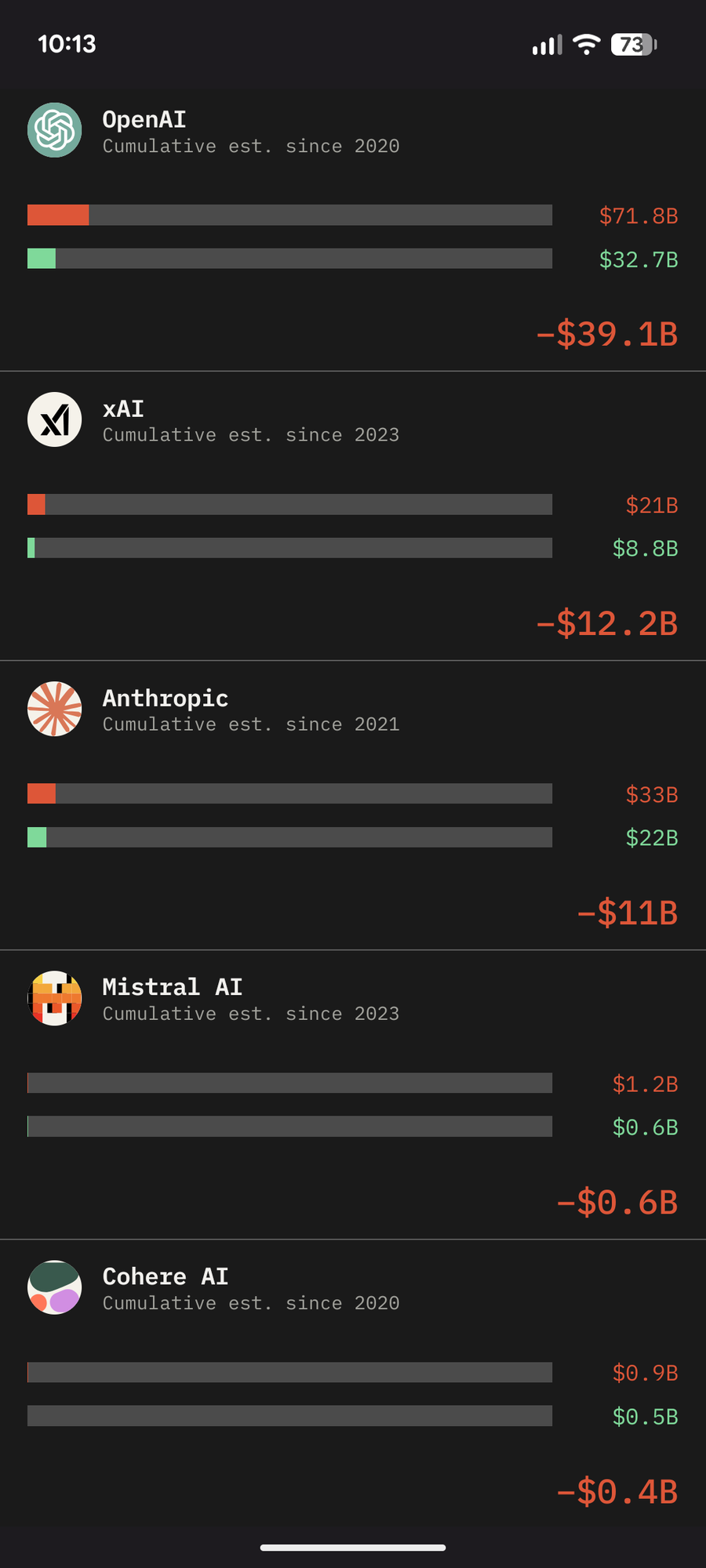
Nope. The answer is still "they're burning cash." Only the companies making silicon are raking it in.
What technical, fundamental reason is there for the crash in price?
Smaller models are inherently faster, and use less gpus to fit inside, and less gpu time per training step. Newer models are smarter at smaller size than older models, and so also come up with correct answer in fewer tokens.
There are 15 labs accross the world competing without patent restriction for software building. It's orders of magnitude faster than Moore's law, because its highly competitive, and software has massive "compiler" resources thrown at it, in investor/government frenzy.
Extremely interesting… so the depreciation of older models is extreme, while new models are constantly presented. And all the while no AI company is making any profit. This whole story is bonkers
The catch is
the cost of a given level of AI performance
And more interestingly the article itself says this
And to this extent, when comparing price drops for AI to drops for other technologies for which we have price series, we are comparing apples and oranges.
Even then, they decided to make it the headline. This is just like LLM bros doing things they don't know anything about. Absolute garbage.
Hadn't you heard? Some day, one of these things is gonna cure cancer. We all just gotta kill ourselves subsidizing it until then!
I wonder how they plan to match "prices are in free fall" to "the AI industry will have to make trillions a year in order not to go bust".
On the other hand, "prices in free fall" might be the answer they got from AI...
At this point the cloud model firms are basically banking on making a superinteligence before anyone else and taking over the planet, otherwise they go bankrupt. I wish I was kidding.
Nvidia wins either way though, local models, cloud models, shovels always sell. So they have that overvalued but still realistic bedrock to build houses of cards on.
Nvidia wins unless some other company starts selling cheaper, faster, more efficient matrix multiplication machines.
I've read some articles about radically different inference architectures that may tilt the scales, but I know this is wishful thinking because I really would like Nvidia to fail badly.
Linus_nvidia.gif
Plenty have tried, all have fallen over flat on their face when it comes to actually providing usable drivers or production at scale. AMD's still completely half assing it even today and Intel's OneAPI and Vino is a bloated joke.
But yes I would love a future where AMD finally hires an actual software team.
It's funny watching them rig the system and simultaneously keep shooting themselves in the dick.
Nvidia - desperate not to lose business as they're now ~93% dependent on AI sales, so they keep 'investing' in OpenAI, Anthropic, etc.. Who turn around and of course immediately buy Nvidia AI chipsets.
OpenAI and Anthropic - panicking that investors will realize their IP is worth nothing (what we've said all along) as they are overtaken by much cheaper models, so they lower their pricing drastically - can't risk losing that market share*.
*market share is irrelevant really, there is no first-to-market winner in AI, but you cant lie to ~~idiots~~ investors for another 16 rounds of funding to 2030 unless you can show userbase growth to them.
Really hard to keep propping up the con when barely anyone is paying.
Fingers crossed for horrible things to happen to then soon.
So in essence the price that the market will bare for the cost of AI usage is significantly lower than what the big AI companies would like it to be (in order to pay back their ever growing debts), which means there is a possibility they might never achieve profitability on their own (without some external/governmental strong-arming)
Yeah, I'd like to see the cost of sub-prime mortgage on that chart.
*bear
Bare bears bore boars beer.
Yeah. Not a surprise.
everyone has bet on AI getting good enough to fully replace humans fast. CEOs mandated use of AI. The results weren't as great as expected. CEOs started limiting AI use to counter the token cost explosion after employees found out how to waste tokens fast.
At the same time, China's AI development is driven by the party instead of companies. They aren't so much interested in money as they are in the strategic solution to the demographic problem caused by the one-child policy (which worked a bit too well too fast). The companies there plan on making money by providing the compute (they literally have the power and a two digit number of nucular GW under construction right now).
So their models are almost as good as US ones and freely downloadable to run on whatever hardware you want. That naturally limits the longterm-achievable AI token prices to little more than the cost of just providing the raw compute.
US AI companies are also in a cut-throat competition for customers right from the start. That obviously doesn't help to keep prices high. Currently, they all burn money so fast that it's hard for a human mind to comprehend.
None of the US AI companies will survive the next decade if they don't actually are the only one making AI actually able to fully replace human workers. They will all go bankrupt and might take the whole US economy with them.
Nvidia will probably be the real winner if they don't fuck this up somehow (not sure if that is even possible) because they are the ones selling the shovels in this gold rush.
In two decades, it will be normal to have the capabilities of current frontier models running locally on your Chinese phone.
The only thing I would add to this is that (in my understanding) Nvidia is largely selling future GPU manufacturing capacity to the large AI providers. So, if the providers end up going belly up, thrn Nvidia might take heftly losses from that as well.
The other day I saw a video talking about this new innovation on LLM inference side of things where they keep some more used weights in RAM and others less used on disk. I always suspected from the sample code I stumbled upon on the IA world that should be extreme opportunities for optimizations. But I cannot stress it enough how dumb the LLM world is where the basics of implementing an LRU cache is pass of as some big innovation. Like any half competent comp-sci or comp-eng professional know about the basics of mitigating this basics bottlenecks like "the data does not fit on available RAM", "The disk is slow", etc.
So is not surprising that now that it seems that the "powerfulness" of this LLMs is starting to plateau that we would start to see some improvement in performance/resource utilization and hence running costs.
That works for "Mixture of Experts" models. These are basically models with distinct sets of weights and only a subset of them will be used on any particular query. The rest can sit on a disk.
It doesn't work for dense models, where every weight is used all the time. There's nothing inactive so a cache has nothing to exploit.
Keep in mind many of the optimizations you're talking about (LRU caching of experts, for example) are only really relevant at the single user local inference scale. As in, an individual wants to run a big model on their machine, but they don't have enough VRAM to fit the model and KV cache. Accordingly, you're basically only describing hobbyist and research projects, which aren't really representative of the AI inference industry as a whole.
Commercial inference keeps everything resident in VRAM, so expert caching isn't necessary. So these things won't help costs. A lot of other low hanging fruit (like hierarchical KV cache) has also existed for a long time for production-ready inference engines.
I am not sure it would not help commercial solutions, if all experts are used all the time, sure, but if for example the usage is biased for some experts it would enable one machine to serve more users in parallel or save on VRAM or DRAM without compromising response time, hence cutting costs.
It still won't help for a couple of reasons. For one, VRAM is fairly abundant on commercial deployments. Even for big models, a company is probably deploying on 1-2 nodes of 8x H200 or newer (hence several TB of VRAM).
But more importantly, commercial inference relies on heavy concurrency. So even if some experts are uncommon, with a lot of concurrent users, they will still fire frequently enough for the performance difference to be felt. And in my own experience, expert use isn't uniform but it isn't particularly biased either. This is especially tough since high-concurrency inference can actually be fairly compute bound, but this expert caching system either starves the system of bandwidth (if you require compute on the GPU, then you're stuck with PCIe speeds which are tiny compared to HBM and even DRAM), or you're starved of compute (if you do compute on the CPU).
It's nice for local inference, but yeah, not representative of commercial inference.
That's cool and all, but when can I buy RAM again?
In 4 years or never. The latter probably being the most likely, since they are not just keeping RAM from you for AI purposes. They don't want you to own you own hardware anymore, so they just simply stop manufacturing consumergrade hardware.
Probably not never - CXMT are trying to aggressively expand to fill the market now the major players have left, but it will still be a few years before prices really come down as a result.
Never if you are in the US. In a few years if you are allowed to buy Chinese.
Because those other technologies are infinitely more useful.... So obviously governments and private equity you're going to invest in AI. Makes perfect sense to me.
God I'm so tired
Kinda sus that the cost of electricity stops at 1973.
So revenue is falling. The only way the bubble grows is forcing this shit into even more places?
So instead of 1$ return for 3$ spent it's now 4$ or 5$ spent.
The cost decline for a given level of performance does tend to slow over time
Even in their tests, there are big drops in 2026 models, and recent ones.
Opus 4.8 (may 2026), by far best model at the time, gets equaled by deepseek 4 pro (july 31) and 4.1 flash (sept 10th) at less than 1/100th the cost. MiMo 2.6 pro (sept 21) is even cheaper and beats opus 4.8 scores by a wide margin. sonnet 4.6 max to gpt luna high is also a 99% cost drop in a short time for lower performance level models.
That's cause you burnt money equivalent of gdp of Spain in that time frame, and I am being generous here.