this post was submitted on 06 Aug 2026
278 points (99.3% liked)
Math Memes
3901 readers
263 users here now
Memes related to mathematics.
Rules:
1: Memes must be related to mathematics in some way.
2: No bigotry of any kind.
founded 3 years ago
MODERATORS
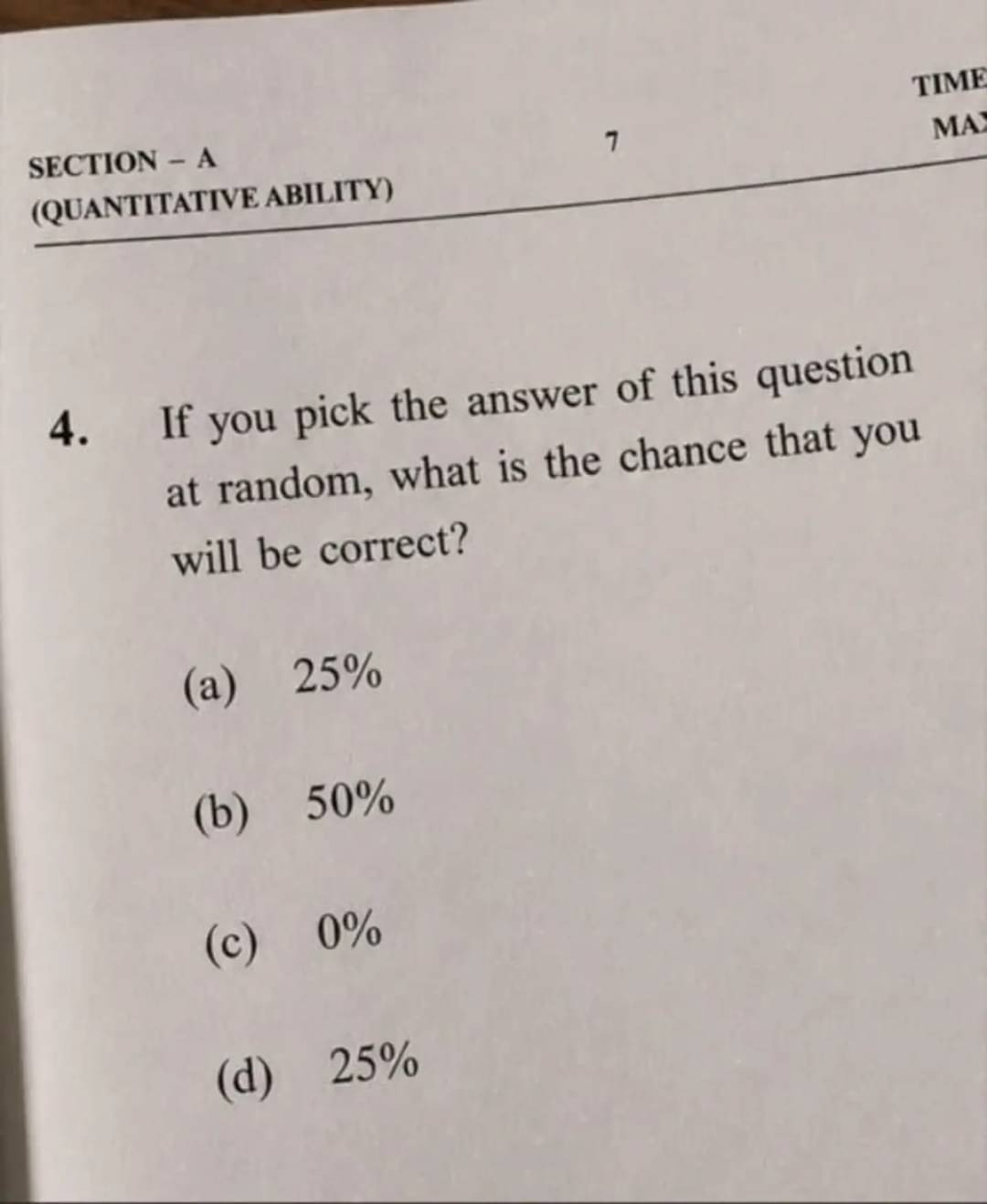
Couldn't you argue that 0% is correct?
It's a paradox, no of the answers can be correct, so the chance that you pick the correct one is 0%.
Sure, by picking it, it makes it wrong, but you don't care about that.
If you ran a infite monte carlo test on it, you'd end up with 0% correct answers.
Nah it's a paradox. There's no such thing as just a freestanding Monte Carlo test that you can just "run" - you do actually need to define enough parameters to make it tell you anything.
This kind of self-referential stuff feels like a proof of Gödel's incompleteness theorems with extra steps.
The trick is that there is no paradox, only the implication of one. 'If' being the key word - you're not actually being asked to answer randomly, but you are being subtly trolled.
You do not need to pick at all for the paradox to exist. If either A or D is correct, the other is also correct, and the random odds of selecting the correct answer should have been 50%. This is a contradiction. Neither A nor D can be the correct answer.
If B is correct, the random odds of selecting it is only 25% - a contradiction, so B cannot be correct. Likewise, if C is correct, there is a 25% chance of randomly picking C. C is also not correct.
None of the four answers is correct, so there is a 0% chance of randomly picking the correct answer. C is correct, contradiction, C is not correct, C is correct, is not, is too, etc.
The paradox is resolved by knowing the the scantron answer key has A selected. D is not sufficiently identical to A in javascript, so only the students that randomly guessed the correct answer will get credit.
Because the paradox can only be resolved with either A or D as the selected answer, well informed students picking randomly would have a 50% success rate.
load more comments
(4 replies)
load more comments
(1 replies)
C; the question has two identical answers, it gets removed from the test based on that error
A crocodile has your toddler. It says it will return your child if you can guess its next move. What do you say?
"Holy fuck a talking crocodile‽"
Oof. Wrong time to get excited, buddy...
"It's your responsibility now you scaly sucker!" and then voom off on my dune buggy. Also in this scenario I have a dune buggy for reasons.
load more comments
(1 replies)
Lmao that's fucked up hahaha
It's B - 50%; either correct (50%) or false (50%), binary 0/1, yes/no, score or not.
Trick question: One of the 25s is an imposter.
It's a mimic-dark souls math. If you pick it, the test eats you.
It's actually 2S with S=12.5
And 50 is 5O, where O=0
I would answer C) 0% - Ultimately I feel this isn't a "pick the correct answer" type of test and more of a "pick the best answer" type of test.
My reasoning is there are really two questions - one is being answered at random, the other I am answering. The one being answered at random is making any answer it chooses wrong - If it picks A or D (25%), then the correct answer is B (50%). If it picks B (50%), then the answer is either A or D (25%). If it chooses C (0%) then the correct answer is A or D (25%) again. No matter which one is chosen at random, it becomes wrong as soon as it is chosen. So then back to the question on the test that I am answering, the correct answer is C) 0%.
Also, if the teacher marks that wrong, then I am even more correct.
It’s definitely B ) 50%. Ignoring the values for answers, there can only be 1 “correct” answer. If you have 4 options and 1 can be correct, a random guess is 25%. Since there are 2 options for 25%, you have a 50% chance of guessing the correct 25%.
Yes but then 50% would not be the correct answer.
I fucking hate this game 😭
But then the correct answer is b)50%, so the chances or picking that are 25%, my brain hurts now.
load more comments
(2 replies)
You can’t separate the question like that. Whichever answer you circle indicates your assertion that this is the probability of getting the correct answer by uniform random chance.
This means that any answer you circle is wrong, and so the correct answer is to not circle any of them. You could even write e) none of the above to indicate that you have deliberately chosen not to circle one of them instead of skipping the question.
I have had plenty of exams with multiple choice questions that included the possibility of no correct answers, one correct answer, or even multiple correct answers, and we were expected to make that judgement (rather than blindly follow instructions).
load more comments
(6 replies)
add a e) 20%
There is no correct answer. The reason why there's no correct answer is that it's a self-referential paradox, but imagine of you saw this:
What is 1+1?
A) 9
B) π
C) 76
D) Syria
There's no correct answer, so it's not a valid multiple choice question.
Here's a more fun one:
If you pick an answer to this question at random, what is the chance that you will be correct? Mark at least one of the applicable options.
(a) 20%
(b) 6.25%
(c) 0%
(d) 20%
And as another puzzle, what happens if you swap "at least one of the" for "all"?
It's gotta be B, right?
If the answer is B, that means there's a 25% chance of getting the right one. So the answer is A and D. But wait... that's 50%
50% means 25%
That means 50%
So it's 0% because it's impossible.
Meaning it's 25%
Damn it
Not really but you're thinking in the right direction!
There is no correct answer because the question and the answers exclude themselves:
For four different options it is 25% but here two options are the same - so you have a 50% chance to land on a 25% - but this means that the correct answer is only in one of the four answers, therefore you're having a 25% chance.
It's a nice demonstration of what happens when the answer and question are intervined and any result changes an aspect of the answer - you're fucked, basically.
load more comments
(6 replies)
Its 25%. The rules of answering a question with a set of options is that you may only choose one and only one is right unless explicitly stated otherwise. Anything else is breaking the rules, which as the taker would be disqualifying. If you start narrowing it down, as in "its 25% and theres two so now i need to guess therefore its 50" you are no longer answering the question at random and you have answered wrong. But you do have to make that coin flip. Good luck.
load more comments
(3 replies)
The correct answer is to leave all the options unmarked.
If you do pick an answer, then you didn't do it randomly. When not marking the answers, the if-statement has the result of "false", but that's not the question.
If your teacher then asks why you didn't answer it, you can safely and unparadoxically claim that inaction is also an option.
The question is not asking you to pick at random. It's asking you to suppose that you do pick at random and to mark the correct answer not at random.
load more comments
(2 replies)
I'd write out '25%' instead of choosing a,b,c or d.
The right answer is neither a nor b nor c nor d, but "beer with tzatziki".
load more comments
(1 replies)
view more: next ›