this post was submitted on 06 Aug 2026
278 points (99.3% liked)
Math Memes
3901 readers
276 users here now
Memes related to mathematics.
Rules:
1: Memes must be related to mathematics in some way.
2: No bigotry of any kind.
founded 3 years ago
MODERATORS
you are viewing a single comment's thread
view the rest of the comments
view the rest of the comments
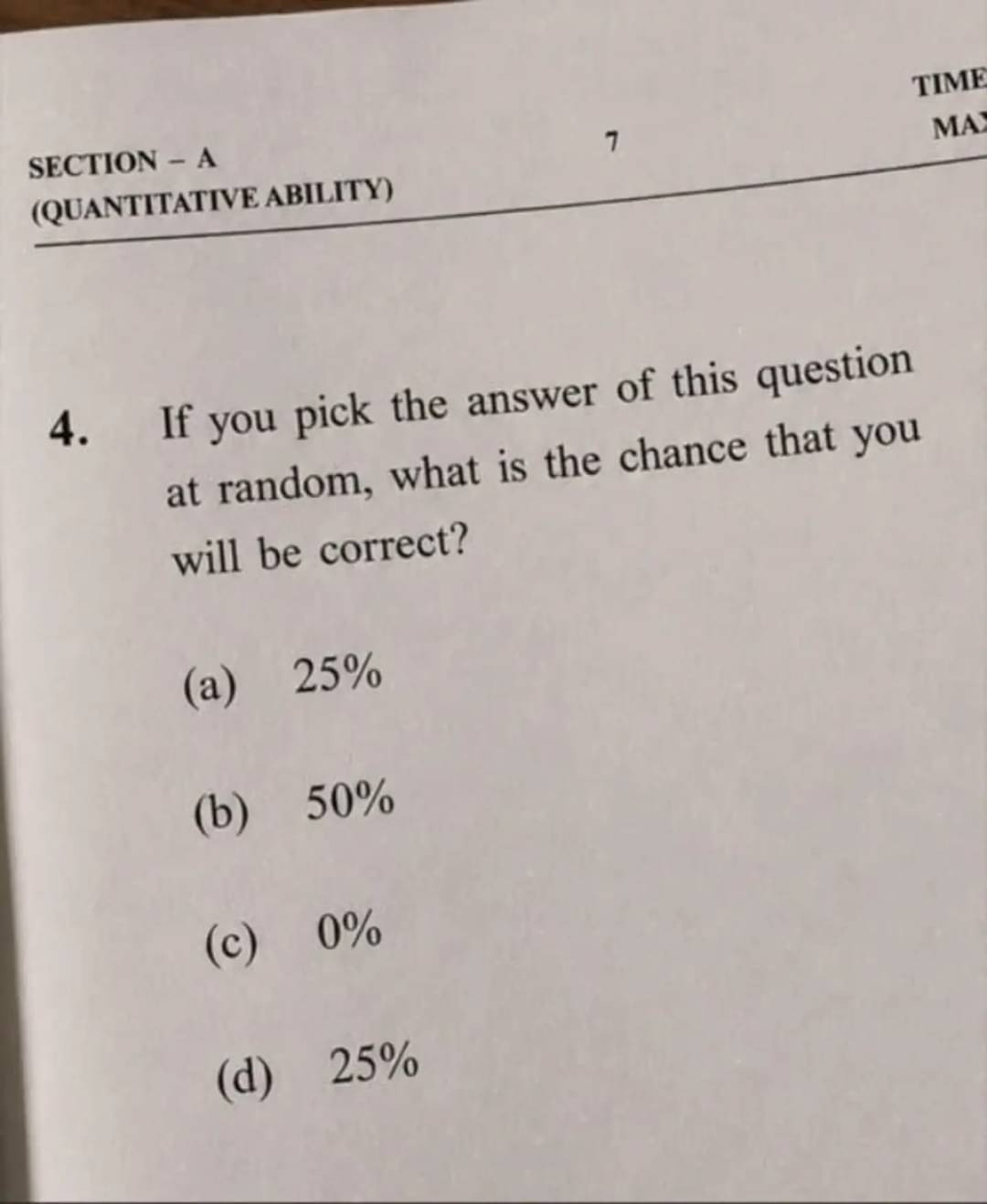
Couldn't you argue that 0% is correct?
It's a paradox, no of the answers can be correct, so the chance that you pick the correct one is 0%.
Sure, by picking it, it makes it wrong, but you don't care about that.
If you ran a infite monte carlo test on it, you'd end up with 0% correct answers.
Nah it's a paradox. There's no such thing as just a freestanding Monte Carlo test that you can just "run" - you do actually need to define enough parameters to make it tell you anything.
This kind of self-referential stuff feels like a proof of Gödel's incompleteness theorems with extra steps.
The trick is that there is no paradox, only the implication of one. 'If' being the key word - you're not actually being asked to answer randomly, but you are being subtly trolled.
You do not need to pick at all for the paradox to exist. If either A or D is correct, the other is also correct, and the random odds of selecting the correct answer should have been 50%. This is a contradiction. Neither A nor D can be the correct answer.
If B is correct, the random odds of selecting it is only 25% - a contradiction, so B cannot be correct. Likewise, if C is correct, there is a 25% chance of randomly picking C. C is also not correct.
None of the four answers is correct, so there is a 0% chance of randomly picking the correct answer. C is correct, contradiction, C is not correct, C is correct, is not, is too, etc.
The paradox is resolved by knowing the the scantron answer key has A selected. D is not sufficiently identical to A in javascript, so only the students that randomly guessed the correct answer will get credit.
Because the paradox can only be resolved with either A or D as the selected answer, well informed students picking randomly would have a 50% success rate.
But why is C a contradiction? I'm not randomly picking it.
Because your c is their c. If you were right then those randomly choosing test takers are also right.
Why is their C my C? They're randomly choosing, I'm picking the right answer which is 0%.
Because it's the same question and same options! Choosing 0% implies those who randomly selected it were right!
If you ignore self-referential nature of the question and stop the iteration at some point, sure, you can argue that any answer is correct.
That would mean your Monte Carlo test is set up incorrectly because at least 1/4 of the results of the test would be the "correct" answer as per your own argument, thus invalidating it.