cross-posted from: https://jlai.lu/post/9070854
A laid back community for good news, pictures and general discussions among people living in Europe.
Topics that should not be discussed here:
Other casual communities:
Language communities
Cities
Countries
cross-posted from: https://jlai.lu/post/9070854
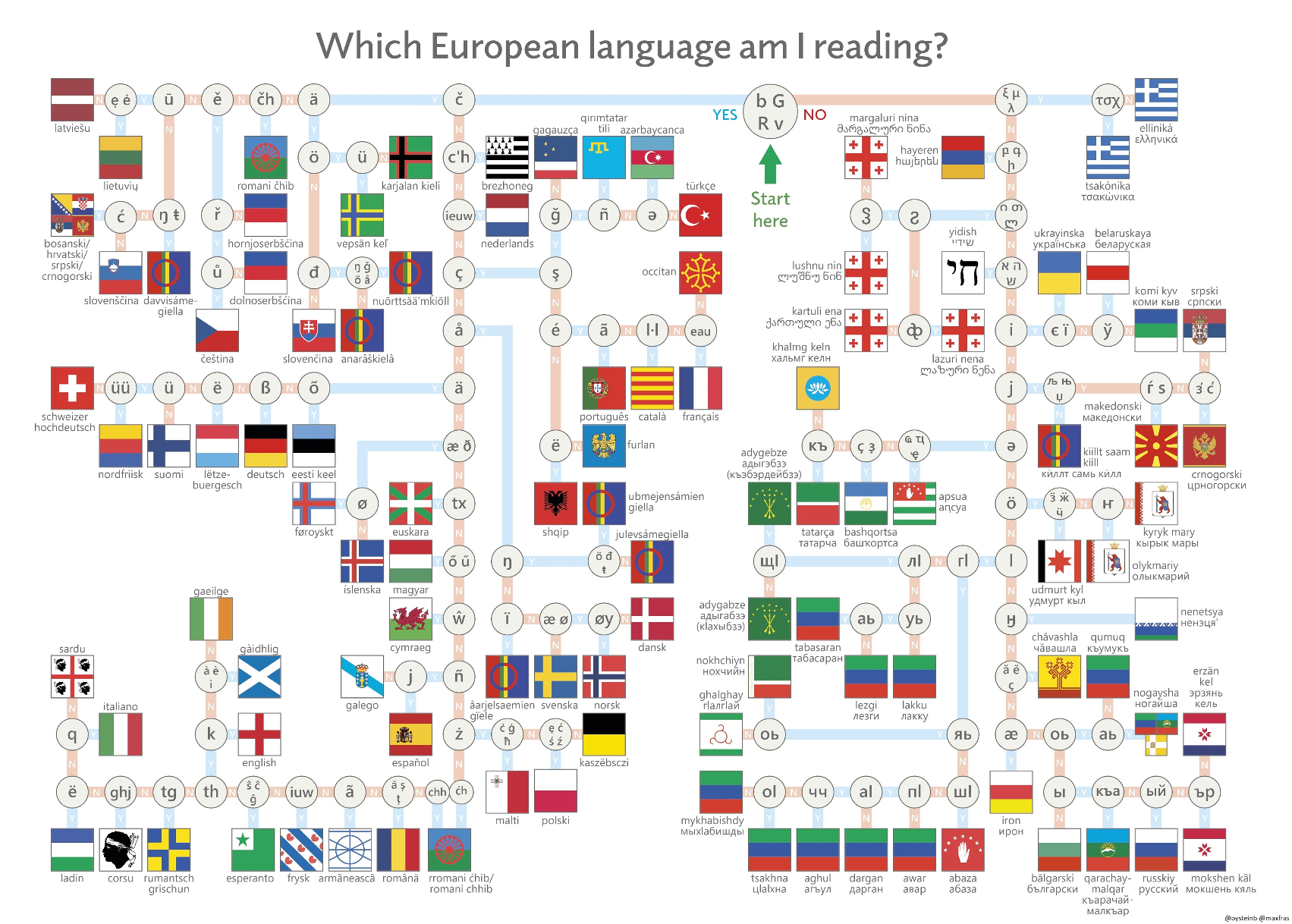
Geoguessr players: Look what they need to mimic a fraction of our power
as a geoguessr player this is actually very helpful and i sent it to our group chat
The source is the geoguessr subreddit
I dunno it's all Greek to me mate
This is awesome! Never occurred to me that you can tell languages (whose writing systems are similar to each other) apart just by analyzing its graphemes while ignoring grammar entirely
If you say "yes" to everything, you end up with Vepsian. If you say "no" to everything, you end up with Bulgarian.
That's only because of the order they're in though. I wonder which ones is the most yes and most no without order.
Ah yes, of course, I am familiar with the endonyms of all these uncommon languages and their (not always unique) associated flags.
That's like half the fun, trying to figure out what the languages might be, based on the other languages near them and just guessing what those letters might be in English or whatever other languages you know.
But yes, it absolutely is difficult, especially with many regions being demarked, which I've probably never heard of.
Nice touch including esperanto.
I tried learning Esperanto through Duolingo, but was a bit disappointed. It was still a bit inconsistent here and there; I was hoping for a 'perfect' language without exceptions.
Still think it's a great initiative though.
Yes, it's not flawless. My personal pet peeve is that there's no clear way to know if a verb is transitive or intransitive. Despite the shortcomings, it's a fun and rewarding language to learn.
I don't know who they are but I like Frysk's flag.
Frisia! It's a province of the Netherlands and I think their language is the closest one to English
Closest to Anglic languages (English, Scots & I think some creoles?) in terms of ancestry - I think Danish is actually the closest to English due to the influence of old norse on English though? Or it could just be coincidence in how they evolved?, and part of the Anglo-Frisian family which means it's pretty closely related
If you like the West Frisian flag wait until you see North Frisia's coat of arms. That's a pot of (red?) grit there, and the motto is "Better dead than slave". Just don't try to conquer them and they're perfectly pleasant to be around with and share a state with, rather cooking grit than looking for trouble. (Not identical to the coat of the district of Nordfriesland, that's quite a bit more territory than North Frisia proper).
The heart shaped figures you are seeing, actually depict leaves of waterlilies.
gonna coin the English word "milieuwise" - as in "to move towards, or be appropriate for, the current environment" and fuck this chart up.
edit: no need, found the error - on the bottom line you get to English by saying no to "chh" but it appears in hitchhiking, beachhead, witchhood, and, humorously, touchholes.
I feel like 'chh' would only count when pronounced as part of one syllable/sound. Which in all your examples isn't the case. Of course, if someone is not at all familiar with the language they wouldn't be able to make that distinction. So the chart still wouldn't be helpful in that case.
Maybe if Low Saxon could finally agree on an orthography we could be in that chart. It's currently split between "Use Dutch orthography", which doesn't work, "use German orthography", which doesn't work, and I guess "use English orthography", which also doesn't work. Technically there should also be a Cyrillic version and who knows with as big as the Diaspora is there's probably a Portuguese version in Brazil.
I enjoy how there's a language called "iron".
Its a solid language, but im a bit rusty with it.
Sorry, im leaving.
what does "b G R v" mean
"Am I seeing those in what I reading".
Why is “ø y” a no for Denmark, but a yes for Norway? I’m pretty sure both countries have the same alphabet?
it's not "ø", "y", it's "øy" in combination (as a digraph?)
same as "th" further down not implying the N languages don't have "t" or "h", just that they don't have "th"
Aha thanks for the explanation.
The "øy" is written without a space between the letters, which seems to mean that these letters occur together in words (more obvious example: "eau" leads into French).
The problem is that we can put words together to form new words. So say I produced a yogurt at a lake(sø) , I could call it søyougurt. It's not a word that would be in a dictionary though, but lots of that kind of words aren't.
French is a strange one here - they have "w" (double vé in the alphabet) but it's used almost exclusively in loan words. So I'm not certain it's determinative the way it's presented here.
I think that choice is more about "ieuw" as a whole, like "nieuw" in Dutch, not the separate 4 letters (like b G R v at the beginning)
I don't get your comment. The "w" isn't used in this graph as a single character.
The Dutch exclusion makes sense to me. I was reading it as separate letters which made the use of "e" a second time redundant.
I kinda broke it with å
Czech here, was a bit surprised to see Ř in another language, because I was lead to belive it was unique to my language. Turns out the pronunciation is, but the letter it self does show up elsewhere.
https://en.m.wikipedia.org/wiki/%C5%98
However what I find is that Ř is in Upper Sorbian, not Lower like the graph in the post implies. And Ů doesn't seem to be in either.
A surprising amount of speakers of Spanish have an ř sound, usually in place of the normal trill. Specifically, it's present in New Mexican Spanish (spoken in New Mexico & Colorado), Amazonic Spanish/"Jungle Spanish" and influenced dialects (spoken in Ecuador, Peru, parts of eastern Bolivia, Paruguay, northern Chile, northern Argentinia, the Colombian highlands, and I think south Venezuela), Guatemala, and Costa Rica.
Specifically, the sound is called a voiced alveolar fricative trill. The IPA symbol is [r̝].
It's said to be due to imported influence from northern Spain (Basque Country, Navarra, La Rioja), where the same sound is also present, and varyingly from the influence of various local Native American languages, some of which in the areas have/had the sound.
In some of those dialects, a pronunciation like [ʐ] may be used instead, which I think is similar to what's spelled ż/rz in Polish. The pronunciation can weaken further into [ɹ̝], which might be hard to distinguish from the r sound of some English speakers, or even more to [ɹ] which is similar to the r sound in some English speech.
As a german, I feel the right side is much more alien to me than the left side (split at "Start here").
Is that circumstancial, or does it reflect some linguistic truth? Like, are the languages on the left one family, and the ones on the right another family, or however linguistic taxonomy would call that?
Maybe it's just that the left side includes all the germanic languages, so that feels more familiar. There are also languages on the left side where I have no clue what or where that might be. But much more so on the right side.
Like yeah, the first split is about having a number of common letters from the Latin alphabet, so the right side is everything else: Cyrillic, Hebrew, …
Swiss German doesn't have orthography and üü can absolutely appear.
Edit: They meant Schriftsprache/Schriftdeutsch, which is almost German but without the ß.
AfaIk, Schweizer Hochdeutsch is not Schwizerdütsch, but a variety of standard German, with the replacement ß->ss.
