this post was submitted on 08 Jul 2026
554 points (100.0% liked)

Science Memes

20668 readers
3070 users here now

Welcome to c/science_memes @ Mander.xyz!

A place for majestic STEMLORD peacocking, as well as memes about the realities of working in a lab.



Meta Post Tags


Rules

  1. Don't throw mud. Behave like an intellectual and remember the human.
  2. Keep it rooted (on topic).
  3. No spam.
  4. Infographics welcome, get schooled.


If you are here asking: "Is this a science meme?"

Probably, yes. We use the Dawkins definition of meme: a replicating idea, not just an image macro with a fact on it. A good post here doesn't need to teach you something. It needs to make you ask something: who, what, where, when, and especially why or how.

Science isn't a filing cabinet of facts, it's a conversation. For example, a photo of an eel or other localized wildlife counts because most people never see one, and wonder is the first step of inquiry. A car meme counts if it makes you curious about what's under the bonnet. If you want to talk about something you noticed in the world, chances are someone else wants to talk about it too.

We moderate for vibe, not category. Pruning is light, especially where a post creates interesting discussion. Experimenting is encouraged.

See the pinned paper on Shitposting as Public Pedagogy if you want the academic case for why this works.


Research Committee

Other Mander Communities

Science and Research

Biology and Life Sciences

Physical Sciences

Humanities and Social Sciences

Practical and Applied Sciences

Memes

Miscellaneous

founded 3 years ago
MODERATORS
you are viewing a single comment's thread
view the rest of the comments
[–] Jakylla@jlai.lu 14 points 1 day ago (5 children)

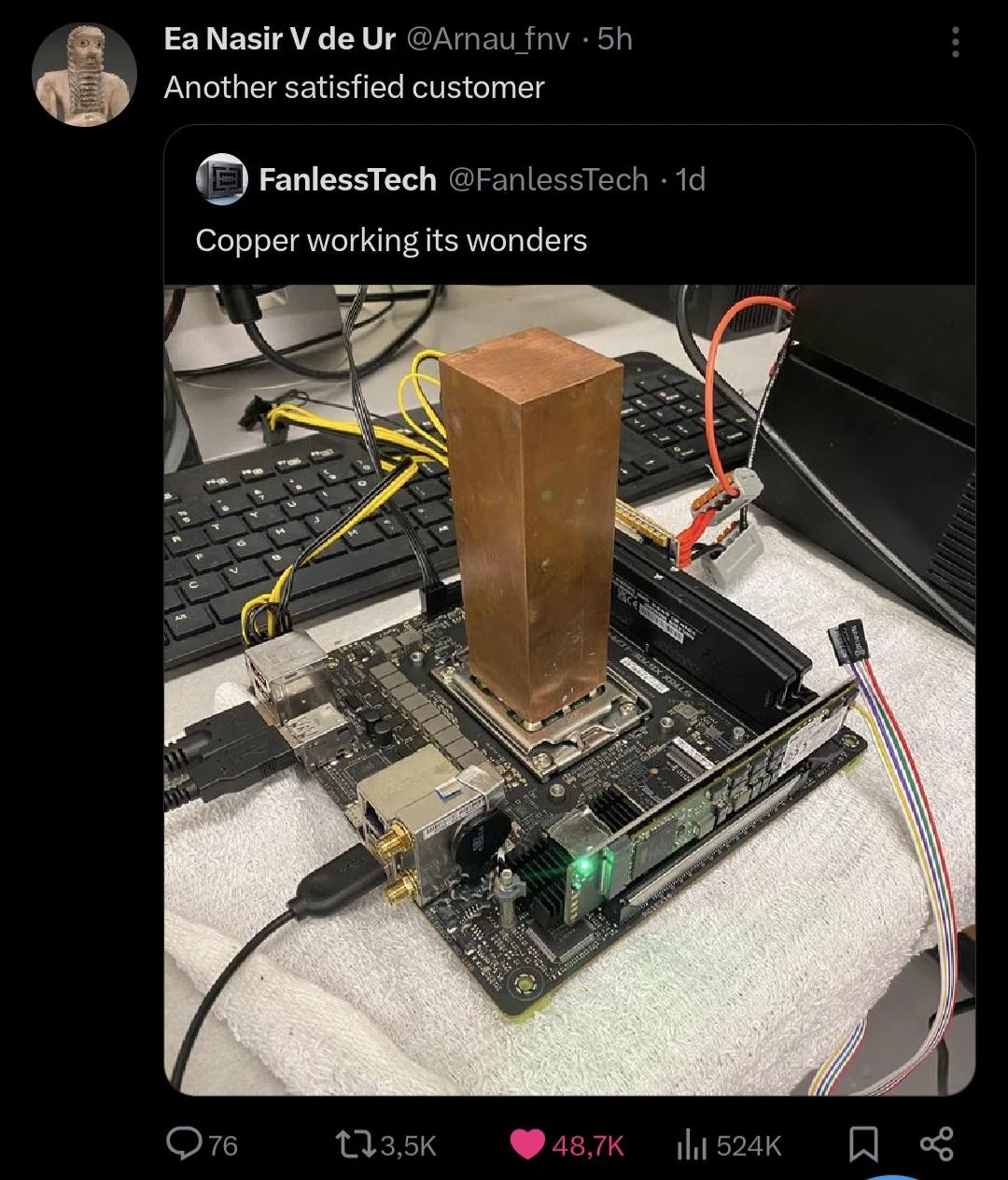
A block of diamond would be even better (copper being at 401 W/mK, Diamond at 3320 W/(mK), almost 10x better)

[–] rockSlayer@lemmy.blahaj.zone 39 points 1 day ago* (last edited 1 day ago) (2 children)

But only 3-5 diamonds are generated per chunk, requires an iron pickaxe, and usually doesn't start appearing regularly until Y level 14.

Meanwhile copper can have up to 16 veins of copper per chunk, requires a stone pickaxe, and appears most frequently at Y=48.

Copper is clearly more accessible for making ore blocks.

Wait a sec, this isn't !minecraft@lemmy.world

[–] kernelle@lemmy.dbzer0.com 10 points 1 day ago

Back to the mines with you, you're yearning

[–] Truscape@lemmy.blahaj.zone 6 points 1 day ago

This is after 1.18, Diamonds are most commonly found at Y=-54 now.

[–] Zachariah@lemmy.world 8 points 1 day ago

with the way prices are going, carbon based heat dissipation may become the preferred option

how pretty would it be if it was a tree-like crystal structure

[–] mnemonicmonkeys@sh.itjust.works 1 points 20 hours ago

It has higher conduction but it's specific heat capacity is worse, at least per mol

[–] SCmSTR@lemmy.blahaj.zone 2 points 1 day ago (3 children)
[–] Dpek@lemmy.zip 2 points 1 day ago (1 children)

Gonna assume kelvin

Think C but what if zero was actualy zero

[–] SCmSTR@lemmy.blahaj.zone 5 points 22 hours ago* (last edited 22 hours ago)

Watts per milliKelvin? I wouldn't think that would be a form of thermal capacity OR thermal dissipation, which is why I asked

Edit:

Looked it up...

Apparently it's "watt per meter-kelvin", a/(the?) measurement of thermal conductivity.

Per Wikipedia ( https://en.wikipedia.org/wiki/Thermal_conductivity_and_resistivity ):

The thermal conductivity of a material is a measure of its ability to conduct heat. It is commonly denoted by k {\displaystyle k}, λ {\displaystyle \lambda }, or κ {\displaystyle \kappa } and, in SI units, is measured in W·m−1·K−1. It quantifies the proportionality between the heat flux (heat flow rate per unit area, W·m−2) and the temperature gradient (K·m−1) in the direction of heat transport.[1] The reciprocal of thermal conductivity is called thermal resistivity.

Materials with high thermal conductivity transfer heat more efficiently than those with low thermal conductivity. Heat transport can arise from different microscopic mechanisms: In metals, thermal conductivity is typically dominated by free electrons, whereas in dielectric materials such as diamond it is largely due to lattice vibrations. Materials with high thermal conductivity are used in heat sink applications, while materials with low thermal conductivity, such as mineral wool or Styrofoam, are used for thermal insulation.

[–] LunarLoony@lemmy.sdf.org 1 points 22 hours ago

Kooling, obviously

[–] BreadOven@lemmy.world 1 points 23 hours ago

Silver would be more feasible though. It's next best after diamond.