this post was submitted on 14 Oct 2024
757 points (96.9% liked)
Science Memes
20656 readers
1941 users here now
Welcome to c/science_memes @ Mander.xyz!
A place for majestic STEMLORD peacocking, as well as memes about the realities of working in a lab.
Meta Post Tags
Rules
- Don't throw mud. Behave like an intellectual and remember the human.
- Keep it rooted (on topic).
- No spam.
- Infographics welcome, get schooled.
If you are here asking: "Is this a science meme?"
Probably, yes. We use the Dawkins definition of meme: a replicating idea, not just an image macro with a fact on it. A good post here doesn't need to teach you something. It needs to make you ask something: who, what, where, when, and especially why or how.
Science isn't a filing cabinet of facts, it's a conversation. For example, a photo of an eel or other localized wildlife counts because most people never see one, and wonder is the first step of inquiry. A car meme counts if it makes you curious about what's under the bonnet. If you want to talk about something you noticed in the world, chances are someone else wants to talk about it too.
We moderate for vibe, not category. Pruning is light, especially where a post creates interesting discussion. Experimenting is encouraged.
See the pinned paper on Shitposting as Public Pedagogy if you want the academic case for why this works.
Research Committee
Other Mander Communities
Science and Research
Biology and Life Sciences
- !abiogenesis@mander.xyz
- !animal-behavior@mander.xyz
- !anthropology@mander.xyz
- !arachnology@mander.xyz
- !balconygardening@slrpnk.net
- !biodiversity@mander.xyz
- !biology@mander.xyz
- !biophysics@mander.xyz
- !botany@mander.xyz
- !ecology@mander.xyz
- !entomology@mander.xyz
- !fermentation@mander.xyz
- !herpetology@mander.xyz
- !houseplants@mander.xyz
- !medicine@mander.xyz
- !microscopy@mander.xyz
- !mycology@mander.xyz
- !nudibranchs@mander.xyz
- !nutrition@mander.xyz
- !palaeoecology@mander.xyz
- !palaeontology@mander.xyz
- !photosynthesis@mander.xyz
- !plantid@mander.xyz
- !plants@mander.xyz
- !reptiles and amphibians@mander.xyz
Physical Sciences
- !astronomy@mander.xyz
- !chemistry@mander.xyz
- !earthscience@mander.xyz
- !geography@mander.xyz
- !geospatial@mander.xyz
- !nuclear@mander.xyz
- !physics@mander.xyz
- !quantum-computing@mander.xyz
- !spectroscopy@mander.xyz
Humanities and Social Sciences
Practical and Applied Sciences
- !exercise-and sports-science@mander.xyz
- !gardening@mander.xyz
- !self sufficiency@mander.xyz
- !soilscience@slrpnk.net
- !terrariums@mander.xyz
- !timelapse@mander.xyz
Memes
Miscellaneous
founded 3 years ago
MODERATORS
you are viewing a single comment's thread
view the rest of the comments
view the rest of the comments
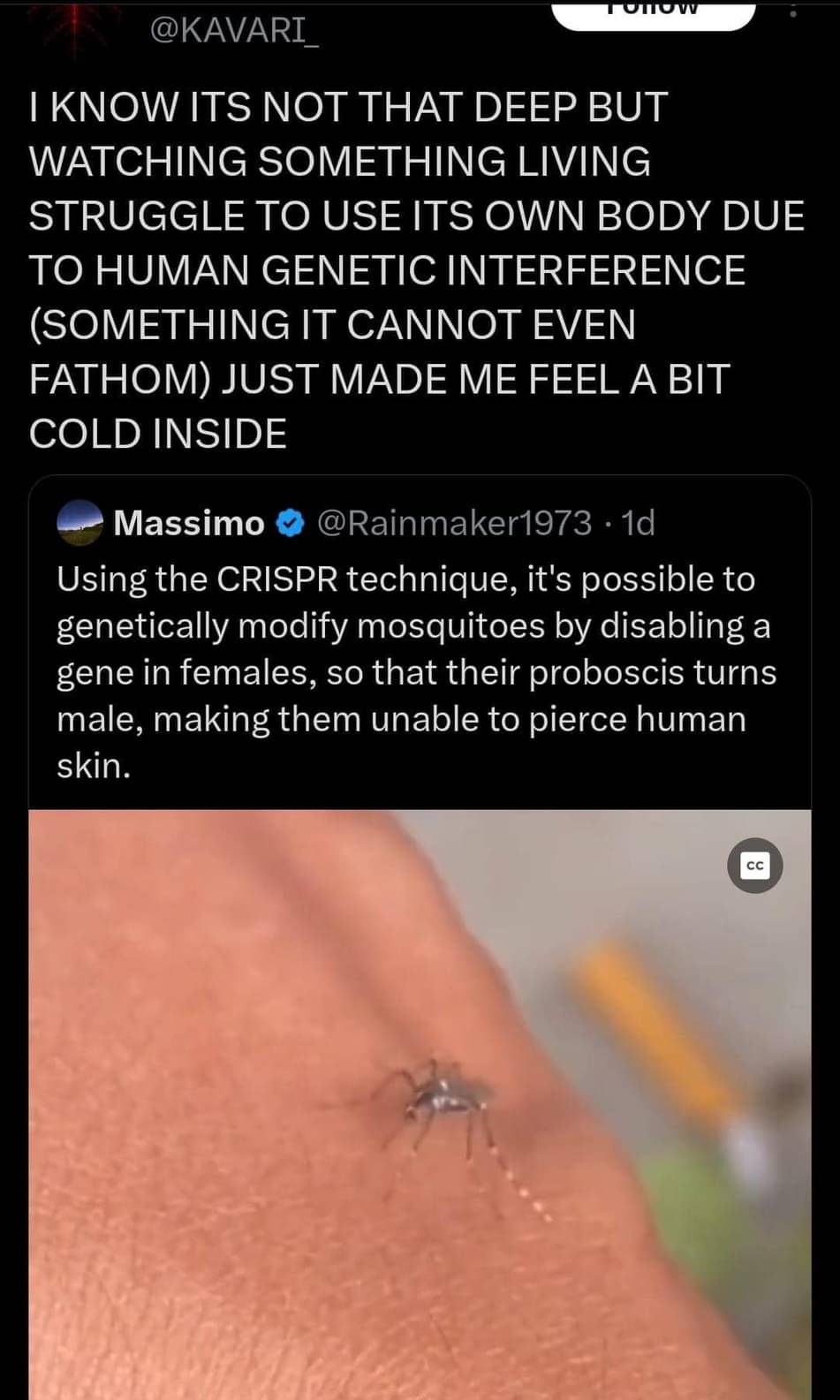
I think it's a genius solution to the explicit problem, but a terrible solution in a larger scope. There are many animals that feed on mosquitos, and they would suffer from massive decreases in mosquito population. This includes birds, frogs, bats, fish, and other insects (many aquatic animals eat mosquito larvae). I would hate to see a cascading reduction in animal populations as a result of these tactics.
I get the concern, and it's a good concern to have when you're talking about what would be such a huge shift in so many ecosystems...
...buuuuuut...
I have to believe this change would happen slowly... mosquitoes wouldn't just go extinct over a holiday weekend. It'd take years, if not decades, of dedication to the eradication strategy and even then, certain populations may prove immune to the best efforts of science.
That being said, even if it did execute as planned, I feel like the gradual decline of the mosquito would coincide with a gradual increase in other invertebrate species that would fill that niche. So as mosquito populations slowly declined in a local pond or creek, you'd see things like say chironomids (midges) thriving with the reduced competition for habitat, and the fish that ate mosquito larvae replacing that part of their diet with more midges.
Not saying there couldn't be other complications, but I don't think we'd see results fast enough that we'd end up with a broken link of the food chain leading to ecosystem collapse.
The Aedes Aegypt can go fuck itself with all the diseases it spreads to us. Also, anywhere where it showed up as an unwanted guest, like all Americas, nature will just roll back 3 centuries or so.