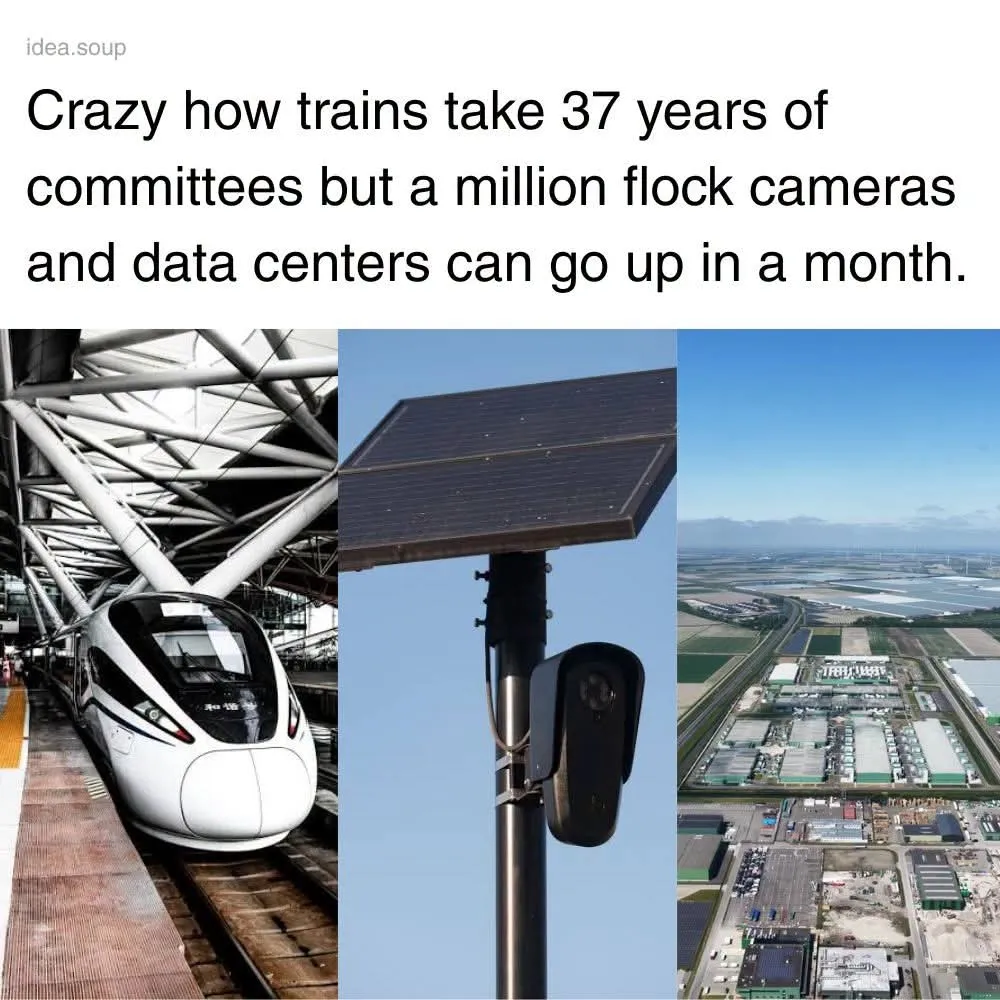
Trains benefit people, those other things benefit billionaires.
For when you need a laugh!
The definition of a "meme" here is intentionally pretty loose. Images, screenshots, and the like are welcome!
But, keep it lighthearted and/or within our server's ideals.
Posts and comments that are hateful, trolling, inciting, and/or overly negative will be removed at the moderators' discretion.
Please follow all slrpnk.net rules and community guidelines
Have fun!
Trains benefit people, those other things benefit billionaires.
And billionaires only care about one thing.
Control.
The future of humanity!
Where humanity is defined as billionaires, everybody else are just NPC.
*nods in understanding
High resolution images of everyone's buttholes
And it's disgusting
While this is true, trains are hard because of all the different people and companies need to give up their land to do it. Billionaires can just buy a chunk of land and then pay off local reps to look the other way and shoehorn the permits.
Trains would require imminent domain at a high rate. People generally dont like the government taking their land.
California high speed rail was something my parents voted on when I was a child.
I had this friend who was a year under me in school. Her kid voted for it too.
It still doesn't exist. California can't build something as modern and cutting edge as a train.
Real trains are cutting edge though. But yeah the usa just cannot.
We can't manage a steam engine.
no you were really good at those! it's just that you should probably have continued after that.
Indeed, the PRR S1, and the UP BigBoy are purely American, and the first is the fastest steam engine ever, and the second is probably the engine that can handle the heaviest loads with the steepest grades, without a chain. Though there are some honorable mention locos in Madison, IN that have the world record for steepest grade without a chain, but those guys can't haul what BigBoy can. BigBoy can't make that particular grade, not because it is too steep, but because the rails are too narrow and curvy. Deisels can't compete for load weights, neither can electric engines. Un/fortunately both diesel and electric beat the crap out of steam on maintenance costs and downtime.
Fucking shame about Roger Rabbit.
This guy trains
If California became it's own country and stopped funding the red States it could find the funding to build anything really
I think the amount of funding is kind of irrelevant. Our government has lost (or perhaps given away) the ability to actually build anything without an infinite array of subcontractors all trying to fleece the taxpayer for as much money as possible. If the budget was higher, the expenses would simply grow proportionally to absorb it.
There's a lot of good comments here, but folks are overlooking a major structural issue in the USA that IMO is largely at the root of why rail development has become so complicated - and that's the fact that local jurisdictions are very powerful compared to many other countries. Every city and county along a route (or even potential route) gets a seat at the table, and will work to represent their constituents and economic interests. This means there's a ton of voices advocating for completing priorities - they want rail to go through their city or county, but only if the HSR gets a stop at their preferred locations. If the jurisdiction doesn't get what they want, they'll often work to grenade the entire project.
China, by comparison and for example, has an authoritarian central government that can just dictate a route, displace individuals or communities in the way, and tell anyone upset to pound sand.
Not trying to say that authoritarianism is the answer. We're well on our way to that, and it's sure not helping things. It's just a structural difference in the USA that makes makes such projects far more complicated, expensive, and inefficient.
If you want to build a train in empty space I'm sure you could get that approved pretty quickly. Of course, it'd be useless. The biggest problem with trains is getting land for it since they are most useful where there's a lot of people.
I hate these data centers and flock cameras as much as the next guy, but they aren't really comparable. Flock cameras don't even take up much space and they are put up on land the government already has. It's like asking why it's so easy to put stop lights.
Sorry, I'm Mr Buzzkill.
The USA has no problem bulldozing housing to build highways.
Yeah, but only because that land belonged to blacks and cut prospering communities in half to drown them in traffic hell. You wouldn't want a repeat of that.
Rip out the extra lanes of the damn roads and highways that induced demand, and we got all the space we need without destroying much in the way of existing buildings. A double track is only about as wide as one lane of our surface stroads.
One direction of high speed rail track would require at just under two freeway lanes worth of width (two directions need ~4 lanes).
And that’s before dealing with the additional freeway/rail safety separation, barriers, shoulders, drainage, etc.
While there are sections of highway that could support this amount of removal, if definitely not as easy as "swap road for track, done."
Not sure how true that is. New highways aren't that common and all the ones I know about took forever to actually get built.
None of this is written in stone. Critical infrastructure should always be prioritized. We see how China did it. In the end it’s all about political will.
We all know that China prioritizes critical infrastructure like flocks of cameras and the associated data centres to closely monitor its population. Hence they are built quickly, whereas trains take way longer then a month to be set up.
If you'll allow me to nerd out a little. I love trains as much as the next guy. I also love arriving at the next station alive. Every single time. And i also want my grandchild to arrive at the station Alive. Every single time.
But by the time we start to actually lay down the tracks, a whole lot of work has already been done. Ground has to be sampled along the way. The ground has to be prepared, large boulders has to be cut/blown apart. Engineers and geologist must have had time to calculate that the ground will hold, perhaps certain areas needs to be reinforced more than others The ground has to be owned by an entity that can authorise the use of it.
Signal cables has to be drawn. There has to be space for trains to pass eachother. And then there are probably solutions to things we didn't even know was a problem.
What's my point? Of course trains take a lot longer than setting up a bunch of cameras on poles... I'd be more concerned if it was the opposite. And yes, I'm hillarious at parties.
FWIW, while you're not incorrect about the build process part, this person specifically mentions the politics and paper process required just to get approval to start conducting land surveys and the like, so his point is valid too. Also fun at parties, cheers!
No it’s really not.
Flock is a massive evil. But there’s zero planning required. They're completely self contained, solar powered cameras. You can put them anywhere. Thats their entire selling point.
You do not need any new infrastructure whatsoever.
Got a stopsign? Strap a flock to it.
Street light? Flock camera.
Tree? Flock camera.
There are no land surveys to do. No finding a site. No dealing with property ownership issues. No construction. Nothing at all other than telling Flock “yeah sure strap a camera to this existing pole”.
A flock camera requires about as much planning as slapping a sticker onto a street sign. They’re not even remotely comparable to fucking trains lol.
All of that is correct however I am also currently watching my government fail to be able to construct a train station along an existing track. So far the process has been going on for about six years and no one has so much has dug a hole yet. It's barely even a construction project, they just need to pour some concrete into a rectangle and then add some stairs and call it a station. But apparently even that requires six years worth of committees.
Meanwhile in Scotland, somewhere with similarish land and planning laws. We're electrifying the whole network, dualing large sections that were single track, removing peak fares, upgrading the rolling stock, and opening brand new stations.
Having a decent rail service is entirely a political choice. Whether those in power want to make it happen or not.
All about setting priorities. One could start a war instead, leading to closing and reopening the Straight of Hormuz, a fuckton of civilian and material casualties and having nothing achieved. What's more "fun"??? Boys be boys, aye?
Everyone is talking about obtaining land and eminent domain and whatnot. ..We have streets. 🤷
Flock cams don't even need a power connection because they run on solar+battery, and wireless data connection. You can put one practically everywhere without any preparation - even the post it sits on is pretty optional, could use cable binders to hang them on a tree.
Data centers often get built where land is cheap, and at least in the US there is a (horrifying and stupid) trend to design them to run off-grid with gas turbines, so you don't even need utilities there, just data connections that you can run underground.
Trains take up a lot of space, and if you want them to be useful, they need to be where the population density is high enough. That means high cost for land, often buying up big amounts of smaller lots where you have to work something out with a multitude of land owners who might not want to part with their - often prime location, because it's in the city - land. A single land owner not selling their land can grind a project like this to a halt, at least if there is hesitancy using eminent domain, which is a crowbar approach and leads to resistance to your project.
Don't get me wrong, i really think the USA would benefit greatly from modernizing and expanding their rail network! But realistically, refitting a train line into a city center where you preferably want the station to be is a hard task, doubly hard if you want to actually pass through the city because its not the head end of the line - it doubles the land acquisition woes. A possibility would be going underground, but underground construction is an expensive endeavor, and the US would probably need to get outside expertise from Switzerland or Austria where we construct tunnels through mountains and below cities on the regular to make it work.
The US famously bulldozes whole districts for their stupid highways, to build a whole highway junction inside cities (or whatever is left inbetween highway and parking lot).
Sure both train tracks and highways are harder than flock cameras or data centers, but the US certainly has no issue with building highways. All the issues are home-made. We have the same fucking issues here in Germany, it just so happened that more of our rail network (relative to size & population) survived the neolibertarian onslaught of the past ~60 years.
At the end of the day train networks primarily serve people, not capital.
Trains take up a lot of space, and if you want them to be useful, they need to be where the population density is high enough. That means high cost for land, often buying up big amounts of smaller lots where you have to work something out with a multitude of land owners who might not want to part with their - often prime location, because it's in the city - land. A single land owner not selling their land can grind a project like this to a halt, at least if there is hesitancy using eminent domain, which is a crowbar approach and leads to resistance to your project.
There's also interference risks. My city was building out their train network, and had to do extensive testing to make sure that the trains didn't disturb the university's experiments. An entire planned hospital was scrapped because it was too close to the tracks, and the trains would interfere with the hospital equipment.
A data centre or cameras wouldn't have the same risk, so wouldn't need to go through the same level of approval/testing.
You're noticing a bit too well citizen....
So what would happen if I went to Home Depot and rented one of their trucks, added full accident coverage, and then immediately crashed into and knocked over, one of the lamp posts with the flock cameras on it?
A dropship would come flying overhead and combine soldiers would drop down and arrest you, if you're lucky.
I am all for calling out privacy-invading cameras but comparing the putting up of small wireless cameras on already existing poles with prepping existing rails for high speed train connections, not to speak of actually buying the trains and maintaining them properly. The cameras have no risks of causing accidents either, aside from people accidentally cutting them down (as one does). So the comparison feels pretty silly to me.
Now compare it to something like building another 3 lanes on a highway, thats more appropriate.
Well of course. Billionaires are motivated to keep an eye on their livestock, but aren't motivated to make sure their livestock has a good quality of life. I mean how else can they hunt down a woman trying to have an abortion? That's their future worker after all....
There’s a really weird misconception about Amtrak and U.S. railroads.
Amtrak is not some ordinary private corporation. It is a federally chartered corporation, with the federal government as its controlling shareholder. Its board is largely made up of presidential appointees who require Senate confirmation. So, functionally, Amtrak is a government-controlled corporation that happens to operate as a for-profit company.
The stranger part is the infrastructure underneath it.
The vast majority of Amtrak’s route mileage runs on tracks owned by private freight railroads. Those freight railroads are enormously important to the U.S. economy, but the industry is also highly consolidated. A handful of Class I railroads control enormous regional networks, creating what is essentially a series of geographic monopolies/oligopolies. Amtrak itself says 97% of its route-miles operate over tracks owned by other railroads.
So you end up with this bizarre situation where the federal government owns and controls the country's principal intercity passenger railroad, but much of the physical railroad infrastructure it depends on is privately owned.
And expanding passenger rail isn't as simple as "just build more trains." You need track capacity, signaling, bridges, grade crossings, stations, dispatching capacity, maintenance facilities, etc. In many places, you're trying to add passenger service to infrastructure that is already being used by private freight companies. Amtrak frequently doesn't even control dispatching on the tracks it operates over.
That's why the U.S. rail situation is so strange. We have an enormous private freight-rail system that is absolutely critical to the economy, a federally controlled passenger railroad, and an infrastructure network that has been extraordinarily difficult and expensive to expand and modernize.
It's not simply "the government sucks at trains" or "private companies suck at trains." The institutional arrangement itself is bizarre. The U.S. essentially split passenger and freight rail into two different systems while leaving much of the underlying infrastructure in private hands.
And then everyone wonders why building modern passenger rail is so damn difficult.
We basically do need to eminent domain the rail network. That should be government owned like the highways.
In America, yeah. Shit country!
I mean... yeah. Trains have had a lot of articulate obstacles out in their place. And it goes without saying that Flock and AI datacenters can fuck right off
But trains also are much, much more complicated projects. A flock camera needs like 4 square get of space next to the road that's already in the ROW, and data centers are built a single piece of land.
Trains, and especially high-speed trains require securing of land and grade separation/fencing that makes their installation very difficult from an engineering and property-ownership stance.
Roads can just be routed between property lines as much as possible because cars can make pretty sharp turns. High-speed trains have to cut properties in half, build off grade, and put up a fence.
Imagine you're a farmer and they put a trail line android your property. Now to get between the house and the barn that was 100 yards away you have to travel 2 miles down the track to the nearest crossing, so you've made a 200 yards round to 8 miles. Yeah, you'll get paid"fair market value" for the 50-ft wide strip of land their treasure from you, but with half your land cut off from the rest the damages are much higher.
You don't want that, so you sue to stop it. And so do thousands of other property owners in the same situation. And the business owners of the roasts that will be bypassed, cut off, or simply used less. And the cities and counties who now have their existing transportation infrastructure fucked.
It's a huge impact, and even if it's a net good, there's severe collateral damage and those imitated will fight to stop it.
The time to secure rail rights was 150 years ago. And that's what they did and why that's where pretty much where all the rails are.
you're ignoring the spirit of the post.
when the wealthy want something done, it gets done.
nothing you're talking about is outside the power of government.... do you want someone's land? then you just take it. nobody is going to put up a fuss for longer than a few months.
and when they do put up a fight, you crush them or pay them off.
we don't have anything good because nobody in power is interested.