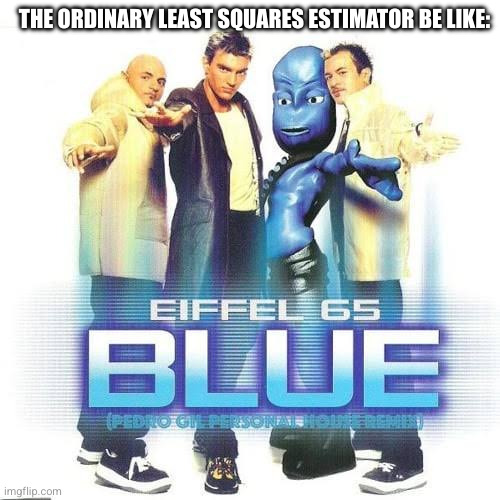
Yo, listen up, here's a story
About a little guy that lives in a BLUE world
And all day and all night and everything he sees is just Best Linear Unbiased Estimator
Da-ba-dee, da-ba-di, da-ba-dee, da-ba-di
A place for majestic STEMLORD peacocking, as well as memes about the realities of working in a lab.

Meta Post Tags
Rules
If you are here asking: "Is this a science meme?"
Probably, yes. We use the Dawkins definition of meme: a replicating idea, not just an image macro with a fact on it. A good post here doesn't need to teach you something. It needs to make you ask something: who, what, where, when, and especially why or how.
Science isn't a filing cabinet of facts, it's a conversation. For example, a photo of an eel or other localized wildlife counts because most people never see one, and wonder is the first step of inquiry. A car meme counts if it makes you curious about what's under the bonnet. If you want to talk about something you noticed in the world, chances are someone else wants to talk about it too.
We moderate for vibe, not category. Pruning is light, especially where a post creates interesting discussion. Experimenting is encouraged.
See the pinned paper on Shitposting as Public Pedagogy if you want the academic case for why this works.
Yo, listen up, here's a story
About a little guy that lives in a BLUE world
And all day and all night and everything he sees is just Best Linear Unbiased Estimator
Da-ba-dee, da-ba-di, da-ba-dee, da-ba-di
I don't get it, can you explain?
To the practicing statisticians out there: Is BLUE at all relevant in the field? Even if you can formulate your data/problem as a linear regression, wouldn't maximum likelihood estimation still be the preferred method in most scenarios? Edit: Of course Bayesian analysis is of equal relevance here!
OLS is well used in a lot of domains. If you have a continuous outcome you have a straightforward and very easy way to get a quick reliable estimate of some interesting parameter. The typical use in most social sciences is to implement some sort of difference-in-differences (or DiD event-study) estimate within a simple linear regression.