this post was submitted on 27 Jun 2024
818 points (95.2% liked)
Science Memes
20648 readers
1606 users here now
Welcome to c/science_memes @ Mander.xyz!
A place for majestic STEMLORD peacocking, as well as memes about the realities of working in a lab.

Meta Post Tags
Rules
- Don't throw mud. Behave like an intellectual and remember the human.
- Keep it rooted (on topic).
- No spam.
- Infographics welcome, get schooled.
If you are here asking: "Is this a science meme?"
Probably, yes. We use the Dawkins definition of meme: a replicating idea, not just an image macro with a fact on it. A good post here doesn't need to teach you something. It needs to make you ask something: who, what, where, when, and especially why or how.
Science isn't a filing cabinet of facts, it's a conversation. For example, a photo of an eel or other localized wildlife counts because most people never see one, and wonder is the first step of inquiry. A car meme counts if it makes you curious about what's under the bonnet. If you want to talk about something you noticed in the world, chances are someone else wants to talk about it too.
We moderate for vibe, not category. Pruning is light, especially where a post creates interesting discussion. Experimenting is encouraged.
See the pinned paper on Shitposting as Public Pedagogy if you want the academic case for why this works.
Research Committee
Other Mander Communities
Science and Research
Biology and Life Sciences
- !abiogenesis@mander.xyz
- !animal-behavior@mander.xyz
- !anthropology@mander.xyz
- !arachnology@mander.xyz
- !balconygardening@slrpnk.net
- !biodiversity@mander.xyz
- !biology@mander.xyz
- !biophysics@mander.xyz
- !botany@mander.xyz
- !ecology@mander.xyz
- !entomology@mander.xyz
- !fermentation@mander.xyz
- !herpetology@mander.xyz
- !houseplants@mander.xyz
- !medicine@mander.xyz
- !microscopy@mander.xyz
- !mycology@mander.xyz
- !nudibranchs@mander.xyz
- !nutrition@mander.xyz
- !palaeoecology@mander.xyz
- !palaeontology@mander.xyz
- !photosynthesis@mander.xyz
- !plantid@mander.xyz
- !plants@mander.xyz
- !reptiles and amphibians@mander.xyz
Physical Sciences
- !astronomy@mander.xyz
- !chemistry@mander.xyz
- !earthscience@mander.xyz
- !geography@mander.xyz
- !geospatial@mander.xyz
- !nuclear@mander.xyz
- !physics@mander.xyz
- !quantum-computing@mander.xyz
- !spectroscopy@mander.xyz
Humanities and Social Sciences
Practical and Applied Sciences
- !exercise-and sports-science@mander.xyz
- !gardening@mander.xyz
- !self sufficiency@mander.xyz
- !soilscience@slrpnk.net
- !terrariums@mander.xyz
- !timelapse@mander.xyz
Memes
Miscellaneous
founded 3 years ago
MODERATORS
you are viewing a single comment's thread
view the rest of the comments
view the rest of the comments
In base 10, if we add 1 and 1, we get the next digit, 2.
In base 2, if we add 1 and 1 there is no 2, thus we increment the next place by 1 getting 10.
We can expand this to numbers with more digits: 111(7) + 1 = 112 = 120 = 200 = 1000
In base 10, with A representing 10 in a single digit: 199 + 1 = 19A = 1A0 = 200
We could do this with larger carryover too: 999 + 111 = AAA = AB0 = B10 = 1110 Different orders are possible here: AAA = 10AA = 10B0 = 1110
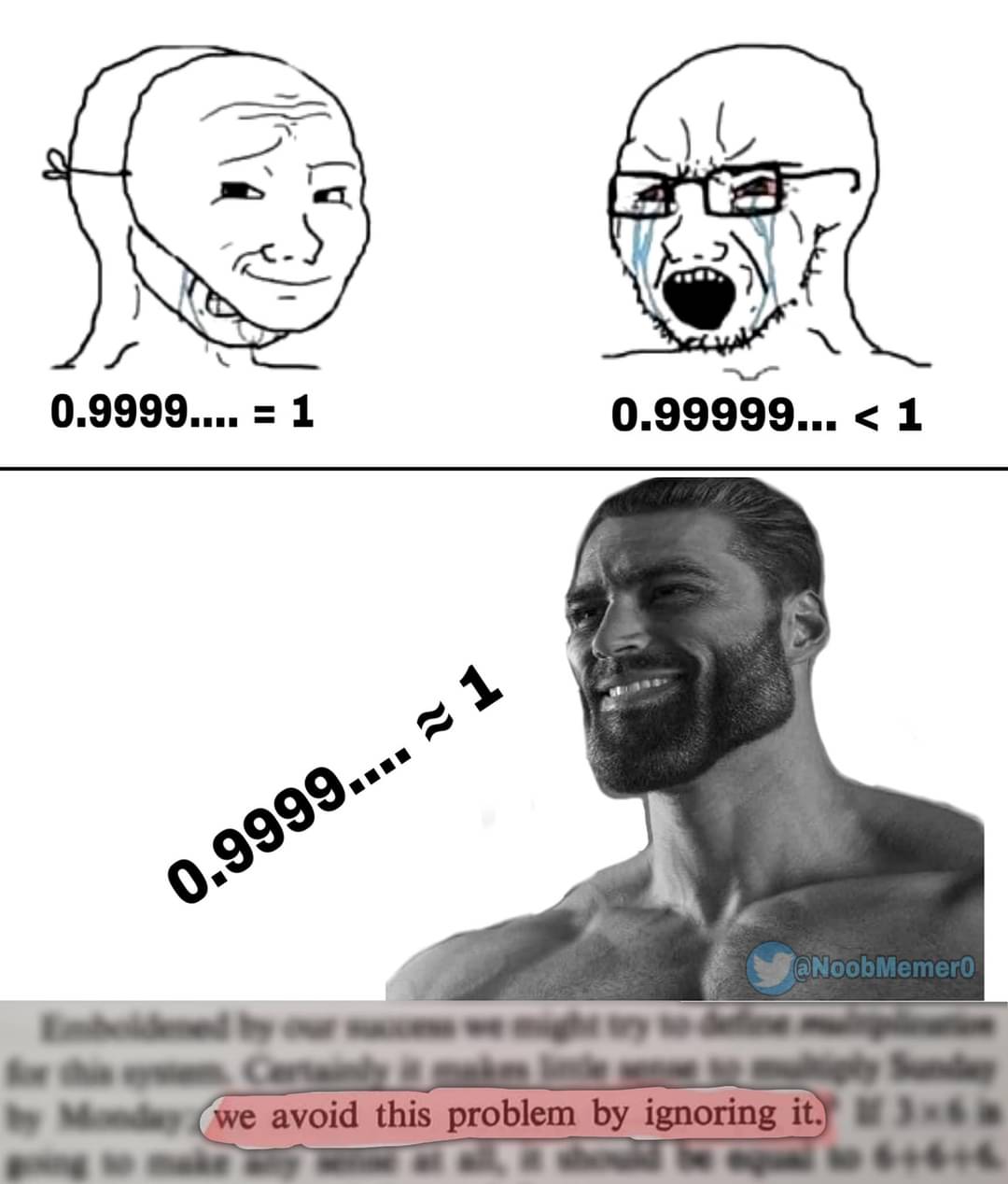
The "carry the 1" process only starts when a digit exceeds the existing digits. Thus 192 is not 2Z2, nor is 100 = A0. The whole point of carryover is to keep each digit within the 0-9 range. Furthermore, by only processing individual digits, we can't start carryover in the middle of a chain. 999 doesn't carry over to 100-1, and while 0.999 does equal 1 - 0.001, (1-0.001) isn't a decimal digit. Thus we can't know if any string of 9s will carry over until we find a digit that is already trying to be greater than 9.
This logic is how basic binary adders work, and some variation of this bitwise logic runs in evey mechanical computer ever made. It works great with integers. It's when we try to have infinite digits that this method falls apart, and then only in the case of infinite 9s. This is because a carry must start at the smallest digit, and a number with infinite decimals has no smallest digit.
Without changing this logic radically, you can't fix this flaw. Computers use workarounds to speed up arithmetic functions, like carry-lookahead and carry-save, but they still require the smallest digit to be computed before the result of the operation can be known.
If I remember, I'll give a formal proof when I have time so long as no one else has done so before me. Simply put, we're not dealing with floats and there's algorithms to add infinite decimals together from the ones place down using back-propagation. Disproving my statement is as simple as providing a pair of real numbers where doing this is impossible.
Are those algorithms taught to people in school?
Once again, I have no issue with the math. I just think the commonly taught system of decimal arithmetic is flawed at representing that math. This flaw is why people get hung up on 0.999... = 1.