this post was submitted on 22 Jan 2024
726 points (99.1% liked)
Science Memes
20668 readers
2402 users here now
Welcome to c/science_memes @ Mander.xyz!
A place for majestic STEMLORD peacocking, as well as memes about the realities of working in a lab.

Meta Post Tags
Rules
- Don't throw mud. Behave like an intellectual and remember the human.
- Keep it rooted (on topic).
- No spam.
- Infographics welcome, get schooled.
If you are here asking: "Is this a science meme?"
Probably, yes. We use the Dawkins definition of meme: a replicating idea, not just an image macro with a fact on it. A good post here doesn't need to teach you something. It needs to make you ask something: who, what, where, when, and especially why or how.
Science isn't a filing cabinet of facts, it's a conversation. For example, a photo of an eel or other localized wildlife counts because most people never see one, and wonder is the first step of inquiry. A car meme counts if it makes you curious about what's under the bonnet. If you want to talk about something you noticed in the world, chances are someone else wants to talk about it too.
We moderate for vibe, not category. Pruning is light, especially where a post creates interesting discussion. Experimenting is encouraged.
See the pinned paper on Shitposting as Public Pedagogy if you want the academic case for why this works.
Research Committee
Other Mander Communities
Science and Research
Biology and Life Sciences
- !abiogenesis@mander.xyz
- !animal-behavior@mander.xyz
- !anthropology@mander.xyz
- !arachnology@mander.xyz
- !balconygardening@slrpnk.net
- !biodiversity@mander.xyz
- !biology@mander.xyz
- !biophysics@mander.xyz
- !botany@mander.xyz
- !ecology@mander.xyz
- !entomology@mander.xyz
- !fermentation@mander.xyz
- !herpetology@mander.xyz
- !houseplants@mander.xyz
- !medicine@mander.xyz
- !microscopy@mander.xyz
- !mycology@mander.xyz
- !nudibranchs@mander.xyz
- !nutrition@mander.xyz
- !palaeoecology@mander.xyz
- !palaeontology@mander.xyz
- !photosynthesis@mander.xyz
- !plantid@mander.xyz
- !plants@mander.xyz
- !reptiles and amphibians@mander.xyz
Physical Sciences
- !astronomy@mander.xyz
- !chemistry@mander.xyz
- !earthscience@mander.xyz
- !geography@mander.xyz
- !geospatial@mander.xyz
- !nuclear@mander.xyz
- !physics@mander.xyz
- !quantum-computing@mander.xyz
- !spectroscopy@mander.xyz
Humanities and Social Sciences
Practical and Applied Sciences
- !exercise-and sports-science@mander.xyz
- !gardening@mander.xyz
- !self sufficiency@mander.xyz
- !soilscience@slrpnk.net
- !terrariums@mander.xyz
- !timelapse@mander.xyz
Memes
Miscellaneous
founded 3 years ago
MODERATORS
you are viewing a single comment's thread
view the rest of the comments
view the rest of the comments
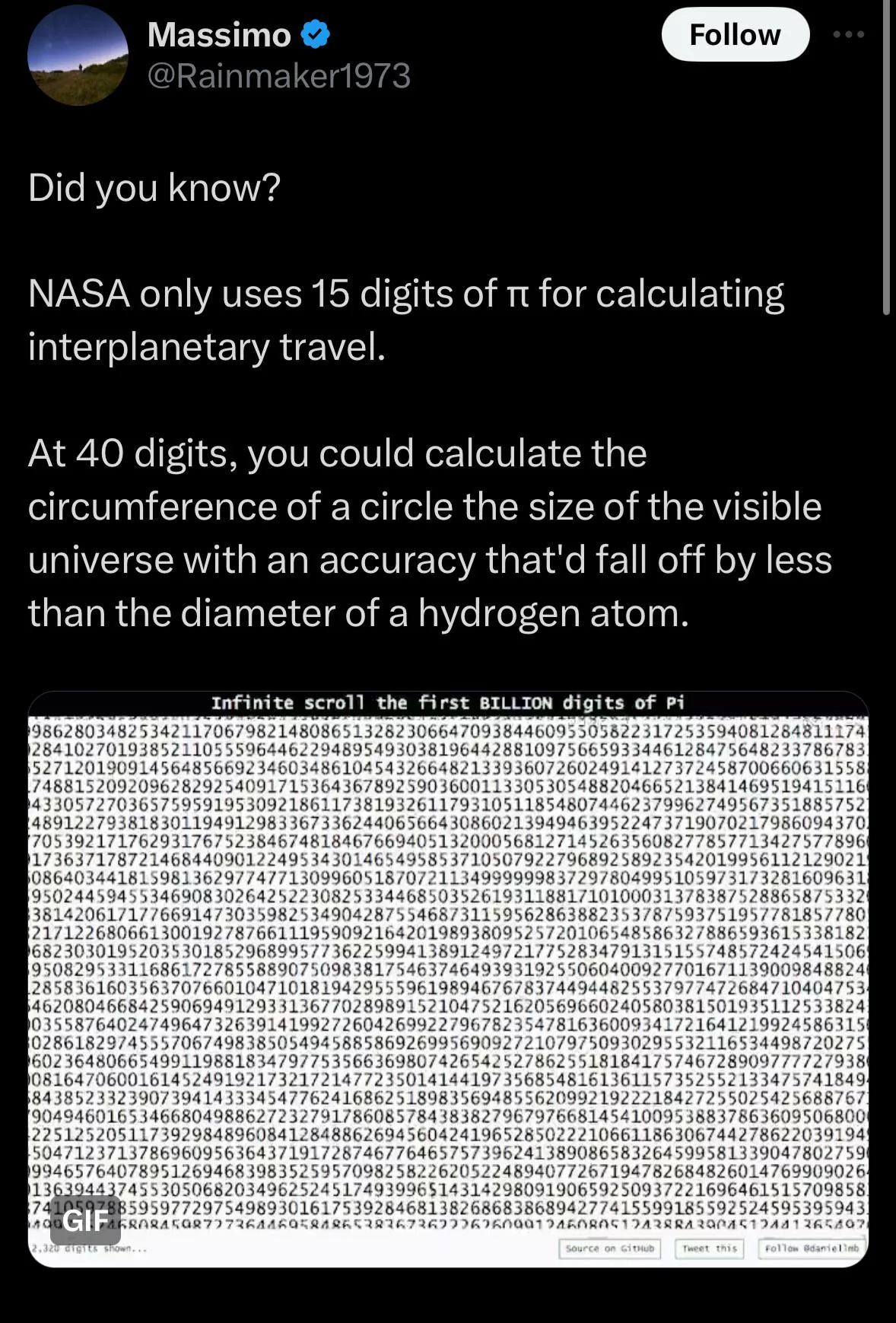
Turns out that's not possible because the complexity of computing pi becomes exponentially harder the more digits you add.
That is definitely not true. Pi has been computed to way more digits than would be feasible if it were exponential. Looks to me like it's O(n log(n)^3) with n=the number of digits, which sounds basically fine for any number of digits any human is going to have the patience to scroll down to.
There was a recent post asking what the self-taught among us feel we are missing from our knowledge base. For me, it's being able to calculate stuff like that for making decisions. I feel like I can spot an equivalence to the travelling salesman problem or to the halting problem a mile away, but anything more subtle is beyond me.
Of course, in this situation, I'd probably just see if I could find a sufficiently large precalculation and just pretend :)
Just put up a little spinning it’s-loading icon with an increasing delay. Then, when you run out of precalculated data, make it spin forever.
“It’s infinte scrolling man, you just didn’t wait long enough. It’s not my fault you can’t be more patient.”
Okay, maybe exponential is the wrong math term, but my point is, the complexity grows with number of digits. Infinite scrolling is therefore impossible because eventually it will become too slow to keep up with scrolling. You may be right that it may go farther than any human is willing to scroll, but that depends on the human and if they're on a potato phone.
As far as I know, the current fastest algorithm is the Bailey–Borwein–Plouffe formula,, which is
O(n log n)to calculate the nth digit (not even the whole number). Infinite scrolling is only possible if we can calculate the nth digit inO(1)time.Oh shit! Yeah, it looks like as of 2022 that article I linked to needs to be updated. It should say O(n log n), yes.
That said, scrolling ever-farther on a web page will always get slower the further down you go, and eventually fail, because of memory allocation. If you ignore some of the factors that make all truly-infinite pages impossible, and require an O(1) algorithm to generate numbers within the inherently-more-than-O(1) process of rendering the page in the first place, then sure, it’s impossible. My point is, the asymptotic complexity is low enough that you can make a page that does it and it’ll work in practice.