this post was submitted on 02 Aug 2026
839 points (97.1% liked)
Work Reform
17490 readers
1964 users here now
A place to discuss positive changes that can make work more equitable, and to vent about current practices. We are NOT against work; we just want the fruits of our labor to be recognized better.
Our Philosophies:
- All workers must be paid a living wage for their labor.
- Income inequality is the main cause of lower living standards.
- Workers must join together and fight back for what is rightfully theirs.
- We must not be divided and conquered. Workers gain the most when they focus on unifying issues.
Our Goals
- Higher wages for underpaid workers.
- Better worker representation, including but not limited to unions.
- Better and fewer working hours.
- Stimulating a massive wave of worker organizing in the United States and beyond.
- Organizing and supporting political causes and campaigns that put workers first.
founded 3 years ago
MODERATORS
you are viewing a single comment's thread
view the rest of the comments
view the rest of the comments
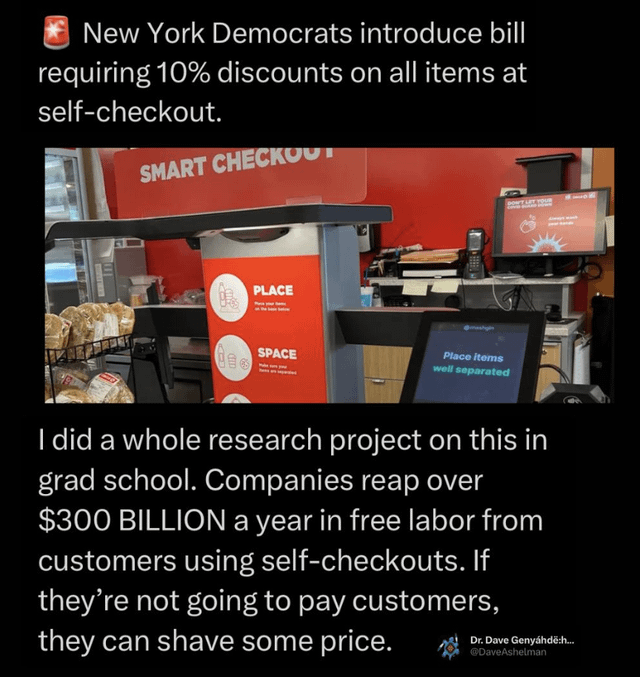
It seems like they will just mark everything up by 10% and then give that discount at self checkout. So they will pocket even more while harming those who don't use self checkout.
Or eliminating cashiers altogether.
It also doesn't really make sense to do it as a percentage. A cashier's wage is hourly, and the labor market has settled on a particular wage for cashiers in this area - say $15/hr.
If I have a $150 grocery bill, a 10% discount would be $15. For maybe 5 minutes of work. Working out to an hourly wage of $180/hr (60/5 = 12, 12 * 15 = 180).
So if they're saying "we should be compensating customers for being made to do labor", they'd be compensating them at roughly 12x the going rate for cashiers in this example, which doesn't really make sense.
Now if it's just meant to be punitive, OK. But then why not actually address the real issue: displacement of workers by technology and passing the labor burden on to unpaid consumers - either make that illegal or tax the company to help mitigate the harm it's causing by eliminating jobs.
For the last point, it is easier to tax unfavored behavior into the ground than it is to outright forbid it. That's why sin taxes exist after all.
I don't think it would be difficult to outright forbid self-checkout at all, actually.
There's a difference between enforcing laws on individuals and enforcing laws on businesses. Businesses can't exactly run and hide, if they're using self-checkout they're going to get found out. That's distinct from something like the drug trade, which is all underground and hidden.
Some people fucking love self checkout. If you ban it, you'll have disability advocacy groups up your arse on behalf of autistic people and others with social anxiety.
ADA compliance will kill the entire thing. You can't charge someone for accommodation of a disability that prevents them from using the self checkout. All the human-staffed registers will be posted as handicap accessible, and they will default to the "discounted" self-checkout price.
Sure, I'm just saying, this wouldn't be a hard law to enforce.
It would be a very dumb law that has zero chance of passing. It would be like banning cars to keep horses employed.
Except horses aren't allowed to vote, so actually, it's nothing like that.
Ahh, it's why we can't actually help the kids and Boomers get all the help. Those who vote right?
when I recently went back to using a staffed lane, I told the folks I had anxiety about being in the lane, and the cashiers comforted me.
I have social anxiety, practicing in the staff lane, has helped me with this. At least, in this small area of life.
I get the point, but if a person doesnt ever push themselves, they wont grow.
We've given up so much as consumers. There was a time when people would be pissed that the store was making them do unpaid labor. Now we don't bat an eye.
My concern here is less about enforcement and more about getting the law passed and through the court system in the first place.
You don't think they'll drag such a tax through the court system? Our enemies don't want any restraints on businesses, anything we try to do will be fought.
Do sin taxes really stop anything though?
They definitely have some effect, simply because they push prices up.
If you have a $150 grocery bill, it's being hiked to ~$166.66 before you get to the checkout. Then the 10% discount is bringing it back down to the $150 you were paying before. The net discount is zero: you're paying exactly what you're paying now.
If you keep going to the cashier after this, you're paying the company the hiked price, which gives them an extra $16.66 for maybe 5 minutes of cashier labor. The company turns around and pays the cashier $1.66, netting an extra $15 from you for their shareholders.
Cost of labor, overhead, and profit are already accounted for in that $150 price of the goods. That's why the store charges $150 for them - because that's what covers the wages, overhead, and includes the maximum markup they can get away with (~3% margin for grocery stores afaik).
All I'm saying is, they do have to be able to cover costs. So because of that and their thin margins, they'd just hike prices (probably more than they'd need to take advantage of the situation).
So it makes more sense to either tax them for avoiding using human labor and passing that labor on to customers (to help pay for the drain they're placing on the economy by not hiring people), or just ban the practice outright. Couple that with price controls to ensure they can't unfairly inflate prices. Things they can't avoid rather than a fee they can hike prices to avoid.
Well. Discounting items in self-checkout is actually a tax on the company for using self-checkout.
But not one that relates to the thing that we're trying to stop them from doing. Cashiers aren't paid per item scanned, they don't get commission. They are paid an hourly wage.
If you wanted to pay customers a rebate for their labor at the market rate for a cashier, or one set by the state, that'd make sense to eliminate the gains the company receives from automation.
So 5 minutes of work at $15/hr = $1.25. So not much, but it mitigates the benefit of not hiring people.
Though, it's still a benefit because you pay a person whether they're actively working or not and you have to pay tax on human labor (contributing to social security, etc) so maybe hiking it higher than whatever the typical wage is for cashiers would make sense.
But either way, 10% doesn't make sense.
Can you imagine if they discounted it based on time? People would be scanning .4 items per minute lol
Imagine the lines at self checkout for ~$10(+) off on decent-sized carts
$100 is a decent basket where I'm at...
$100 isn't much of a big cart these days. That's a week or less of food for many.
That's the only way it could work.
Grocery stores average margins of ~3%. They can't do universal 10% discounts.
The CEO of Kroger made $15.63 million in 2024. Pretty sure there are lots of ways they could make it work. They choose not to.
That's not how math works.
2024
Revenue was $147B
Profit was $3.8B or 2.8%
The lowest estimate of sales volume through self checkout is 38%.
So a 10% self checkout discount is 3.8% hit to revenue. When profits are only 2.8% they'll take a 1% loss.
The CEO pay being only 0.4% of that $3.8B profit. Isn't remotely enough to matter.
Do you think the CEO compensation is the only place they are siphoning off funds to the oligarchs? And even with all the greed, they are still admitting to robbing $3.8B from the working class. That's all profits are.
The system rewards greed and corruption. So that's what they do. They conspire with other corporations to inflate prices. They take advantage of disasters to gouge consumers. These aren't conspiracies, they are things that have been admitted to under oath and discovered through investigation.
We're looking a 2 different things here. I'm doing the math on a specific policy and how it would effect a specific company. You come back with generalizations and broad conceptions.
You are right generally. We agree generally. But here specifically, this policy won't do anything to help that. It's bad policy-making. We're both right.
The numbers are public. You can do the math and convince us.
say you’ve never worked in accounting without saying it
They're welcome to lie with the numbers! But then I can at least reason about it. Right now, we're looking at some cherry-picked end points and ignoring the proposed numerics entirely.
That's an abysmally small number compared to the amount of product they move.
Yes, sure, CEO's should make less. But that amounts to fractions of a percent on the typical purchase, not 10%.
Sure they can. They hike prices 11.11% and the 10% discount brings them right back to their original price. Their 3% margin stays a 3% margin. They can even post the "discounted" price on the shelves to make it seem like customers are getting a good deal.
You're pretending that stores can just arbitrarily raise prices. They already set their prices as the maximum the market will bear. And yes, ultimately the point is to make self-checkout cheaper than regular.
They arbitrarily raise prices all the time. Have you not noticed? And are you going to just stop eating food if it suddenly costs 10 percent more?
You think that was arbitrary? Do you have any idea how much work stores put in to setting prices? It's more complex than this, but to illustrate, companies will maximize for total revenue, so quantity sold times price. And they know that whenever they raise the price, even by ten cents, some number of people will not purchase that item. They only raise prices if they predict the decline in sales will be more than offset by the increase in revenue per item.
It may seem arbitrary to you, but it's anything but. The prices in the store are already at what the company estimates to be the optimum total revenue level.
yeah you're right about your point so far, but this is different. if every grocery store in town were forced to raise prices by 5%, then they could all do it because all their competition does it too.
but if only one store decides to do it, then the customers would change to the other store nearby who offers lower prices.
Note that cheaper self-checkout means more demand for it (and less demand for cashiers). So we'll have fewer jobs, and worse service for those who can't (for w/e reason) use self-checkout.
Most of its happening anyway.