this post was submitted on 03 Nov 2024
1147 points (98.6% liked)
Science Memes
20679 readers
923 users here now
Welcome to c/science_memes @ Mander.xyz!
A place for majestic STEMLORD peacocking, as well as memes about the realities of working in a lab.

Meta Post Tags
Rules
- Don't throw mud. Behave like an intellectual and remember the human.
- Keep it rooted (on topic).
- No spam.
- Infographics welcome, get schooled.
If you are here asking: "Is this a science meme?"
Probably, yes. We use the Dawkins definition of meme: a replicating idea, not just an image macro with a fact on it. A good post here doesn't need to teach you something. It needs to make you ask something: who, what, where, when, and especially why or how.
Science isn't a filing cabinet of facts, it's a conversation. For example, a photo of an eel or other localized wildlife counts because most people never see one, and wonder is the first step of inquiry. A car meme counts if it makes you curious about what's under the bonnet. If you want to talk about something you noticed in the world, chances are someone else wants to talk about it too.
We moderate for vibe, not category. Pruning is light, especially where a post creates interesting discussion. Experimenting is encouraged.
See the pinned paper on Shitposting as Public Pedagogy if you want the academic case for why this works.
Research Committee
Other Mander Communities
Science and Research
Biology and Life Sciences
- !abiogenesis@mander.xyz
- !animal-behavior@mander.xyz
- !anthropology@mander.xyz
- !arachnology@mander.xyz
- !balconygardening@slrpnk.net
- !biodiversity@mander.xyz
- !biology@mander.xyz
- !biophysics@mander.xyz
- !botany@mander.xyz
- !ecology@mander.xyz
- !entomology@mander.xyz
- !fermentation@mander.xyz
- !herpetology@mander.xyz
- !houseplants@mander.xyz
- !medicine@mander.xyz
- !microscopy@mander.xyz
- !mycology@mander.xyz
- !nudibranchs@mander.xyz
- !nutrition@mander.xyz
- !palaeoecology@mander.xyz
- !palaeontology@mander.xyz
- !photosynthesis@mander.xyz
- !plantid@mander.xyz
- !plants@mander.xyz
- !reptiles and amphibians@mander.xyz
Physical Sciences
- !astronomy@mander.xyz
- !chemistry@mander.xyz
- !earthscience@mander.xyz
- !geography@mander.xyz
- !geospatial@mander.xyz
- !nuclear@mander.xyz
- !physics@mander.xyz
- !quantum-computing@mander.xyz
- !spectroscopy@mander.xyz
Humanities and Social Sciences
Practical and Applied Sciences
- !exercise-and sports-science@mander.xyz
- !gardening@mander.xyz
- !self sufficiency@mander.xyz
- !soilscience@slrpnk.net
- !terrariums@mander.xyz
- !timelapse@mander.xyz
Memes
Miscellaneous
founded 3 years ago
MODERATORS
you are viewing a single comment's thread
view the rest of the comments
view the rest of the comments
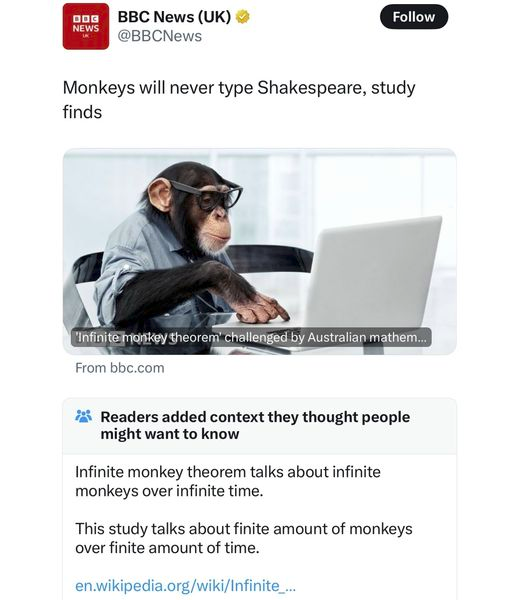
The "Infinite monkey theorem" concerns itself with Probability (the mathematical field). It has been mathematically proven that given the random input (the mathematical kind - not the human-created kind) of the monkeys, and the infinite time, the probability of the "complete works of William Shakespeare" rolling out of the typewriter in between the other random output is
1.It's a mathematical theorem that just uses monkeys to speak to the imagination, not a practical exercise, other than to prove the maths.
You should look into another brain-breaking probability problem called the "Monty Hall Problem". Note that some of the greatest mathematical minds of the time failed said puzzle. Switching 100% increases the chance of winning. No, it won't guarantee a win, but it will increase your chances, mathematically.
The proof assumes that the monkeys mash the keys at random and that there is a nonzero probability to write any chunk of text appearing in Shakespeare's works. If there is a section that the monkeys cannot generate, for example if we removed the letter 'e' from their typewriter, the monkeys will never write the complete works of Shakespeare regardless of the amount of time spent on it, so their point still stands and it depends on the assumptions you make about the monkey typists' typing skills.
The probability is 1 but that does not mean that it will happen. There is a set of options where it does not happen. It happens "almost surely".
Yeah I get that, what I'm arguing is that monkey input != random input. Therefore the probably is not 1.
And the Monty Hall problem is really cool, and yes, I've seen it before, but it doesn't have anything to do with this one.