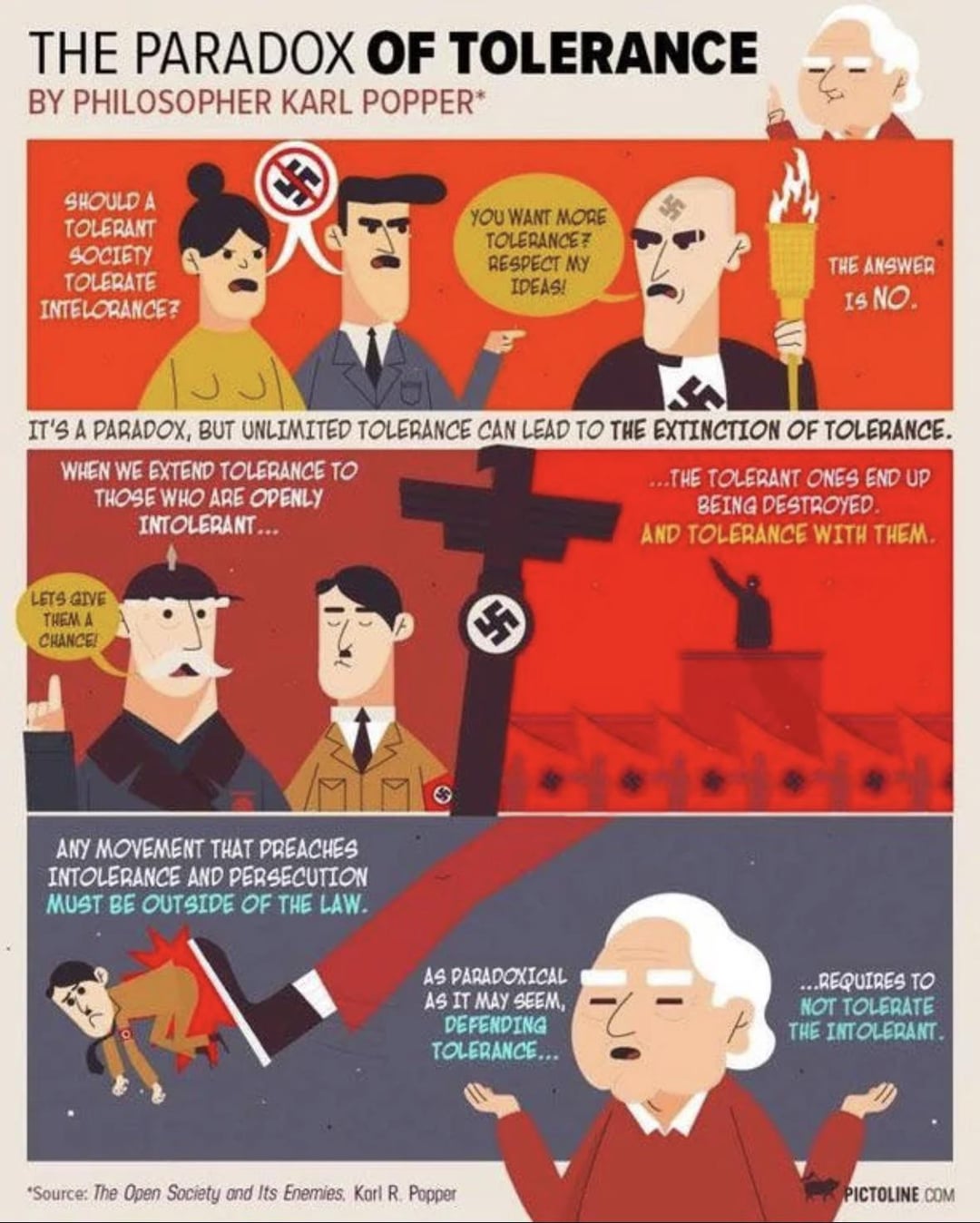
"Tolerance has a limit. Beyond that limit, intolerance becomes duty."
- Rig Védā
1. Defining a Guide Guides are comprehensive reference materials, how-tos, or comparison tables. A guide must be well-organized both in content and layout. Information should be easily accessible without unnecessary navigation. Guides can include flowcharts, step-by-step instructions, or visual references that compare different elements side by side.
2. Infographic Guidelines Infographics are permitted if they are educational and informative. They should aim to convey complex information visually and clearly. However, infographics that primarily serve as visual essays without structured guidance will be subject to removal.
3. Grey Area Moderators may use discretion when deciding to remove posts. If in doubt, message us or use downvotes for content you find inappropriate.
4. Source Attribution If you know the original source of a guide, share it in the comments to credit the creators.
5. Diverse Content To keep our community engaging, avoid saturating the feed with similar topics. Excessive posts on a single topic may be moderated to maintain diversity.
6. Verify in Comments Always check the comments for additional insights or corrections. Moderators rely on community expertise for accuracy.
Direct Image Links Only Only direct links to .png, .jpg, and .jpeg image formats are permitted.
Educational Infographics Only Infographics must aim to educate and inform with structured content. Purely narrative or non-informative infographics may be removed.
Serious Guides Only Nonserious or comedy-based guides will be removed.
No Harmful Content Guides promoting dangerous or harmful activities/materials will be removed. This includes content intended to cause harm to others.
By following these rules, we can maintain a diverse and informative community. If you have any questions or concerns, feel free to reach out to the moderators. Thank you for contributing responsibly!
"Tolerance has a limit. Beyond that limit, intolerance becomes duty."
Hilter was initially intolerant to those who were intolerant of the rich. National Socialism was universally unpopular for an entire generation. But it flipped and gained massive universal appeal in the shadow of a bloody communist initiated civil war.
You can't preach tolerance while being intolerant of people who happen to have more money than you, just like you can't claim to be tolerant while being intolerant of those with more melanin than you. It's all relative. No one has zero money and very few have zero melanin. But anyone who has more than me is a bad guy is not a very tolerant position.
Anyone reading this is in the 10 percentile globally. It's like light blacks being racist to dark blacks (which is a real thing).
Damn, you're kinda dumb
And not afraid of announce it
That's... brave..?
What's that? It's strange how this post seems to attract all kind of rubbish and brainfarts.
all things in moderation
Intolerance to not tolerant - just use the double negation and the paradox disappears.
It never really seemed like a paradox to me to begin with. To suggest that it is is just a rhetorical game used by the intolerant in bad faith.
The person who put forward the idea, or gave it a name, was a pretty notable philosopher who was notably in favor of a discourse driven liberal democracy, and against fascism.
He didn't mean paradox in the sense of "self contradictory and unresolvable" like the liars paradox. He meant it in the sense of "seemingly contradictory".
In order to have the most tolerant, rational discourse driven society possible there are some things you cannot tolerate, nor engage in discussion with , because if you cannot be persuaded there cannot be rational discussion.
So the paradox was named by a person explaining why you don't have to listen to Nazis just because you want to be open to new ideas and perspectives.
Coming to the conclusion that it's not contradictory is agreeing with the argument that it's okay to just tell Nazis to fuck off.
I see, well said. I'm not well informed on the absolute origin of the phrase. It wasn't clear to me if the philosopher was responding to people saying that being intolerant of Nazis/other types of bigots in the pursuit of tolerance of diverse types of people was contradictory and therefore not morally or ethically sound, or just spontaneous hand-wringing.
Not a direct response, but a response as part of a larger philosophical narrative.
He was a true believer in a society driven by rational discussion and the free exchange of ideas, which was the main point of his work.
As part of describing how he thought society should be run (tldr: we should discuss things, change institutions peacefully, and make small changes that we can actually tell if they worked instead of upending society in the name of an untested ideology) he spent some time describing the edge cases and weaknesses, which is where the quote comes from.
He wrote the work during WW2 after fleeing Germany, so there's more than a little implied context that people would have at the time of publication. Basically a general vibe of "what the fuck! Let's not do that again!"
I've posted about this exact fucking thing before and I completely agree. There is no paradox, it's just a bullshit argument easily dismantled
Well, it kinda is, if you take the terms at face value: To defend tolerance by being intolerant.
The fact that it can be simply resolved by requiring tolerance to be mutual doesn't make the original less of a paradox.
I see what you're saying, but to me it's not a paradox that needs addressing because to most people it's obvious that these are qualitatively different kinds of tolerance. To me it feels like a technical gotcha divorced from the obvious intent. I might be assuming too much there.
Any movement that preaches intolerance and persecution must be outside of the law.
This is a common misconception about the Paradox of Tolerance, and I'm going to reference the person who invented it: Karl Popper in his 1945 work, The Open Society and Its Enemies:
I do not imply, for instance, that we should always suppress the utterance of intolerant philosophies; as long as we can counter them by rational argument and keep them in check by public opinion, suppression would certainly be most unwise.
But we should claim the right to suppress them if necessary even by force; for it may easily turn out that they are not prepared to meet us on the level of rational argument, but begin by denouncing all argument they may forbid their followers to listen to rational argument, because it is deceptive, and teach them to answer arguments by the use of their fists or pistols.
Popper argues that we should tolerate intolerance only up to the point of violence. That is, if one physically attacks us, we no longer have the burden of tolerance. Popper is commonly misquoted and intentionally misused to justify violence against disagreement, and that is clearly not his position.
The graphic above states that we should not tolerate "movements" which preach "intolerance." This is a subjective standard. I think Islam preaches intolerance. By this standard, I would be justified in banning all Muslims from immigrating to Denmark. This is why Popper used the much clearer standard of physical violence. Any modern society must tolerate disagreement - including "intolerant" disagreement. We resolve that intolerance at the ballot box. We cannot allow physical violence. No, someone saying mean words is not physical violence.
But we should claim the right to suppress them if necessary even by force
He then goes on, in the paragraph you quoted, to make it clear that it's refusing rational argument that's a problem because it can lead to violence, not violence itself.
Further, if you finish the paragraph it becomes clear that the opening statement is anything but a misunderstanding:
We should therefore claim, in the name of tolerance, the right not to tolerate the intolerant. We should claim that any movement preaching intolerance places itself outside the law and we should consider incitement to intolerance and persecution as criminal, in the same way as we should consider incitement to murder, or to kidnapping, or to the revival of the slave trade, as criminal.
You don't have to agree with him, you can be partial to rawles, but popper was not vague.
I disagree with this assessment of the text - assuming it's correct, I'm not familiar with the source.
What this extract is saying imo is as long as it's possible to effectively keep in check and counter intolerance with argument and public opinion, suppression is unwise.
But, tolerance should reserve the right to suppress intolerance before it becomes violent, specifically when intolerance acts in bad faith and refuses to participate in logical argument or debate, and instead denounces argument entirely.
So the threshold is not violence itself, but one example of what "may" lead to violence.
Just my 2¢ on the text (not my opinion on the topic).
There is no way to reconcile your interpretation with the actual text:
and teach them to answer arguments by the use of their fists or pistols.
A preemptive strike is neither stated nor implied by Popper. I find that a dangerous proposition for a democratic nation. It would justify any and all manner of violence based on nothing and anything but the subjective and active imaginations of the politically inclined.
I've re-read it and still kindly and respectfully disagree about the meaning of that excerpt in isolation. Whatever the implications of this interpretation are, I have no idea because I'm not familiar with the work (however naïvely).
Here's a detailed breakdown of my take:
I do not imply, for instance, that we should always suppress the utterance of intolerant philosophies;
The key word here is always, so, intolerant philosophies shouldn't always be suppressed.
as long as we can counter them by rational argument and keep them in check by public opinion, suppression would certainly be most unwise.
The condition for not suppressing intolerant philosophies is if they can be kept in check and countered by public opinion and rational argument.
But we should claim the right to suppress them if necessary even by force;
Reserve the right to suppression if necessary..
for it may easily turn out that
Because the following things might easily happen:
they [the intolerant] are not prepared to meet us on the level of rational argument, but begin by denouncing all argument they may forbid their followers to listen to rational argument, because it is deceptive, and teach them to answer arguments by the use of their fists or pistols.
An example of what may occur when the first approach fails due to essentially bad faith, and the reasoning for why to reserve the right to suppression. But it doesn't frame violence as the threshold for when to apply that suppression.
Anyway, that's my take. I'm still assuming this quote is accurate - I haven't checked it.
And once again I'm absolutely not agreeing with these positions or assertions about the suppression of intolerance, this is just how I understand the text.
Understand tolerance as a social contract and not as a moral obligation. Tolerance is about piece within a society, not about right or wrong. If you do, there is no paradox, because the contract is broken and therefore does no longer apply. It also allows you to counter far right ideologies from whomever they come.
this line of thinking has narrowed way too much.
people used 're****' as a general slur for years and nobody was rounding up the mentally challenged for extermination. in fact, nobody ever used this word in front of the mentally challenged other than the socially awkward.
nazi's shouldn't be tolerated. but the modern world acts like people who make mistakes or are mildly offensive are the same thing as nazis.
Maybe that was the case during woke 1 but we have a lot more visible, vehement Nazis and general fascism now to bring that term back to its roots
It's closer to the social contract of tolerance. If the contract is broken then the gloves are off, no one gives a damn about the universalist Christians but the Evangelicals are broadly hated on average, hell even my bloodthist is generally more socially acceptable than your average Evangelical since my focus is moreso directly on folks and entities who cause harm through secondary or primary effect.
This is an asked and answered question.
Tolerance is not a moral stance, it is part of the social contract. Those that violate the social contract, like Nazis, are not protected by it. Paradox solved.
Exactly. The “paradox” part disappears as soon as you start viewing things through the lens of a social contract. The intolerant are intentionally and repeatedly breaking the social contract, and are therefore not protected by it.
It's funny how the word "tolerance" already implies that something is bad but you just act as if it's not. You wouldn't tolerate having enough food and water, you'd only tolerate the lack thereof.
There's a straightforward way to resolve the paradox of tolerance, IMO. Treat tolerance as a social contract. An intolerant person has explicitly rejected the contract.