this post was submitted on 21 Aug 2026
676 points (96.3% liked)
Cool Guides
6609 readers
247 users here now
Rules for Posting Guides on Our Community
1. Defining a Guide Guides are comprehensive reference materials, how-tos, or comparison tables. A guide must be well-organized both in content and layout. Information should be easily accessible without unnecessary navigation. Guides can include flowcharts, step-by-step instructions, or visual references that compare different elements side by side.
2. Infographic Guidelines Infographics are permitted if they are educational and informative. They should aim to convey complex information visually and clearly. However, infographics that primarily serve as visual essays without structured guidance will be subject to removal.
3. Grey Area Moderators may use discretion when deciding to remove posts. If in doubt, message us or use downvotes for content you find inappropriate.
4. Source Attribution If you know the original source of a guide, share it in the comments to credit the creators.
5. Diverse Content To keep our community engaging, avoid saturating the feed with similar topics. Excessive posts on a single topic may be moderated to maintain diversity.
6. Verify in Comments Always check the comments for additional insights or corrections. Moderators rely on community expertise for accuracy.
Community Guidelines
-
Direct Image Links Only Only direct links to .png, .jpg, and .jpeg image formats are permitted.
-
Educational Infographics Only Infographics must aim to educate and inform with structured content. Purely narrative or non-informative infographics may be removed.
-
Serious Guides Only Nonserious or comedy-based guides will be removed.
-
No Harmful Content Guides promoting dangerous or harmful activities/materials will be removed. This includes content intended to cause harm to others.
By following these rules, we can maintain a diverse and informative community. If you have any questions or concerns, feel free to reach out to the moderators. Thank you for contributing responsibly!
founded 3 years ago
MODERATORS
you are viewing a single comment's thread
view the rest of the comments
view the rest of the comments
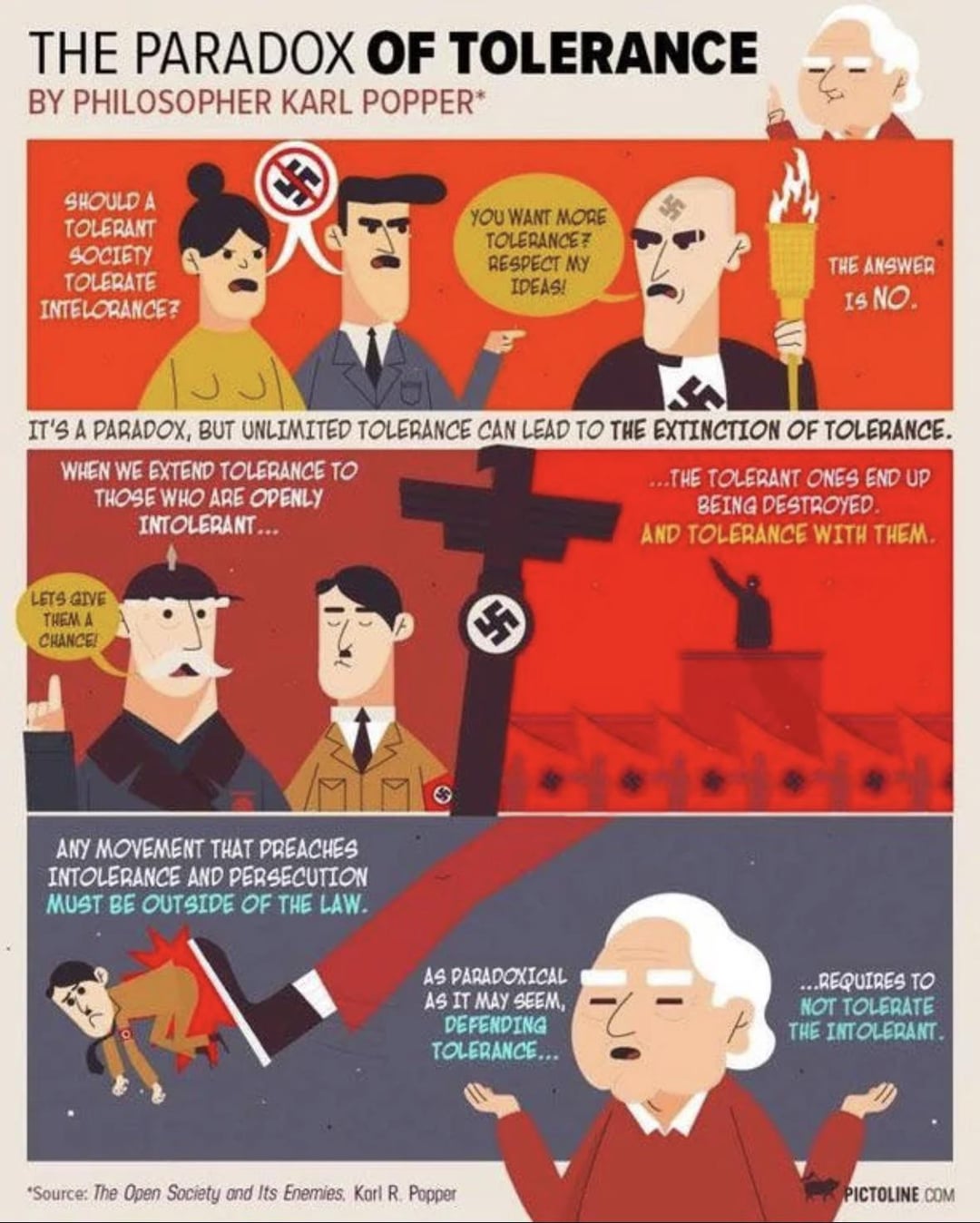
This is a common misconception about the Paradox of Tolerance, and I'm going to reference the person who invented it: Karl Popper in his 1945 work, The Open Society and Its Enemies:
Popper argues that we should tolerate intolerance only up to the point of violence. That is, if one physically attacks us, we no longer have the burden of tolerance. Popper is commonly misquoted and intentionally misused to justify violence against disagreement, and that is clearly not his position.
The graphic above states that we should not tolerate "movements" which preach "intolerance." This is a subjective standard. I think Islam preaches intolerance. By this standard, I would be justified in banning all Muslims from immigrating to Denmark. This is why Popper used the much clearer standard of physical violence. Any modern society must tolerate disagreement - including "intolerant" disagreement. We resolve that intolerance at the ballot box. We cannot allow physical violence. No, someone saying mean words is not physical violence.
He then goes on, in the paragraph you quoted, to make it clear that it's refusing rational argument that's a problem because it can lead to violence, not violence itself.
Further, if you finish the paragraph it becomes clear that the opening statement is anything but a misunderstanding:
You don't have to agree with him, you can be partial to rawles, but popper was not vague.
I disagree with this assessment of the text - assuming it's correct, I'm not familiar with the source.
What this extract is saying imo is as long as it's possible to effectively keep in check and counter intolerance with argument and public opinion, suppression is unwise.
But, tolerance should reserve the right to suppress intolerance before it becomes violent, specifically when intolerance acts in bad faith and refuses to participate in logical argument or debate, and instead denounces argument entirely.
So the threshold is not violence itself, but one example of what "may" lead to violence.
Just my 2¢ on the text (not my opinion on the topic).
There is no way to reconcile your interpretation with the actual text:
A preemptive strike is neither stated nor implied by Popper. I find that a dangerous proposition for a democratic nation. It would justify any and all manner of violence based on nothing and anything but the subjective and active imaginations of the politically inclined.
I've re-read it and still kindly and respectfully disagree about the meaning of that excerpt in isolation. Whatever the implications of this interpretation are, I have no idea because I'm not familiar with the work (however naïvely).
Here's a detailed breakdown of my take:
The key word here is always, so, intolerant philosophies shouldn't always be suppressed.
The condition for not suppressing intolerant philosophies is if they can be kept in check and countered by public opinion and rational argument.
Reserve the right to suppression if necessary..
Because the following things might easily happen:
An example of what may occur when the first approach fails due to essentially bad faith, and the reasoning for why to reserve the right to suppression. But it doesn't frame violence as the threshold for when to apply that suppression.
Anyway, that's my take. I'm still assuming this quote is accurate - I haven't checked it.
And once again I'm absolutely not agreeing with these positions or assertions about the suppression of intolerance, this is just how I understand the text.