this post was submitted on 21 Aug 2026
685 points (96.3% liked)
Cool Guides
6615 readers
244 users here now
Rules for Posting Guides on Our Community
1. Defining a Guide Guides are comprehensive reference materials, how-tos, or comparison tables. A guide must be well-organized both in content and layout. Information should be easily accessible without unnecessary navigation. Guides can include flowcharts, step-by-step instructions, or visual references that compare different elements side by side.
2. Infographic Guidelines Infographics are permitted if they are educational and informative. They should aim to convey complex information visually and clearly. However, infographics that primarily serve as visual essays without structured guidance will be subject to removal.
3. Grey Area Moderators may use discretion when deciding to remove posts. If in doubt, message us or use downvotes for content you find inappropriate.
4. Source Attribution If you know the original source of a guide, share it in the comments to credit the creators.
5. Diverse Content To keep our community engaging, avoid saturating the feed with similar topics. Excessive posts on a single topic may be moderated to maintain diversity.
6. Verify in Comments Always check the comments for additional insights or corrections. Moderators rely on community expertise for accuracy.
Community Guidelines
-
Direct Image Links Only Only direct links to .png, .jpg, and .jpeg image formats are permitted.
-
Educational Infographics Only Infographics must aim to educate and inform with structured content. Purely narrative or non-informative infographics may be removed.
-
Serious Guides Only Nonserious or comedy-based guides will be removed.
-
No Harmful Content Guides promoting dangerous or harmful activities/materials will be removed. This includes content intended to cause harm to others.
By following these rules, we can maintain a diverse and informative community. If you have any questions or concerns, feel free to reach out to the moderators. Thank you for contributing responsibly!
founded 3 years ago
MODERATORS
you are viewing a single comment's thread
view the rest of the comments
view the rest of the comments
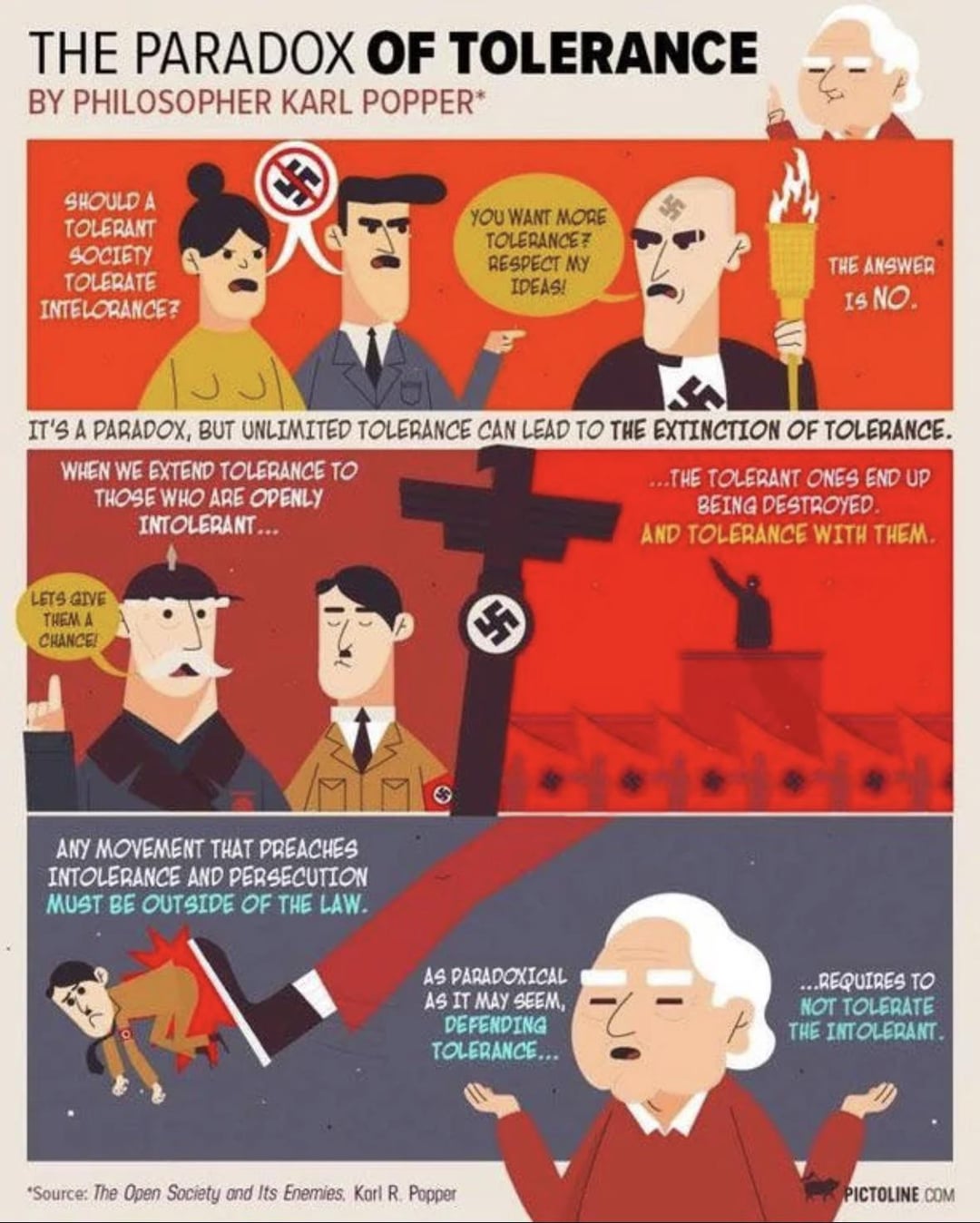
The person who put forward the idea, or gave it a name, was a pretty notable philosopher who was notably in favor of a discourse driven liberal democracy, and against fascism.
He didn't mean paradox in the sense of "self contradictory and unresolvable" like the liars paradox. He meant it in the sense of "seemingly contradictory".
In order to have the most tolerant, rational discourse driven society possible there are some things you cannot tolerate, nor engage in discussion with , because if you cannot be persuaded there cannot be rational discussion.
So the paradox was named by a person explaining why you don't have to listen to Nazis just because you want to be open to new ideas and perspectives.
Coming to the conclusion that it's not contradictory is agreeing with the argument that it's okay to just tell Nazis to fuck off.
I see, well said. I'm not well informed on the absolute origin of the phrase. It wasn't clear to me if the philosopher was responding to people saying that being intolerant of Nazis/other types of bigots in the pursuit of tolerance of diverse types of people was contradictory and therefore not morally or ethically sound, or just spontaneous hand-wringing.
Not a direct response, but a response as part of a larger philosophical narrative.
He was a true believer in a society driven by rational discussion and the free exchange of ideas, which was the main point of his work.
As part of describing how he thought society should be run (tldr: we should discuss things, change institutions peacefully, and make small changes that we can actually tell if they worked instead of upending society in the name of an untested ideology) he spent some time describing the edge cases and weaknesses, which is where the quote comes from.
He wrote the work during WW2 after fleeing Germany, so there's more than a little implied context that people would have at the time of publication. Basically a general vibe of "what the fuck! Let's not do that again!"