this post was submitted on 09 May 2026
671 points (98.8% liked)
People Twitter
10247 readers
378 users here now
People tweeting stuff. We allow tweets from anyone.
RULES:
- Mark NSFW content.
- No doxxing people.
- Must be a pic of the tweet or similar. No direct links to the tweet.
- No bullying or international politcs
- Be excellent to each other.
- Provide an archived link to the tweet (or similar) being shown if it's a major celebrity, figure or any politician. If you replace the "x" at their site with xcancel (so it beomes xcancel.com), and you're not on mobile, it will save video. https://web.archive.org/save is another great option. Archive.is is no longer recommended because they remove/alter content.
founded 3 years ago
MODERATORS
This is a lot like when Boston PD was found to screen out all the smart applicants. Sometime the company wants an obedient idiot.
Might actually be the case, lol.
Answer this question correctly (or even intelligently at all) and your application is rejected.
This is a direct appliacation of the hairy ball theorem.
I ain't even kidding
Hairy ball theorem applies to even-dimensional spheres (the ordinary sphere is the 2D surface of the 3D solid), but a cube in four-dimensional space is a three-dimensional surface, so it doesn't apply.
This is a question about graph theory, not topology; it's asking for a Hamiltonian path on the surface of 4D cube (where faces are vertices, which is different than the normal polytope graph).
load more comments
(5 replies)
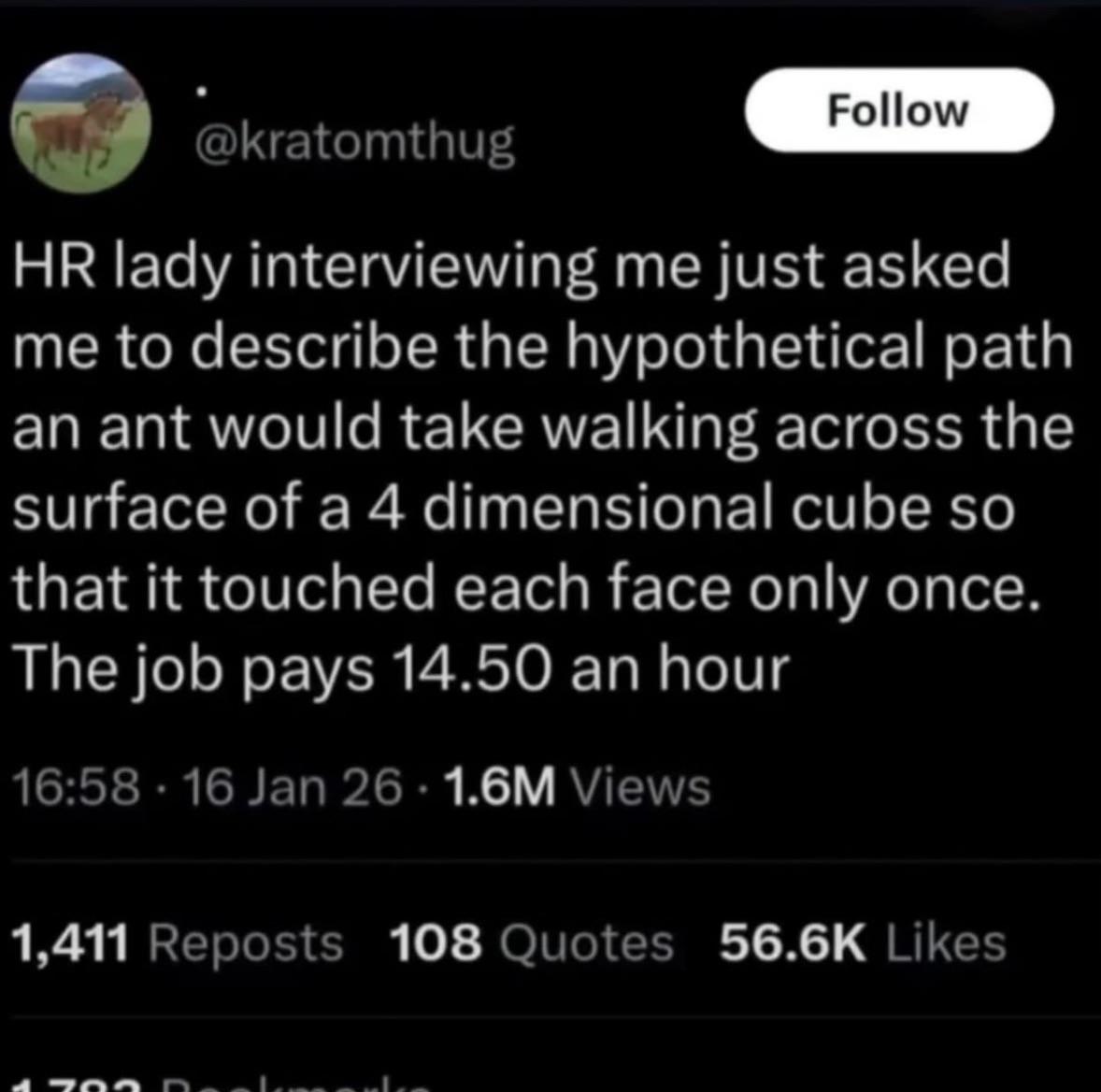
This is actually quite fun and simple! Even if the problem and my following explanation look complicated :P
Let's look at the three dimensional case. One can parametrize a 3 dimensional cube as the Cartesian product of intervals [0, 1] x [0, 1] x [0, 1]. This means a cube is a set of points (a, b, c) where a, b and c are real numbers between 0 and 1. The 2 dimensional sides of the cube are then given by fixing one coordinate. That is, the 6 sides are
{0}    x [0, 1] x [0, 1],
{1}    x [0, 1] x [0, 1],
[0, 1] x {0}    x [0, 1],
[0, 1] x {1}    x [0, 1],
[0, 1] x [0, 1] x {0} and
[0, 1] x [0, 1] x {1}.
Now we just start in the middle of a side at (0, 0.5, 0.5). To get to the next side we walk towards an edge (0, 0, 0.5) and then to the middle of the next side (0.5, 0, 0.5). We iterate this process until we run out of sides with a fixed 0, then walk towards a side with a fixed 1 and continue there. That is:
   (0  , 0.5, 0.5)
-> (0  , 0  , 0.5)
-> (0.5, 0  , 0.5)
-> (0.5, 0  , 0  )
-> (0.5, 0.5, 0  )
-> (1  , 0.5, 0  )
-> (1  , 0.5, 0.5)
-> (1  , 1  , 0.5)
-> (0.5, 1  , 0.5)
-> (0.5, 1  , 1  )
-> (0.5, 0.5, 1  )
This path basically spirals around the cube, going through every side only once. Here's a visualization (sorry, I'm no artist :P)

The same procedure works on a 4 dimensional cube or any other higher dimension. For the 4 dimensional cube it goes like this:
   (0  , 0.5, 0.5, 0.5)
-> (0  , 0  , 0.5, 0.5)
-> (0.5, 0  , 0.5, 0.5)
-> (0.5, 0  , 0  , 0.5)
-> ...
-> (0.5, 0.5, 0.5, 0  )
-> (1  , 0.5, 0.5, 0  )
-> (1  , 0.5, 0.5, 0.5)
-> (1  , 1  , 0.5, 0.5)
-> ...
-> (0.5, 0.5, 0.5, 1  )
This works for arbitrary dimension except for the 1 dimensional cube (which is just a line) because the "sides" there are the two end points of the line and not connected at all. Additionally note, that it is never specified how edges count in this problem, whether they somehow count towards a face or whether you're allowed to go back and fourth on edges. You could technically only walk along edges and step into the sides every now and then.
You owe me $14.50 for reading that.
I skipped all the blabla and looked at the drawing and was pleased to see the path I started visualising in my head was exactly like that. I do think I would've needed a cube in my hands to confirm it, or a bit longer thinking about it instead to complete it.
load more comments
(1 replies)
Four dimensional? That is a tesseract. This is impossible to describe how an ant would even interact with let alone touch all eight cells only once.
Once done with the first cube, the ant takes a gondola, going along the 4th dimension and repeats the walk he did on the first cube.
load more comments
(2 replies)
Too many people are obsessing about 4d topology in this thread. The real difficulty in the question is the non -deterministic pathfinding of the ant, in the absence of pheromones.
tricky with only four dimentions, but I'd use a Grathenbour's loop with a transverse Z axis movement if gimbal locks are ignored, naturally.

How does this compare in efficiency to casting Xagyg's Planar Binding and simply using a standard verity geas to question a daemon from one of the higher hypergeometric dimensions?
making sure you cannot solve it, so you are perfect for the job
Possible candidate responses:
- Solves it (too smart for job)
- "That's bullshit, who needs this for a $14.50/hr job?" (too intolerant of bullshit for job)
- Tries to solve it but fails (lacks self-awareness for job)
- Knows they can't solve it so doesn't even try (too lazy for job)
- Doesn't understand the question/comprehend what a hypercube is (too dumb for job)
Maybe they're trying to weed out all actual applicants because they're hiring the boss' kid.
You forgot option 6, spew a bunch of techno bubble at the HR person who will definitely not understand the problem themselves and wouldn't be able to tell if you'd answered it or not.
That's just response 1 from the perspective of the HR person scoring it.
load more comments
(1 replies)
I believe this is sometimes the case. I was called for an interview with a group of 15 other people ones. We were like a class, being interviewed as a group, and were supposed to solve some problems together. Nobody in that group could solve even the simple, obvious problems - we're talking basic math and reading comprehension here. Got an email the next day informing me that they had I had not been selected for recruitment.
Sure. Draw the cube for me and I will plot it's path.
Herr you go: 
I still don't understand it. Can you rotate it along the W axis so I can visualize it better?
load more comments
(1 replies)
Be glad you got the shitty interview instead of getting ghosted
Entry level positions to Gregg's (fast food sausage roll chain) require 1000 word personal statements as part of online applications
load more comments
(2 replies)
Choose a starting face and remember it. Walk each face of a cell containing that face touching each face once much like you would a 3-cube.
Pick any adjoining cell and move into one of its faces from there, walk each of its faces saving the one opposite the face you started on for last.
From there you're on a shared face with the cell opposite your starting cell. Traverse this one in a similar manner to the last, but this time also visit the adjoining faces of each cell adjacent to the second cell you filled, before once again ending opposite the face you started on for this cell.
Now you're on a shared face with the final cell, opposite the face you started on. Walk around the remaining four faces and you're done.
Followed these steps, ended up on the ceiling of my neighbor's tea room.
Wait, isn’t this trivial?
If we’re talking about “faces” as in the cubic faces of a tesseract then each of the 8 faces are connected to all other faces except the opposite face. So just spiral around from your starting face (keeping the faces you’ve visited on the inside of the spiral) and you’re fine.
If you mean 2D faces connecting the 3D ones, then things get more difficult but not that much because you can do the exact same thing. Choose a 1D edge as your origin, pick a face touching that edge to start with, traverse that edge twice to get the next two faces. Then traverse three faces which share edges with those faces you already traversed (there are 6 faces with this property, 3 for each vertex of our origin edge, the set you pick determines the “direction” of your overall progress through/around the tesseract). Repeat that step again but for the faces that share edges with two of the three you just did. Repeat again and again and again until the last three faces share a vertex with the origin edge you started with. You’re done.
Am I missing something? Did the prompt mean to say you can only traverse each edge once?
Edit: the 2D face path I described would miss 6 faces. Those six faces should be traversed in the middle, so do the first three faces, the second three, then all six which touch those last three and the three you would have done next on the original path. Then do the rest just like I originally mentioned.
I understood some of those words.
Have you ever seen one of those images of a tesseract where it’s like a cube in a cube? (You can just look up “tesseract” to find an image)
Now, pick one of the corners of the outer cube and find the line that connects it to a corner of the inner cube. That’s our origin “edge” and we’re basically just going to move in through the cube along that direction.
There are three “faces” which share that “edge” (line). We do those ones first.
Then we move deeper in and do the three faces of the inner cube which share the corner our origin line connects to.
Then we have to zig zag around the six “faces” that exist between inner and outer cubes which are roughly perpendicular to our origin edge. (Imagine you broke the tesseract in half by cutting halfway between your starting corner and the corner opposite it. The “faces” we need to traverse would intersect that plane)
After that, we do the three faces on the far side of the inner cube. (The ones opposite our starting corner)
Then we do the three around the line which connects that far corner of the inner cube to the outer cube.
Then we do the three faces on the outside of the large cube at that corner.
Finally we do the three faces on the outside of the cube around our starting corner.
load more comments
(1 replies)
Well I think the ant would probably wander around until it found food
Okay, if you can explain to me in detail how four dimensional topology is going to be important to me while I'm stocking the shelves of your grocery store, I'll give you an answer.
load more comments
(7 replies)
Isn't a cube by definition a 3 dimensional object? If it were 4 dimensional, it would no longer be a cube.
Its a generalisation. A 4d cube is a shape that has the same length in all 4 dimensions. You can also talk of 5d cubes, 6d cubes, etc. These are commonly called n-cubes: a 4-cube is a 4d cube.
There are also 4D spheres, even though spheres are definitionally 3D. They are called n-spheres.
load more comments
(1 replies)
At $14.50 per hour, he's going to take the shortest route.
Forward, left, right, forward, left.
That’s a three dimensional cube.
Which I thought by definition was a cube.
What is a four dimensional cube?
What is a two dimensional cube?
What is a four dimensional cube?
2 three dimensional cubes, A and B, and each corner in A is connected by a new edge to it's equivalent corner in B. This is also called a tesseract.
What is a two dimensional cube?
A square.
In general, if you have an n-dimensional cube, you can get an n+1 dimensional cube by doubling it, and connecting each corner with it's equivalent corner.
A 0-dimensional cube is just a single dot.
A 1-dimensional cube is a two dots, connected by a line.
A 2-dimensional cube is 2 lines, connected. Also called a square.
A 3-dimensional cube is 2 squares, connected. Also called, well, a cube.
A 4-dimensional cube is 2 cubes, connected. Also called a tesseract.
A 5-dimensional cube is 2 tesseracts, connected.
In general, this is called the n-dimensional hypercube.
And continuing this, each edge on an n-dimensional cube will, together with its copy and the two edges connecting it to its copy, form another face on the n+1 dimensional cube. This new face will border exactly one face on the original cube, and one face on the copy. It's also bordered by two other connecting faces.
So, basically, if I start out on a face on the original cube, I can walk onto a connecting face, and then walk around all four connecting faces, and walk to the copy face. From there, I walk to another copy face, over the four connecting faces, and then back to the original cube. This way I should be able to continue going back and fourth between the cube and the copy, always walking across all the connecting faces.
I got a rubics cube here, with sides white, red, blue, orange, green, and yellow. For each of these faces, there exist 5 additional ones on the tesseract. For white: white, white_copy, and white_c1 to white_c4.
The solution is white, white_c1, white_c2, white_c3, white_c4, white_copy, red_copy, red_c1, red_c2, red_c3, red_c4, red, green, green_c1, green_c2, green_c3, green_c4, green_copy, orange_copy, orange_c1, orange_c2, orange_c3, orange_c4, orange, blue, blue_c1, blue_c2, blue_c3, blue_c4, blue_copy, yellow_copy, yellow_c1, yellow_c2, yellow_c3, yellow_c5, yellow.
load more comments
(4 replies)
load more comments
(1 replies)
"Being that the fourth dimension is time, it would need a flux capacitor and have to hit 88mph but where he's going he doesn't need 'sides.'"
view more: next ›