this post was submitted on 03 Mar 2026
433 points (98.2% liked)

xkcd

15567 readers
618 users here now

A community for a webcomic of romance, sarcasm, math, and language.

founded 2 years ago
MODERATORS
 

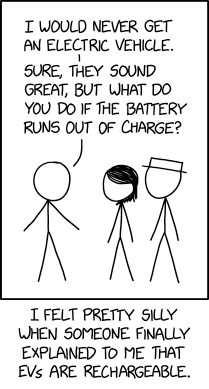
xkcd #3214: Electric Vehicles

Title text:

Now that I've finally gotten an electric vehicle, I'm never going back to an acoustic one.

Transcript:

Transcript will show once it’s been added to explainxkcd.com

Source: https://xkcd.com/3214/
explainxkcd for #3214

top 50 comments
sorted by: hot top controversial new old
[–] Katana314@lemmy.world 9 points 6 hours ago (1 children)

A car powered by gasoline? It'll never take off. I mean, what will you do if it runs out of gas? Start a war in the middle east?

[–] saimen@feddit.org 6 points 4 hours ago

Also imagine the logistics! You would have to refine the oil, get it from places all over the world and distribute it to all the gas stations all over the country. With electric cars you can just tap the already existing power grid.

[–] rumba@lemmy.zip 4 points 5 hours ago

Costco: 4000 pack of kirkland brand AA batteries...

[–] tgirlschierke@lemmy.blahaj.zone 1 points 4 hours ago (3 children)

I'm sure charging stations exist, but I've only ever seen one with my own eyes once (Brazil, major city)

[–] mineralfellow@lemmy.world 3 points 2 hours ago

In South Africa, I have seen plenty in the big cities, but nothing on the countryside.

[–] Miaou@jlai.lu 1 points 3 hours ago (1 children)

I saw BYDs everywhere when I was there, but I don't recall seeing stations, now that you mention it

[–] RememberTheApollo_@lemmy.world 1 points 2 hours ago* (last edited 1 hour ago)

Charge at home. I think most people do that. A quick unscientific stat looked up seems to indicate 80% charge at home in the US. Probably similar in other countries?

[–] Obi@sopuli.xyz 1 points 4 hours ago

Meanwhile in Europe I take off for road trips with my EV that has very mid range, fully trusting there's gonna be a station when I need one, at first I used to plan the trips around charges but quickly figured out it's not necessary. If you have a newer model with big range then it's really a total non-issue. Sucks to hear Brazil isn't there yet but I'm sure the infrastructure will catch up soon.

[–] kalpol@lemmy.ca 8 points 8 hours ago (1 children)

In all seriousness, the transition of small devices away from AA/AAA batteries is very annoying. I always had batteries charged, now I have to constantly plug some junk in and wait?

[–] pnelego@lemmy.world 7 points 8 hours ago (3 children)

I invested in some rechargeable NiMH AAs, and AAAs. Now sometimes I think i prefer some things with old school batteries just because of how convenient it is. Granted, that system wouldn't work well for my headphones, or my phone. But seems just fine for the odd remote control, kitchen gadget or portable lamp.

[–] BanMe@lemmy.world 1 points 6 hours ago (2 children)

Rechargeable AAs and AAAs have finally been perfected, I am kind of annoyed by things that have only internal batteries now, I don't want them going to the landfill just because the cheap device died. Let me keep running the batteries for a decade in other shit.

[–] kalpol@lemmy.ca 1 points 3 hours ago

The internal batteries often aren't that hard to replace. If you can get the device open the batteries are standard sizes you can order and often just plug in. Except phones, phone manufacturing relies on pure evil

[–] rumba@lemmy.zip 2 points 5 hours ago

For decades we had battery packs that could be replaced. we have lifepo4 that's super safe to handle, i don't know why we don't have replacable battery packs anymore :/

load more comments (2 replies)
[–] w3ird_sloth@lemmy.world 1 points 5 hours ago

user.user.age = "9000"; Done.

[–] arudesalad@piefed.ca 2 points 7 hours ago* (last edited 7 hours ago)

He was one of that days lucky 10000

[–] Sam_Bass@lemmy.world 1 points 6 hours ago (2 children)

OK then what do you do if there are no chargers in range?

[–] yes_this_time@lemmy.world 2 points 5 hours ago (1 children)

Proper charging infrastructure is important but there are far more electrical outlets out there than gas stations.

[–] Appoxo@lemmy.dbzer0.com 1 points 4 hours ago

Too bad those outlets charge at a rate that you will be standing there until next day if you have a longer distamce to drive and can't just sleep then and there.

[–] BanMe@lemmy.world 1 points 6 hours ago

There's a crank on the front. Obviously.

[–] sefra1@lemmy.zip -2 points 5 hours ago* (last edited 4 hours ago) (6 children)

EVs as they are now, are only useful for rich people, for two reasons.

  1. Batteries only last 5 to 10 years max, meanwhile poor people drive cars that are at least 20 years old, since replacing the batteries costs usually as much as the whole car, there wont be any of those new electric cars on the road in 20 years.

Electric cars are essentially disposable, where they are expected to be destroyed or "recycled" instead of repaired.

Ofc rich people buy new cars every few years anyway, so it's not an issue for them.

  1. There's not enough infrastructure for charging electric cars, having to drive extra into a charging station which is usually being used and wait until said charger is free is a too much of an inconvenience for people who already don't have any free time at hand.

A gasoline car can be fueled in 30 seconds + 2 minutes to pay, and there's usually a line at most service stations. Even if there's mass adoption and all gas stations were converted into EV chargers, even if it only takes 10 minutes to charge an EV, that is 12 minutes per person, it would still amplify the queue to the point where it would be impossible to get anything charged.

Ofc rich people can just charge in their backyard or garage at night, so not an issue for them either.

I'm not saying that EVs are bad, but there has to be serious investment in infrastructure and batteries need to be cheaper and cheaply REPLACEABLE in order for the poor to be able to adopt EVs

[–] exasperation@lemmy.dbzer0.com 2 points 3 hours ago (1 children)

Batteries only last 5 to 10 years max,

Real world studies are showing they last about an average of 12-15 years on average, and every manufacturer has a warranty for at least 8 years, with many up to 10.

A gasoline car can be fueled in 30 seconds

The typical passenger gas station pump flows at 7.9 gallons per minute. For most passenger cars and trucks, with tanks between 15 and 35 gallons, that's about 2-5 minutes of pumping.

A typical level 3 charger will take a battery from 10% to 80% in about 25 minutes. And chargers can be in places where gasoline pumps can't be, like ordinary parking lots and garages. So the dual purpose parking where you can charge the car while you shop at the grocery store or work out at the gym or sleep overnight at home is just a completely different paradigm from what we're used to.

The average car lasts about 12 years, by the way. EVs last basically as long as ICE vehicles. Which also makes sense, because it doesn't have to mix the fluids that lubricate and cool with combustion residue and foul up the engine that way.

So your data is out of date, and those fears that were commonly cited in 2015 have pretty much proven to be false for the technology that was around in 2015. Now, in 2026, there's been even more advances in managing battery/charging health and chemistry, with more of an infrastructure for maintenance, repair, and charging.

[–] sefra1@lemmy.zip 0 points 2 hours ago (1 children)

Real world studies are showing they last about an average of 12-15 years on average

And that's a problem for ppl who buy 20 year old cars.

A typical level 3 charger will take a battery from 10% to 80% in about 25 minutes. And chargers can be in places where gasoline pumps can’t be, like ordinary parking lots and garages. So the dual purpose parking where you can charge the car while you shop at the grocery store or work out at the gym or sleep overnight at home is just a completely different paradigm from what we’re used to.

Yes, you are right, I take back my "converting gas pumps into EV chargers", that situation can be solved by having more charge points in other places, unfortunately, as things are know, I know from an EV drive himself that it's almost impossible to find a free charger at least where I live.

The average car lasts about 12 years, by the way. EVs last basically as long as ICE vehicles

I guess that greatly depends on where you live, since you said "gallons" before I'm assuming US, at least here few people I know can afford a 12 years old car.

[–] exasperation@lemmy.dbzer0.com 2 points 2 hours ago

So if you're in a country where it's economically feasible to continue maintaining cars beyond 15 years, why wouldn't you think that the much cheaper electric cars wouldn't dominate the market even more?

Compared to the U.S.'s low adoption rates, EVs sell at higher rates in certain rich countries like Norway and Denmark, middle income countries like China and Turkiye, and poor countries like Estonia and Nepal. The cheapest EVs, globally, are cheaper than the cheapest ICE vehicles.

And that's a problem for ppl who buy 20 year old cars.

The cost of maintaining a car to last 20 years can be applied to EVs and ICE cars alike. I suspect that EVs will be easier to maintain to those ages. In the U.S., that doesn't really happen in large part because our labor and parts network is expensive enough that buying new is comparably cheaper than repairing, past the 15 year mark, for most vehicles. EVs don't actually change the equation any.

[–] SapientLasagna@lemmy.ca 2 points 4 hours ago (1 children)

Batteries only last 5 to 10 years max

Most manufactures offer 8 or 10 year warranties. Batteries are expected to last the life of the car (10-20 years). This is similar to the expected lifespan of the engine, because it's designed that way rather than being a fundamental limitation of the technology, same as contemporary car engine lifespans.

Electric cars are essentially disposable

All cars are expected to be recycled when major components are damaged or worn out.

Ofc rich people can just charge in their backyard or garage at night, so not an issue for them either.

Charging in your driveway works fine, and you might be overstating the percentage of people who live in apartments and also have a car. Maybe true in your locality but not mine.

I’m not saying that EVs are bad, but there has to be serious investment in infrastructure and batteries need to be cheaper and cheaply REPLACEABLE in order for the poor to be able to adopt EVs

Replaceable batteries make the car cost more, not less, same as engineering in easily swappable engines (some tanks have this, no cars do). The big thing you're not getting is that POOR PEOPLE DON'T BUY NEW CARS. The only thing required for adoption of EVs by poor people is a healthy supply of used EVs.

[–] sefra1@lemmy.zip 1 points 3 hours ago

Batteries are expected to last the life of the car (10-20 years)

But that's the problem, because the manufacturer always expects the car to last less than what it really does, poor people buy cars long after their "expected lifetime" has passed, (that is, when the previously owner considers the car to be too unreliable him), that's when the person who is scrapping by, buys the unreliable car because it's the only he can afford, now, repairing an old car as it keeps breaking down is expensive, but it's still doable and much cheaper than buying a new car. But if the batteries are dead and the price of batteries cost as much as they seem to cost, then there's no way to fix the car.

Also I'm septic if an electric car battery can last 20 years at all, there isn't any good data on it, but if it uses the same technology as laptops Lithin-ion I don't see it lasting much more than 10. From my experience Lithin-ion don't lose capacity in a linear fashion, it's more like a cliff, one day the laptop lasts an our, next day lasts 10 minutes.

All cars are expected to be recycled when major components are damaged or worn out.

You see, that's the problem, it's "Reduce, Reuse, and Recycle", recycling should be the last option when the object really is at it's limit and can't function (and be fixed no more), if things are build to be durable then there's no need to recycle them.

Charging in your driveway works fine

Would be fun to test how long I could set a power cord down from my apartment window into the driveway without it being stolen or vandalized. Or maybe the police would find some law to fine me for that.

Replaceable batteries make the car cost more, not less, same as engineering in easily swappable engines

Yes, but the lifetime of the car will be much longer, so when you equate the price of the vehicle to it's useful lifetime it actually becomes cheaper.

The big thing you’re not getting is that POOR PEOPLE DON’T BUY NEW CARS

Yes, and that's exactly what I'm saying, if poor people don't buy new cars, and there are no old electric cars in the market because their batteries expired and the cars got recycled instead of repaired.

[–] saimen@feddit.org 3 points 4 hours ago* (last edited 4 hours ago) (1 children)

Batteries only last 5 to 10 years max

Source? I thought we don't really have sufficient real live data, but it seems like the batteries last longer than was expected. And it's not that they completely break, it's just that they lose capacity meaning range.

that is 12 minutes per person, it would still amplify the queue to the point where it would be impossible to get anything charged.

According to this estimate you simply would need 5-6 times more charging points than fueling points, which is already the case for the majority of gas stations at highways where I live.

[–] GhostedIC@sh.itjust.works 1 points 4 hours ago

So, I'm going off of talking to mechanics and a lot of YouTube. But theres a few ways to slice it.

Most batteries aren't experiencing total failures, which was more common on your electric cars of 15+ years ago (think Nissan leaf). But they lose capacity as they are used. 25% after 5 years is common. After 10 years it could be 50%. An EV advertised with 300 miles of range only really gets 250 from a full charge when it's really cold out, by the time it's a 10 year old car that could be anywhere from 90-140 miles depending on how the battery is holding up. And it still takes just as long to charge to 100%.

When a car loses this much performance, most people would say it "needs" a new battery. Not really sure how long cars manufactured 2020 and later are going to last before a complete failure on average, it might be 15-20 years. But even after the first couple years they are losing performance.

This is why EVs fetch extremely low prices used, and a lot of people recommend leasing rather than buying them. Because you can't make or fix a battery at home, and the price of a new battery is $10k-$20k on a car that, probably, is starting to get other issues and has little or no service availability (since most owners are junking them).

So currently, a $30k Corolla is going to be worth far more 5 years after purchase than an $80k whatever EV you care to name.

[–] Qwel@sopuli.xyz 1 points 3 hours ago* (last edited 3 hours ago)

Batteries are about 30% of the price of a full car, which is a lot, but significantly less than 100%. You definitely have an incentive to replace them instead of the full car.

To replace most of them, you need to unscrew the 4 big bolts that hold it, remove the dead one, put a new one in and rescrew the 4 big bolts. This is made difficult by the 700kg that the batteries weigh, but is doable if you have the equipment to lift and move heavy things.

Your issue is Tesla. Tesla has an absurd and dangerous battery design to make their models as flat as possible. I will not list the reasons why Tesla should not be used as a reference

I am not sure why you are stating that only the rich can charge at home, it is much cheaper than charging at a station. Fast chargers do sometimes have a queue issue, but it's not as bad as it would be at a gas station with three lanes. They're not converting gas stations to charging stations, they're adding chargers to parkings that can charge dozens of car in parallel. And you won't use them often because it's so pricey.

[–] UltraMagnus0001@lemmy.world 1 points 4 hours ago

Most people live in apartments or rent. Plug in hybrids sound more feasible for now until the infrastructure is better. I know I can't afford a charger and upgrade to my house to get an electric car. I'm intrigue by the Hyundai ionic5 n, but where do I park it to charge? I've driven many electric cars and even the low power ones feel nice to drive because of the torque. The audi etron and Hyundai ionics are awesome.

[–] Jako302@feddit.org 0 points 4 hours ago (1 children)

The main issue with your second arguments and the anti EV sentiment in general is that most people seem to think you have to fill them up like gasolin cars.

Everyone that lives in a more rural area can simply plug them in at home and charge overnight. And I don't mean with a fancy private chraging point, a simple 3 phase AC plug will fill your car to 100% in about 8 hours. Even if you only have access to a 230V AC socket, you can still get ~4% per hour, which nets you 50% charge over night, in other words about 150-200km. The power grid doesn't care much since the average load in the night is usually a lot lower.

For more urban areas there is a need for more infrastructure, yes, but even then you don't really need superchargers. 11/22kW chargers in public and private parking lots can be built in bulk, are a lot cheaper and are enough for 90% of what the people need.

The only people that need superchargers are:

  1. People that live and work in high population cities. Most of what they drive with their cars could have been done with public transport if they live and work in the same city, so not too much sympathy from me here. As for grocery shopping and the like, a huge array of 11kW chargers at the supermarket would solve that problem since most people in that area would need to charge like once a week.

  2. People that drive 200+km a day. Sure it happens, probably more than I think, but in overall numbers they only constitute a few percent of the cars on the road at any given time.

[–] sefra1@lemmy.zip 1 points 3 hours ago

People that live and work in high population cities. Most of what they drive with their cars could have been done with public transport if they live and work in the same city, so not too much sympathy from me here.

You're assuming that all high population cities have an efficient public traffic system, unfortunately that couldn't be forwarder from truth, at least in my city, while for some places I can take the metro and it's actually faster than driving, other places are dependent on very old busses that only show up once per hour and ~~sometimes~~ more often than not, don't show up at all.

[–] AbsolutelyNotAVelociraptor@piefed.social 76 points 17 hours ago (54 children)

As an EV owner, I have recieved an interesting amount of reasons why people won't buy them:

  1. The autonomy is not real (so far it's been in my case and in any case, in italy, for how people drive, the declared consumptions are all fake because people here only drives by pressing the accelerator to the bottom)
  2. What if there's a blackout in the whole city and you can't charge your car? (The whole city, for a long time? I'd be worried about other stuff, but go on...)
  3. What if all the public plugs are occupied when you want to charge and you find yourself without battery to go to "ork tomorrow? (ALL OF THEM? At the same time? And why are you waiting to charge your car until it reaches 1% charge?)
  4. What if you come back from a long trip and have a 10% battery remaining and then you recieve an emergency call and have to leave immediately and you can't because the 50-60km you have in your battery are not enough to reach your destination? (I can get to a quick charge station and get 200km in 15mins or so? The world is not ending? And if it's THAT urgent then I should be calling an ambulance anyway, because I probably need one)
  5. I don't want an automatic car! I love changing my gear! (Thank fuck I got rid of the clutch and the gears... never been happier when I drive!)
  6. Ah... but the speed, the torque of a thermic sports car... (Dude, you can't afford a sports car, what the thell are you talking about? And even if I can't either and I have a pretty average EV, you should just press the accelerator of an EV to the bottom and see for yourself)
  7. But it's all about the feeling... the sound... (oh, I get it now... you want to "feel powerful" making everyone look at you and your noise making machine... yeah, I can't compete there, and I don't even want to anyway)
  8. But the electricity is made by burning fuel! (Most of it comes from green sources and, anyway, what the hell do you think your car run on? Water? Are you not very intelligent?)
  9. But the lithium comes from child labor!! (Says while casually using their iPhone, wearing clothes made in a third world country...)

After this, they usually proceed to make absurd claims like "I don't care, I just don't trust EVs.

[–] SapientLasagna@lemmy.ca 1 points 3 hours ago

If it helps, my EV technically has a manual transmission. 100% of gear shifts are manual (it only has a single reduction gear).

load more comments (53 replies)
load more comments
view more: next ›