cross-posted from: https://aussie.zone/post/34370513
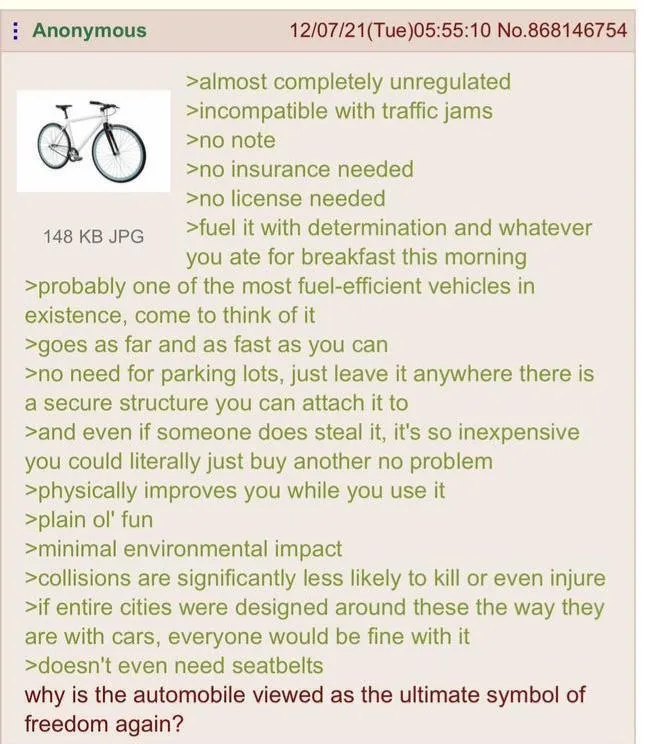
Anon likes bikes
A place to discuss problems of car centric infrastructure or how it hurts us all. Let's explore the bad world of Cars!
1. Be Civil
You may not agree on ideas, but please do not be needlessly rude or insulting to other people in this community.
2. No hate speech
Don't discriminate or disparage people on the basis of sex, gender, race, ethnicity, nationality, religion, or sexuality.
3. Don't harass people
Don't follow people you disagree with into multiple threads or into PMs to insult, disparage, or otherwise attack them. And certainly don't doxx any non-public figures.
4. Stay on topic
This community is about cars, their externalities in society, car-dependency, and solutions to these.
5. No reposts
Do not repost content that has already been posted in this community.
Moderator discretion will be used to judge reports with regard to the above rules.
In the absence of a flair system on lemmy yet, let’s try to make it easier to scan through posts by type in here by using tags:
cross-posted from: https://aussie.zone/post/34370513
Anon likes bikes
Not only are bikes one of the most efficient forms of transport, they might be the most efficient form of powered locomotion, period. A human being on a bicycle is far more efficient than anything in nature.
ETA: Unless you consider e-bikes a separate category, since they (can) add regenerative braking on top of everything else.
Yes, actually:
(Besides a 'velomobile', anyway ... which is basically just a bicycle with bodywork for better aerodynamics.)
Death sentence to whoever chose to animate a fake scatter plot over this thing. And yeah velomobiles are just speed-optimized bicycles.
Finally a graph that dares to compare cows and jet fighters!
Probably not the only graph that does so. Both are relevant sources of greenhouse gas emissions as well, so they probably share some graphs on the topic of climate change.
Mice should be ashamed of their inefficiency.
This is so cool. Why do I intuitively expect the efficiency should increase with the Y axis instead through? It feels somewhat upside down?
The Y axis is cost of transport, low cost = high efficiency.
Now if we could just get a salmon on a velomobile
Velomobile looks like fun but they cost so much. Seems like they are typically custom built and use carbon fibre. So several thousand or more. Meanwhile my bike was like £600.
Correct me if I'm wrong, but I assume that the main upside of a velomobile is removing the un-aerodynamicality of the human on it
Which makes me wonder whether a bike without a biker will be more aerodynamic than a velomobile
curious where lighter than air vehicles and trains end up on there
Blimp efficiency depends on size, a big one would be on the bottom right. But then some wind would send it tumbling around and it would crash into Jet transport and Horse, rapidly disintegrating as it pulverizes Human on a velomobile against the bottom axis.
Same as sailing ships I suppose, if you are just using the wind like a hot air balloon anyway.
It would be very difficult to measure how much energy (in calories) a sailing ship is using in order to move.
The notion of "fuel efficiency" kinda stops making sense for a sailboat.
Actually, the vast majority of e-bikes do not have regenerative braking.
Because on a bike, you don't actually tend to use your brakes very much or very often. And even when you do use the brakes, you're slowing a smaller mass down from a lower speed (compared to cars with regen braking). There's just not much energy there to be harvested from regen braking. Which makes it generally not worth the extra money, weight, and complexity to include a regen braking system.
Interesting, didn't realize.
I don't think most e-bikes have regen braking... Maybe the really expensive ones might...
regenerative breaking on a bicycle ? not on mine thank god. I often coast down hills, last thing i want to have to do is pedal so the damn bike don't brake
I'm not sure why anyone would design it like that. I would expect it to be linked to the brake handles, not active at all times.
No one would do that. On mine it's a switch but most are wired to the brakes as you mentioned. The main benefit is really just that you get brakes for free without any wear, though it is only generally possible on direct drive hub motors.
I have a hybrid with regenerative breaking. I'm not sure how well it compare to a theoretical regenerative ebike setup, but at least with my car I never need to use the gas even when the regenerative ebike is on.
That, and when I do give it gas it automatically decreases the regenerative breaking, which I imagine wouldn't be too hard to implement on a bicycle.