this post was submitted on 12 Mar 2026
567 points (99.1% liked)
History Memes
2910 readers
1000 users here now
A place to share history memes!
Rules:
-
No sexism, racism, homophobia, transphobia, assorted bigotry, etc.
-
No fascism (including tankies/red fash), atrocity denial or apologia, etc.
-
Tag NSFW pics as NSFW.
-
Follow all Piefed.social rules.
-
History referenced must be 20+ years old.
-
Avoid posting AI-generated content whenever possible.
Banner courtesy of @setsneedtofeed@lemmy.world
OTHER COMMS IN THE HISTORYVERSE:
- !historyruins@piefed.social
- !historyart@piefed.social
- !historyartifacts@piefed.social
- !historyphotos@piefed.social
- !askhistorians@piefed.social
founded 1 year ago
MODERATORS
you are viewing a single comment's thread
view the rest of the comments
view the rest of the comments
That's why long eſs is a ſuperior letter to ſtart uſing again. No controverſy with this fun letter. And the rules for uſage mean you're conſtantly on your toes!
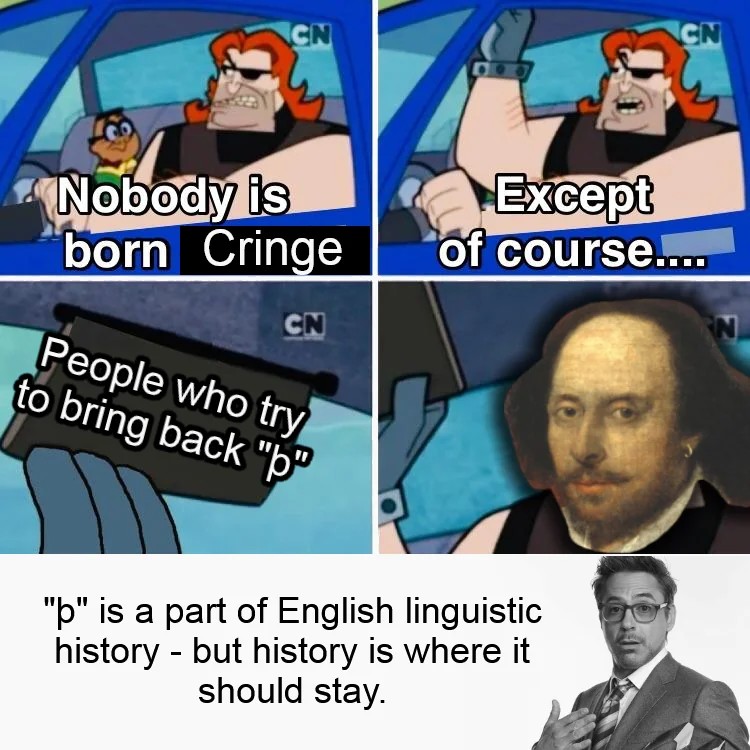
While I get the joke, and well done on it, I think the difference is that there is no real reason for the long s. It doesn't actually change anything or make anything more predictable. Thorn and eth (to a lesser degree) serve an actual purpose in differentiating an actual sound distinction. If we're using thorn for all TH sounds, then it's right back in the same boat. But if we use it to make a voice/unvoiced distinction, then it does serve a purpose. Whether that purpose is worth serving is another question entirely
Excuse me, but long s is a narrower letter so it saves space, which in an electronic world is… uh… well, okay, it's not at a premium. :)
Good point on thorn/eth. I suppose the complication is having to use four new letters (caps/lower) to replace two old letters (well… four old letters, caps/lower again. heh). On any sort of serious note? Eh. There's so much with English anyway, cobbled together from so many languages… I'm not sure I'd argue to solve just that problem. But I'd be fine enough with it if it became a thing, sure.
And it wouldn't be too terrible in most cases to make it work. I'm a fan of the compose key, and frankly, compose+fs for long ess isn't bad; same with compose+th for þ, compose+TH for Þ. And dh/DH for ð/Ð. It slows down typing a little bit to hit three keys instead of two (compose+dh instead of just th), but it's really not a big deal. I use symbols like £€°¿‽≠—é and many more only barely thinking about them because I use them a lot. And before Lemmy, using ¹ a lot because Lemmy has built-in footnotes, but I manually made my own elsewhere. heh.
I wish more people used the compose key to use the real symbols. They're there, and they're more pleasant to read. :) (and Windows users have wincompose to give them the compose key)