this post was submitted on 03 Mar 2026
551 points (100.0% liked)
History Memes
2381 readers
5 users here now
A place to share history memes!
Rules:
-
No sexism, racism, homophobia, transphobia, assorted bigotry, etc.
-
No fascism (including tankies/red fash), atrocity denial or apologia, etc.
-
Tag NSFW pics as NSFW.
-
Follow all Piefed.social rules.
-
History referenced must be 20+ years old.
Banner courtesy of @setsneedtofeed@lemmy.world
OTHER COMMS IN THE HISTORYVERSE:
- !historymusic@quokk.au
- !historygallery@quokk.au
- !historyruins@piefed.social
- !historyart@piefed.social
- !historyartifacts@piefed.social
- !historyphotos@piefed.social
founded 11 months ago
MODERATORS
you are viewing a single comment's thread
view the rest of the comments
view the rest of the comments
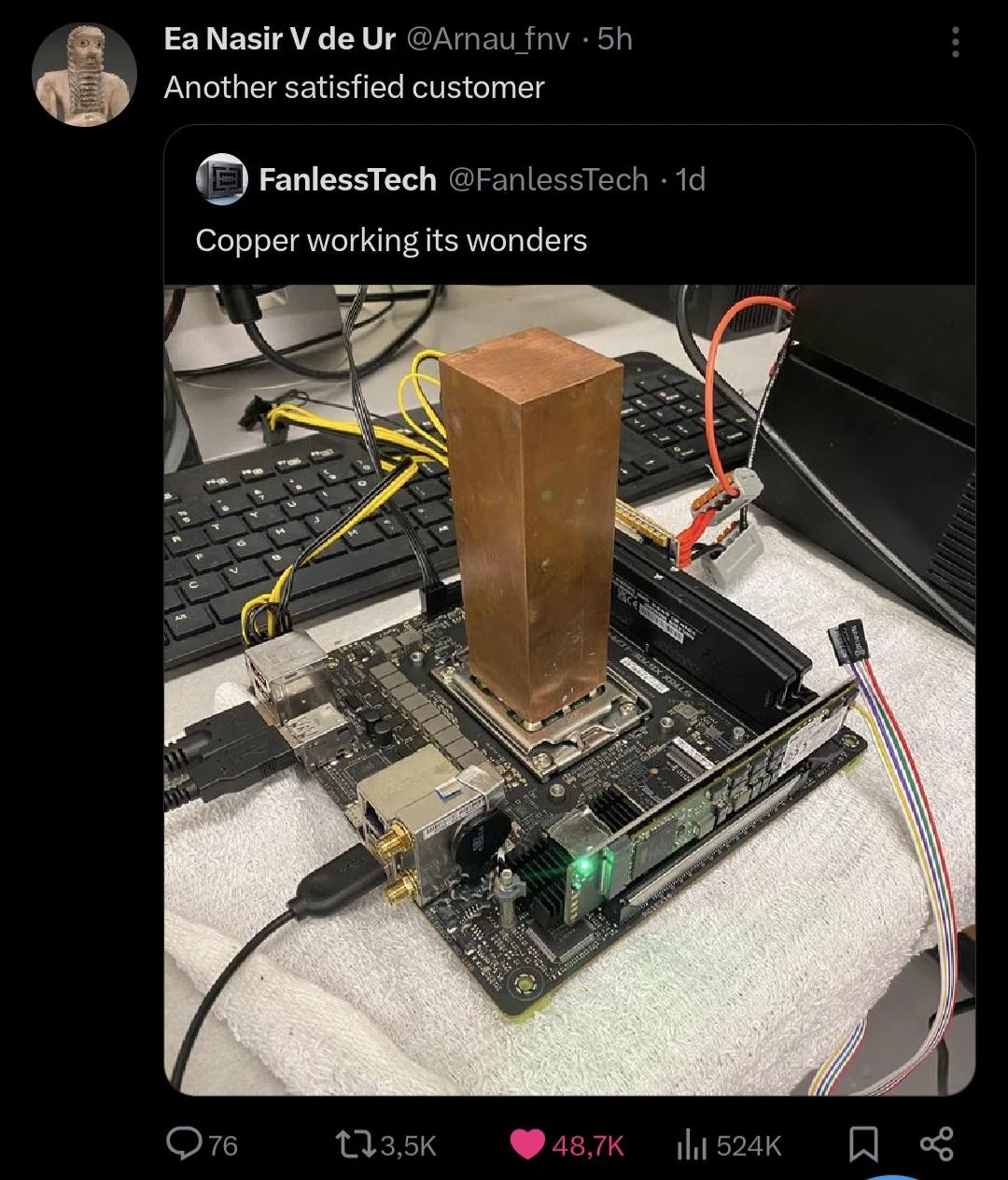
Copper is actually ~25-250X leas efficient at transferring heat than a heat pipe and convection is hundreds of times more efficient than radiation at transferring heat and the fins on a heat sink would have hundreds of times less surface area for dissipating heat all that is to say this might work but it would be orders of magnitude less efficient than a standard heat sink.
Heat pipes are fucking magic and you can't convince me otherwise
PHASE CHANGE IS LIFE
I am in my 40s and almost every day it still pops back into my head how freaking amazing it was in high school chemistry watching water in the beaker above the bunsen burner stay the same temperature while all that damn energy went into the phase change.
I also have a pond in my back yard as a hobby. The ice has pretty much all melted now, after a lot built up during the very cold weather we had a while back. But holy hell, I started up the waterfall pump while there was still ice in places but water could flow. I had big slabs of ice that were in MOVING water and did not melt for DAYS because the water was almost the same temperature. It looked wrong, but the energy just wasn't there to do otherwise.
But without this ridiculous heatsink, we never would have gotten the most perfectly nerdy Lemmy post.
And to give it credit, I think this design wins for how much heat you can sink into the heatsink itself before you need somewhere else to put it!
It might? The only thing is that Heat pipes still transfer heat faster than copper and the air from the fan moves the heat faster than it travels through the copper, the only question is is that enough faster to make up for the speed it takes to transfer the heat from the fins into the air that is all technically radiative and thus slow but it's only hundreds of times slower and as I already said the heat sink would be orders of magnitude faster so I doubt it.
Oh I don't doubt that it would suck at it. It would just hold a lot of the heat within itself, eventually, lol.
That's the joke.
I assume the joke was either how expensive or how heavy it would be.
Yeah, but won't it also be much cheaper than machined, branded stuff?
Considering you can get a half decent tower cooler from aliexpress for like $10, probably not.
Guess we need to do a Cu block vs cheap Ali Express cooler comparison.
Cooling ability for the given workload (probably not much if the customer was satisfied by this one) and noise.
I would say it would have been much better to have the block wider at the top (trapezoidal vertical x-section). That way it could give even better cooling performance.
Water moving is much better at removing heat than heat pipes could ever imagine. It depends on how fast the mass of water is moving.
I'm pretty sure the way heat pipes move heat is with water funny enough
Phase changing water
Yup, phase changing. Water in vacuum has to touch the heat source, evaporate, travel to the cooler side, condense and start over. As soon as your heat source prevents the cooling from happening, the cycle stops and it over heats. Like there's a point at which the water can't cool the source because its overwhelming.
What do you think heat pipes contain? Basically the same thing as water cooling systems.
Water cooling is basically a misnomer - it's basically a heat relocation system that that gets the heat moved to what are usually air coolers that pass the heat off into the air. If the airflow in your PC is ideal and smart enough, no need for water cooling, you can air cool at the source at nearly the same efficiency, no need for a pump. It's not as easy to manage in terms of space, but it has less maintenance issues.
I mean to say that a heat pipe not only contains less water per unit area for the phase changing cycle, since its under vacuum, but also the cycle only works at a particular heat per unit volume and temperature range. If you go past the temp range you get runaway.
Water in an active cycle has an almost unlimited ability to relocate heat. You still need to give that heat to something else, but you can pass a kilo of water thru a tiny labyrinth of fins at the heat source and a large surface area radiator with fan on the heat sink side. Vs a few ounces of water trapped inside a pipe running as a heat engine basically. Active pumping is brute force. At some point you won't be able to contain the water pressure if your source is too hot, but there are many different working fluids.
Its irritating when we try designing a new cooling system at work and some guy will always want a heat pipe when clearly there is only a narrow band where those things are effective. Specially annoying if you don't have control over the heat source. If you did have control over the source, then maybe you can tune it for a heat pipe. Car engines don't have heat pipes. Solar collectors don't use heat pipes either for the most part. Heat pipes need a constant source of heat that always stays below their max bandwidth.
It doesn't work for a lot of things, but your PC is basically a couple of flat panels where a lot of heat produced is localized to the GPU and CPU and it is potentially very easy to maintain a directed airflow close to them. A heatsink is basically good enough for that, and almost every GPU incorporates one, even the 5090's, even though the airflow design usually sucks for all of them because of how generic it is. Speaking of car engines, you can go a step better and precisely control the airflow to get great cooling results just with air cooling: https://www.youtube.com/watch?v=cehXZftIYok
I see your point, but if it works nearly as well, why go for a costlier solution that requires more maintenance and lasts less when it doesn't require it?
I feel the need to point out that water cooling has an upper limit as well. If you get things hot enough, the water is going to flash into steam, at which point it’s going to decimate whatever system it’s in.
You can add additives to prevent that, but at some point it’s no longer “water”.
Reading this back, I suppose this is pedantism. But still.
Yeah, you control the flashpoint via pressure. the higher the pressure, the higher the temperature. However at some point it makes more sense to use a molten salt, an oil or a liquid metal to transport heat away.
If the temperature is near 20C to 100C there's nothing like flowing water.