this post was submitted on 12 Feb 2026
166 points (100.0% liked)
History Memes
1946 readers
633 users here now
A place to share history memes!
Rules:
-
No sexism, racism, homophobia, transphobia, assorted bigotry, etc.
-
No fascism (including tankies/red fash), atrocity denial or apologia, etc.
-
Tag NSFW pics as NSFW.
-
Follow all Piefed.social rules.
-
History referenced must be 20+ years old.
Banner courtesy of @setsneedtofeed@lemmy.world
OTHER COMMS IN THE HISTORYVERSE:
- !historymusic@quokk.au
- !historygallery@quokk.au
- !historymemes@piefed.social
- !historyruins@piefed.social
- !historyart@piefed.social
- !historyartifacts@piefed.social
- !historyphotos@piefed.social
founded 9 months ago
MODERATORS
you are viewing a single comment's thread
view the rest of the comments
view the rest of the comments
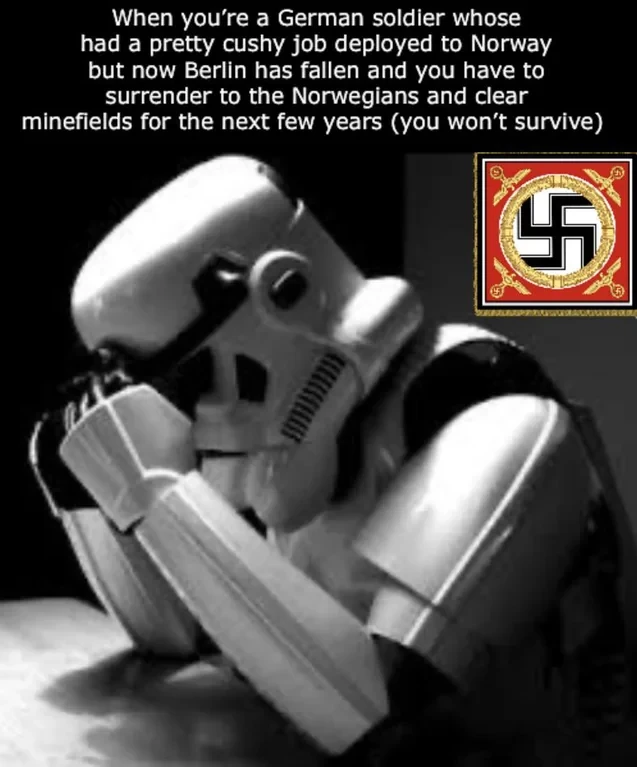
Explanation: After WW2, Norway, using a very dubious interpretation of international law, forced German PoWs to disarm the minefields that the Nazis themselves had laid down in Norway - a very dangerous task. This was pretty well illegal, but none of the Allies after WW2 had the motivation left in them to quarrel over international law with a member of the coalition who had spent years under Nazi occupation. Hundreds of German PoWs died, and thousands were injured.
Denmark would also use German PoWs to clear minefields, but by a negotiated surrender agreement, and using German PoWs with pre-existing demining experience, which is a bit less objectionable, but still illegal under international law.
This was done by all the allies, not just Norway and Denmark. In 1945 none of the allies had motivation to stop Norway, since they themselves had decided to do it this way. https://en.wikipedia.org/wiki/Forced_labor_of_Germans_after_World_War_II
Even mine sweeping at sea was done by German sailor POWs. https://en.wikipedia.org/wiki/German_Mine_Sweeping_Administration
As legal justification as to why they could do this, the allied command claimed that these prisoners of war weren't POWs anymore after Germany surrendered, instead they were "Disarmed Enemy Forces" and thus according to them the Geneva convention no longer applied: https://en.wikipedia.org/wiki/Disarmed_Enemy_Forces
There's also a Danish film about these POWs: Land of Mine. Good movie imo. And after seeing it a few years ago, I looked up the historical background, which is how I knew that your comment was incorrect.
The movie is also partially incorrect, as Danish military wasn't involved in the clearing, it was overseen by British officers.
I just assume that every historical movie contains inaccuracies. Narrative reasons, budget constraints, dramatization, ... I don't always agree with the creative choices, but I understand why they do it and I'm not going to let it ruin my viewing experience. I can always jump into a wikipedia rabbit hole after the movie.
I can only think of one movie where they went too far for my tastes: the Hollywood movie where it's USA soldiers who capture an intact enigma machine from a u boat.
That said, the danish military was involved in the mine clearing, only not in the way how it was depicted in the movie. https://commons.lib.jmu.edu/cisr-journal/vol22/iss1/4/ The actual pdf contains a better description of who did what than the abstract.
I never knew this.
I don't feel any shame about that part of history.
You should know that it isn't very close to what actually went down. It was the British forces who had negotiated this as part of the surrender deal with the German forces. It was British forces who oversaw the mineclearing process (in Denmark).
You know what? I am okay with this!
Mm. A lot of them were young conscripts. Just kids. And violating international law with dubious arguments doesn't sit right. With me, at least.
I don't know that I have any strong condemnation for the occupied countries who used German PoWs in that way, considering that the question becomes who is going to die rather than if someone is going to die with the post-war situation being what it was. But it's still something that sits uneasy.
The even larger issue, one that underpins a lot of laws of warfare, is that you want people to have every good reason to surrender. If POWs have to be treated according to specific laws, then everyone knows approximately how bad it can be, and they all know that at the worst, they can surrender. If you can set POWs to work clearing minefields or commit any other given atrocities against them, then armies have every reason to fight to the death rather than surrender when backed into a corner, and that doesn't do anyone any good.
it's a fair point. but the reality of many wars reaching a point of "total war" ware both sides abandon any rules agreed to or even within their own cultural norms, it has a limit to how effective it will be.
surrendering in a losing war very early and quickly is wise, but few people who are running a country at war are wise or motivated by any form of loss reduction.
I knew a professor from Austria who was 15 near the end of the war. His school gave the class a choice of enlistments: Army, Navy (u boat), or airforce. He said none and was mocked and shunned by his classmates. When the tanks rolled into town he was handed a rifle and promptly ran up to the first tank to surrender.
It’s not near the hundred worst things that happened due to WW2, though it’s not alright either.
have you dealt with teenagers?
Hell, have you dealt with Toddlers? they will look you in the eye while asking you if the thing they are actively doing , which they KNOW they are not meant to do , is an OK thing to do.
If your ass ended up in the nazi army, fucking go clear that minefield. You enjoyed setting it up, now dismantle it you sack of shit.
... okay? I don't understand the relevance there.
Considering the conscription policies and casualty rates of Nazi Germany, it's doubtful that many of those involved in setting up the minefields were sent to disarm them after the war.
Most people, when confronted with the possibility of execution for refusal, will not become valiant martyrs when presented with a conscription notice. Nor will most people develop in such a way as to preplan their martyrdom against the social norms of their society out of some inborn shared morality. Kids in particular lack the life experience to know just how fucked what they're being told is. Fuck, man, an entire generation volunteered to die on the fields of WW1 because dumb 18-20 year old kids were told it was sweet and fitting to die for their fucking country.
The point of totalitarian states is the subversion of the whole of society, to the point where it is nearly impossible to get by without some level of 'compromise' of oneself. I don't really see the position that everyone who didn't resist the Nazis is deserving of a gruesome death. The Morgenthau Plan is more along those lines, if you want to get into the business of genocide-for-genocide.
Anyone wearing a fascist's uniform is fair game during the war. Anyone wearing a fascist's uniform should be investigated and prosecuted for anything done during the war. But taking the dregs conscripted by the end of the war and treating them all as full partners in the Nazi experiment, and equally deserving of punishment for the regime's crimes?
Nah, man. I'm not going to condemn the occupied countries for going that route given their circumstances, but I'm also not going to pretend like it's not an immensely ugly choice that was made.
Forced to mine at gunpoint.
Forced to demine at gunpoint.
This has nothing to do with anything you posted.
They liked following orders so much.
That is an incredibly wrong summation of events. It was the allied forces who literally wanted this, and it was them who carried out the main part of this process.