132
U.S. ambassador gives prime minister the cover he needs to cut Canada’s F-35 order
(ca.news.yahoo.com)
This. Truly sustainable practices require a considerably lower profit margin per acre, thereby forcing the parasitical middlemen to give farmers more without utterly hosing the consumer for all that they are worth.
And some overproduction is required to handle lean years. While you cannot keep fruit fresh for years, you can convert it into almost-analogous forms like flash-frozen in the field, within minutes of being picked, such that it can bridge the gap in lean years.
So there always will be some overproduction and some waste in the system, but not to the point where it needs to be intentionally made inedible so it cannot be given away, in order to create artificial scarcity to sustain market prices.
Except… the “eco-fascists” are also not wrong.
The healthy carrying capacity of a pre-modern civ Earth has been estimated at 2 Billion humans at a totally vegan diet. Bring a Western diet into the picture, and that drops to somewhere between 1B and 500M people.
I mean, yes, you can put every arable square meter of soil under agriculture and feed many more billions than exist. But this would utterly destroy the ecosystem within a few short years, causing a subsequent collapse of humanity to zero. A healthy ecological balance has 80+% wild areas - defined as anything more than 10km from any human access - and by comparison less than 2% of CONUS meets this definition.
And having overshot the planet’s carrying capacity by more than 4×, we have also caused a corresponding decline in that carrying capacity via ecosystem degradation, pollution, soil erosion and innumerable other stressors. If humanity is to see a significant collapse that includes tech collapse (fertilizer production, etc.), we will be exceedingly lucky to come out the far side with more than a few tens of millions of people planet-wide.
And for reference, before European colonization North America was likely to have had as many as 300M natives before disease emptied the continent.
If you were using any other form of RAID across multiple drives, you would be absolutely correct.
Simple mirroring? From what I have seen, that’s better done as HW RAID. There is no need to introduce software latency into a mirror RAID, and no benefit from file systems in a mirror.
And finally: how often are you going to be moving any boot drive from one system to another? I have been working with computers since 1982 and in the IT industry since 1997, and I have done this - for myself - a grand total of once. In every other case, I have wanted to use a newer or better drive in the new system, or wanted to re-do the install because reasons.
Do we know that?
Ran across a paper years ago that did confirm this, but laid out various reasons why, including:
As the saying goes, your kid didn’t become a “dirty leftist/commie” because they were indoctrinated by their professors. They became one as a reaction to being exposed to the wider world and all of its variety.
To be liberal requires empathy. A deep understanding of others and their situations and the knowledge that your own personal needs dont always automatically outweigh others.
Not strictly necessarily. For me, it comes down to logic, reason, and evidence.
I’m neurodivergent. This means that among some mild cognitive superpowers, I also have some significant weaknesses, such as an inability to understand or even recognize the inner workings of others. Essentially, the first half of your second sentence, above. That simply isn’t in my wheelhouse, no matter how hard I try. It’s analogous to asking a blind person to pick out the colour red.
But I reach the same place - the second half of the second sentence - by using logic and reason and evidence - and in many cases, science - to come to an understanding of what is correct and good and right and how the needs of others simply don’t restrict my own personal needs in any way, and so carry equally as much importance and have all the same ability to be fulfilled without conflict. And because some of these people are disadvantaged or oppressed, it is my duty as a fucking human being to have their back whenever I have a decent opportunity to do so.
This is because reality itself has a strong left-leaning bias, and intelligence makes you encounter that a lot more as you interact with reality.
Sure, there are highly intelligent right-wingers, but intelligence only gives you the cognitive tools to discover reality, it doesn’t force you to use them. Just because a person is intelligent doesn’t mean they can’t slide off into wharrderp fantasy land.
If you cut onions with a knife, sure. I use a Japanese mandolin called Benriner that is so sharp that I can get through several yellow onions before I start having issues.
If you ever have difficulty recording the perfect fart, pureé up a kilogram of the freshest garlic you can find, and get me a travel ticket to wherever the sound booth is. Trust me, I could get you hundreds of the most exquisite farts from even a fraction of that garlic.
Sure, some will be short and wet and of the kind where you’re going to want to ask if I need to wipe afterwards. But most will be long and sonorous and reverberate across the entire room; the kind of farts where you wonder if I’ve got a full bassoon crammed up my kiester.
Not in the least.
At this point, there isn’t much left to use aside from political violence.
And if you look through the history of effective political change away from fascism and totalitarianism, it’s pretty much 0% peaceful protest and 100% violent revolution.
Let’s start with removing members of ICE from the gene pool. I advocate castration as a long-term option of eliminating any genetic influence of fascism on future generations (low IQ, genetic propensity for authoritarianism, genetic propensity for sociopathy, etc.), but others may be in favour of methods that can more permanently prevent these fascists from terrorizing existing citizens.
Just throwing my balls around on the orchard…


I have seen these before, but for the life of me I cannot seem to recall what they are called or what they’re for.
Google search - especially image search, where I’m trying to bring up similar items - is now a total potato and seemingly capped at one screen of results in a secure and sanitized browser.

When I bring up an image by itself, I can do a long press on the image and get the app Safari drop-down interface (see attached), which gives me (along with other tools) the option to download the image to my camera roll or to copy the image for pasting elsewhere.
Unfortunately, the Avelon app blocks this action entirely.
If there is a workaround, it gives no indication as to what it is, forcing the user to thrash around and discover the box with the out/up arrow in the lower right.
If there is a way to whitelist this behaviour, there is also no way to inform the user on what setting they need to adjust.
At any rate, this is a noticeably frustrating suboptimal UI/UX, and should be addressed.

This is why Galen West is a card-carrying member of the Parasite Class.
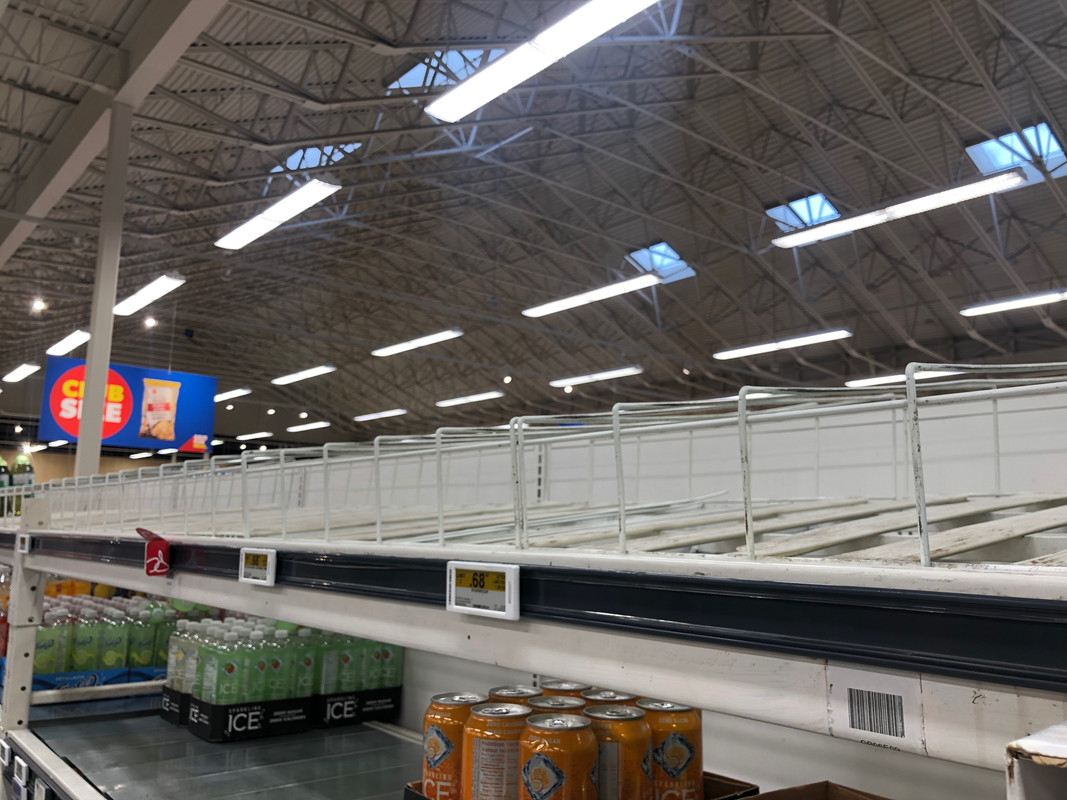
And yes, I confirmed the no-shipments, zero-stock with the store manager. 5 days and counting with no stock so far, when the sale started there was maybe 12-24 bottles for 128,000 residents in the city.
And current levels of production are the very stressors that are eroding the planet’s carrying capacity. When you have so much land taken up for agriculture, which poisons with herbicides and kills anything that gets into the fields and pollutes the waters with fertilizers and eradicates any biodiversity with monocultures, where is the room for a healthy ecosystem?
Again - CONUS has less than 2% “untouched ecosystems”. This is largely to mostly thanks to agriculture. It should be 80% or more.