74
This one included.
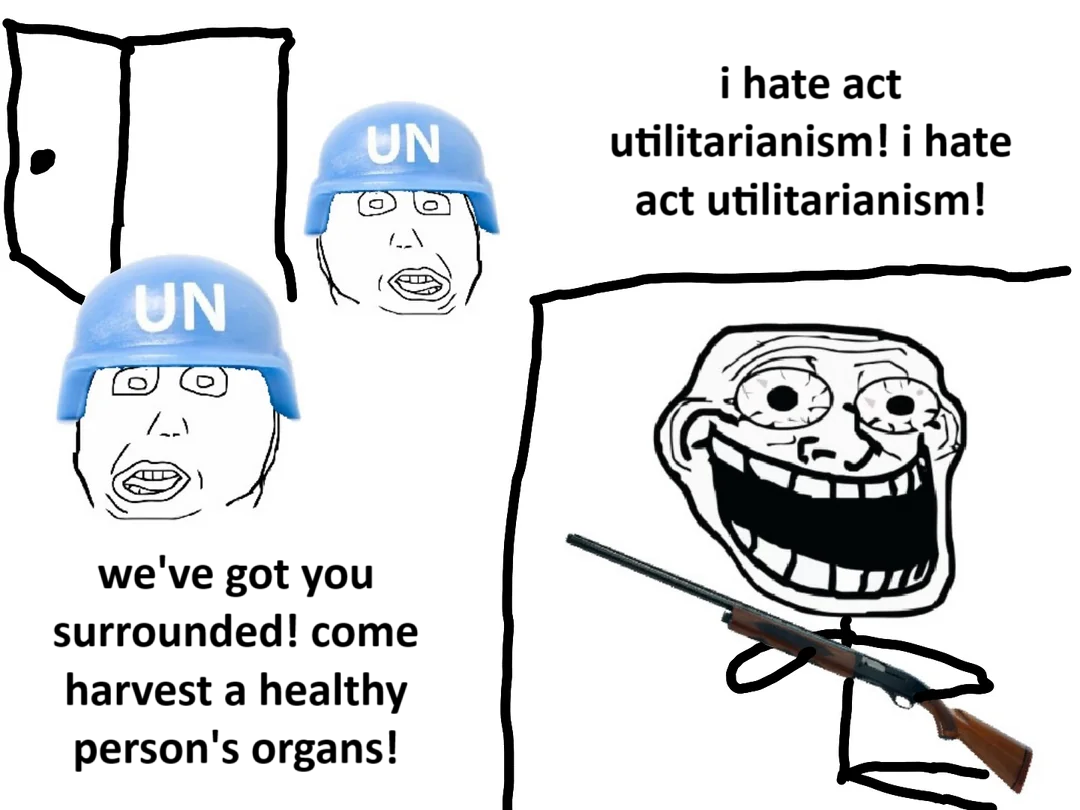
"Insane leaps of mental gymnasics," like, "Doing nothing has no impact on the election."
As opposed to "logic," like, "Doing nothing is a +0 which is neither an increase nor a decrease except also it is a decrease because it's not an increase and not increasing is the same as decreasing because zero doesn't exist."
Tell you what, if doing nothing counts as helping someone, then rest assured that I'll give Kamala my "help."
Could've said that from the start! You didn't have to die on this hill.
I don't especially want to continue the conversation into that with you after it took 20 comments of you slinging insults and shit over something that you now say doesn't matter to get here. If I have to pull teeth over something so simple, obvious, and relatively unimportant then I see no sense in discussing other stuff.
It's not as if the terms I was insisting on would make it impossible to criticize my position. There's no reason you couldn't have accepted those terms to start and continued the debate.
It doesn't matter how many times you repeat it, you'll still be as wrong as saying that I'm draining a pool by standing next to it with an empty hose. It's simply not how language works and you can twist words around and tell me otherwise a thousand times, and it just means you'll be dead wrong a thousand times.
"At fault for not fighting something" you can argue that, sure. "Benefiting," or "helping" you cannot. There is no argument, it's just definitionally false.
Letting the water evaporate is not the same as causing the water to evaporate. Letting Trump win (if he will) is not the same as causing Trump to win or helping him win. The baseline is doing nothing. If I did not exist, then the odds would be the same. Therefore I cannot be said to be helping Trump. That's just not how language works. Otherwise you could just as easily say that I'm helping Kamala by not voting for Trump, at which is a clear contradiction.
"You're helping Trump compared to if you had voted Kamala?" Fine. "You're helping Trump?" False. That is how it is and no amount of saying otherwise or trying to play games with language is going to change it.
Rank them by which benefits trump the most, and you discover that +1 for kamala is better for kamala and worse for trump.
The fact that you cannot understand this is insane.
I understand this perfectly and I have never disputed it. In fact I've said it myself.
Your inaction is still a choice that benefits the party you least support, because if you had voted for the party you don’t least support, you’d be benefitting the party you support.
Compared to voting for Kamala, yes, voting third party benefits Trump. But it is not correct to say that it benefits Trump without that qualification.
Even by your own example, not turning the water on will cause the pool to evaporate, which is not as bad as directly draining it, but still causing it to drain more than if you had done something to benefit it.
Lmao. I am not "causing" the water to evaporate. If I gather a bunch of people together to stand next to a pool of water, will each of us "cause" it to disappear faster? Am I causing every puddle in the world to evaporate right now as we speak? This is so ridiculous I can't even be frustrated or annoyed by your nonsense anymore, you're just doubling down on absurdity into full clown shit.
Really? Do Republicans talk about rejecting the ideology of lesser-evilism? Pretty sure they rely on it the same way the Demorcrats do to make people fall in line with their shitty candidate. I don't see why they'd want to undercut their support and lose every hesitant Trump voter. Pretty sure you've just decided that any and all criticism that can ever be applied to Biden or Harris is a "Republican talking point" but that doesn't make it at all true.
I haven't said any "Republican talking points," unless in their double-talk on the issue they happened to land on something similar to what I said. If so, I'm unaware of it, and they obviously don't mean it since they contradict themselves all the time. At that point, virtually any statement about anything could be called a "Republican talking point."
I of course will not be voting for Harris since genocide is a red line and unlike Biden, when I draw a red line I actually mean it. And I do not subscribe to the ideology of lesser-evilism, so I do not feel compelled at all to pick between two candidates who are both completely awful and unacceptable.
Well, it took 20 comments of you deflecting with ad hominem and baseless accusations, but you finally answered the question 👏👏👏
I swear, you waste so much time with this pointless, unproductive bullshit that it's impossible to discuss anything with you.
Can I drain a pool of water by standing next to it with a hose that's turned off? By not turning the water on, I am not increasing the amount of water in the pool, and according to you, not increasing is the same as decreasing, and it stands to reason that if I decrease the amount of water long enough, eventually there will be none left. That's the logic you're using and obviously it's nonsense.
In the same way that standing next to a pool with the hose turned off does not increase or decrease the amount of water in the pool, not voting for Kamala or Trump does not increase or decrease their chances of winning.
This is extremely simple. You are being purposely obtuse in pretending otherwise.
Grifters grifting grifters lol.
Republicans: Minorities are eating people's dogs!
Normal response: No they aren't, and if a culture does eat dogs it's no worse than other kinds of meat.
Liberal response: We're gonna get the actual dog-eating minorities!
Stop letting them define the terms of discourse, stg.
This one included.
Being a lib is so easy, you can just say anything and if it's wrong, just bring up "Tianmen" square.

cross-posted from: https://lemmy.ml/post/19534199
Before I begin, I have a confession: until recently (until today, in fact), I was a tankie. But this morning I just woke up and realized everything I believed and everything I'd been saying was wrong, and my critics were right about everything. And so, I have decided to completely and totally adopt their way of thinking.
The above image is an example to illustrate how my thinking has changed. You may be familiar with "Russell's Teapot," a thought experiment from Bertrand Russell where he imagines that someone says that there is a tiny, invisible teapot, floating out in space. He argues that while such a claim cannot strictly be disproved, it can be dismissed without evidence because there is no evidence to support it. The burden of proof is on the person making the claim. He goes on to explain that while he could not disprove the existence of God, he still considered himself an atheist, because he did not see sufficient evidence for the claim of God's existence to be credible.
In my previous (tankie) way of thinking, I would have agreed with this idea, that claims made without evidence can be dismissed without evidence. But I now understand that this made me a Bad Person. Suppose that, as in the beautiful diagram I drew in MS Paint, the claim is not only that the teapot exists, but that inside of the teapot, there are a bunch of tiny invisible people who are geopolitical enemies of the United States and they are committing genocide against innocent people. Again, before, I would have said that that only makes the claim more implausible and would require extraordinary proof. Now, I realize how wrong I was, and I can only say that I deeply regret and apologize for my statements. The existence of the teapot can be proven incontrovertibly, by the following logic:
If you claim that the teapot does not exist, you are denying that the genocide inside it is happening.
If you deny the genocide is happening, you are a genocide denier and therefore a fascist.
Fascism is wrong.
Therefore, it is impossible to correctly deny the teapot's existence.
As a brief aside, I should mention that in addition to my political conversion, I have also experienced a drastic change in my religious beliefs, as it is now trivially easy to prove that God exists. According to the Torah, God flooded the world, wiping out virtually all of humanity, including countless ethnic groups. To deny the existence of God makes you a genocide denier and a fascist. However, it should be added that to worship God is genocide apologia, which is also fascist. The only non-fascist belief, which is necessarily correct, is that God exists and is evil. Moving on.
Before, I believed that it was ridiculous for the US to spend as much on the military as the next 9 countries combined. I wanted to slash the military budget to fund domestic spending, schools, hospitals, making sure bridges don't collapse, helping the poor, etc. I see now how wrong I was. The Genocide Teapot exists, somewhere out there in space, in fact, there could be countless numbers of them out there. Therefore, the real progressive thing to do is to further cut domestic spending and have everyone tighten our belts so that we can produce as many missiles as possible, to be fired out into space indiscriminately, in hopes of hitting a Genocide Teapot.
However, we must also consider the possibility that these teapots could be located here on Earth too. Teapots are a form of china, which is a very suspicious connection. Clearly, the US must be permitted to inspect every square inch of China in search of these invisible teapots, and refusal to comply should be considered an admission of guilt. But we should not, of course, limit ourselves to China. Perhaps there are Genocide Teapots in Russia, or Brazil, or Germany, or Canada, who knows? I do, because to deny that Genocide Teapots exist in all of those places is genocide denial, which is fascist and wrong.
In conclusion, we should bomb every country in the world simultaneously, including ourselves, and anyone who disagrees with me is a war-loving fascist.
Thank you.

Before I begin, I have a confession: until recently (until today, in fact), I was a tankie. But this morning I just woke up and realized everything I believed and everything I'd been saying was wrong, and my critics were right about everything. And so, I have decided to completely and totally adopt their way of thinking.
The above image is an example to illustrate how my thinking has changed. You may be familiar with "Russell's Teapot," a thought experiment from Bertrand Russell where he imagines that someone says that there is a tiny, invisible teapot, floating out in space. He argues that while such a claim cannot strictly be disproved, it can be dismissed without evidence because there is no evidence to support it. The burden of proof is on the person making the claim. He goes on to explain that while he could not disprove the existence of God, he still considered himself an atheist, because he did not see sufficient evidence for the claim of God's existence to be credible.
In my previous (tankie) way of thinking, I would have agreed with this idea, that claims made without evidence can be dismissed without evidence. But I now understand that this made me a Bad Person. Suppose that, as in the beautiful diagram I drew in MS Paint, the claim is not only that the teapot exists, but that inside of the teapot, there are a bunch of tiny invisible people who are geopolitical enemies of the United States and they are committing genocide against innocent people. Again, before, I would have said that that only makes the claim more implausible and would require extraordinary proof. Now, I realize how wrong I was, and I can only say that I deeply regret and apologize for my statements. The existence of the teapot can be proven incontrovertibly, by the following logic:
If you claim that the teapot does not exist, you are denying that the genocide inside it is happening.
If you deny the genocide is happening, you are a genocide denier and therefore a fascist.
Fascism is wrong.
Therefore, it is impossible to correctly deny the teapot's existence.
As a brief aside, I should mention that in addition to my political conversion, I have also experienced a drastic change in my religious beliefs, as it is now trivially easy to prove that God exists. According to the Torah, God flooded the world, wiping out virtually all of humanity, including countless ethnic groups. To deny the existence of God makes you a genocide denier and a fascist. However, it should be added that to worship God is genocide apologia, which is also fascist. The only non-fascist belief, which is necessarily correct, is that God exists and is evil. Moving on.
Before, I believed that it was ridiculous for the US to spend as much on the military as the next 9 countries combined. I wanted to slash the military budget to fund domestic spending, schools, hospitals, making sure bridges don't collapse, helping the poor, etc. I see now how wrong I was. The Genocide Teapot exists, somewhere out there in space, in fact, there could be countless numbers of them out there. Therefore, the real progressive thing to do is to further cut domestic spending and have everyone tighten our belts so that we can produce as many missiles as possible, to be fired out into space indiscriminately, in hopes of hitting a Genocide Teapot.
However, we must also consider the possibility that these teapots could be located here on Earth too. Teapots are a form of china, which is a very suspicious connection. Clearly, the US must be permitted to inspect every square inch of China in search of these invisible teapots, and refusal to comply should be considered an admission of guilt. But we should not, of course, limit ourselves to China. Perhaps there are Genocide Teapots in Russia, or Brazil, or Germany, or Canada, who knows? I do, because to deny that Genocide Teapots exist in all of those places is genocide denial, which is fascist and wrong.
In conclusion, we should bomb every country in the world simultaneously, including ourselves, and anyone who disagrees with me is a war-loving fascist.
Thank you.
President Trump kept America out of new wars and brought thousands of brave troops home from Afghanistan, Iraq, Somalia, and many other countries. Joe Biden has undermined our military readiness and surrendered our strength to the Taliban.
When Trump pulls troops out of Afghanistan, it's "bringing thousands of brave troops home," but when Biden does the same, it's, "surrendering our strength to the Taliban." He brags about "keeping America out of foreign wars" while at the same time bragging about assassinating "the world's number one terrorist," Iranian general Qasem Soleimani, which was an extreme act of provocation.
This is taken from the issues page of Trump's campaign website, and there are several more statements relating to foreign policy, frequently and boldly contradicting each other. It's a perfect example of the "If By Whiskey" tactic. So what's actually going on here? Well, to understand the reasons for this equivocation, we need to analyze the foreign policy positions of Americans.
Broadly speaking, people fall into one of four camps: Idealist Hawk (liberals), Idealist Dove (libertarians), Realist Hawk (nationalists), and Realist Dove (socialists).
Idealist Hawks believe that US foreign policy is driven by benevolence and spreading freedom, and the fact that it repeatedly fails to do so (Iraq, Afghanistan, Vietnam, etc) is explainable by a variety of excuses. Generally, they are more interested in current events and easily persuaded to support intervention based on seeing a bad thing happening, without a broader analysis or explanation of the situation or how things have played out historically.
Idealist Doves also believe that US foreign policy is driven by benevolence, but they see that as a bad thing. They are generally right libertarians or hold libertarian values, they see war as another example of wasteful government spending as it tries and fails to improve people's lives, which they generally don't see as a valid goal in the first place. Being idealists, they are still rather easily duped into supporting war and militarism, often, they will support a "night watchman state," with police and the military being the only legitimate functions.
Realist Hawks are nationalists who believe that states pursue their own material interests and are right to do so. They are incapable of distinguishing between the state's interest and their own. Some few are rich enough to actually receive benefits from US foreign policy, but most just root for America in the same way that they might root for a football team.
Realist Doves, which I am a part of, do not believe that US foreign policy is not grounded in benevolence and does not benefit the people it claims to be helping, but also (generally) that it doesn't benefit the majority of people at home. We see it as being driven by and for class interests, and are opposed to the class it benefits.
Trump's foreign policy equivocation, and his "America First" slogan allows him to appeal to both the Idealist Doves (libertarians) and the Realist Hawks (nationalists). He can't consistently take any line on any specific thing. If by Afghanistan, you mean a disastrous nation-building exercise, wasteful government spending, and endangering our troops for the sake of helping foreigners, then of course Trump opposes it. But if by Afghanistan, you mean exerting American strength, intimidating Russia and China, and weakening terrorists to keep America safe, then of course Trump supports it.
In reality, to the extent that Trump has coherent beliefs at all, he is a Realist Hawk, a nationalist, and his record reflects that. But part of the reason he was able to get anywhere was because he was able to triangulate and equivocate well enough to dupe anti-war libertarians.
Unfortunately, in American politics, the conflict is generally between Idealist Hawks and everyone else. This is part of what allows the nationalists and libertarians to put aside their differences (the other part being that libertarians are easily duped). Realist Doves are not represented anywhere, the Idealist Interventionists consider us Russian bots along with everyone else who disagrees with them on foreign policy (regardless of how or why), the Idealist Doves are extremely unreliable, and the Realist Hawks may see the world in a similar way but have diametrically opposed priorities.
tl;dr: Trump's halfhearted antiwar posturing is an obvious ruse that only an idiot would fall for, but painting everyone skeptical of US foreign policy with the same brush helps him to sell it and to paint over ideological rifts that could otherwise be potentially exploited.

What is Soulism? Soulism, also known as anarcho-antirealism, is a school of anarchist thought which views reality and natural laws as unjust hierarchies.
Some people might laugh at the idea and say it's not a serious ideology, but this is no laughing matter. If these people are successful, then consensus reality would be destroyed and we would return to what the world was like before the Enlightenment. What did that world look like? Well, you had:
Ultra-powerful wizards hoarding knowledge in high towers, reshaping reality to their whims, with no regard for the common people
Bloodthirsty, aristocratic vampires operating openly, and on a much larger scale than they do today
Viscous, rage-driven werewolves terrorizing the populace, massacring entire villages with reckless abandon
Fey beings abducting children and replacing them with their own
Demons and angels waging massive wars against each other with humans caught in the crossfire
Fortunately, out of this age of chaos and insecurity emerged a group of scientists dedicated to protecting and advancing humanity by establishing a consensus reality and putting a stop to these out-of-control reality deviants.
Before, if you got sick or injured, you'd have to travel across the land through dangerous enchanted forests seeking a skilled faith healer or magical healing potion. But with consensus reality, easily accessible and consistent medical practices were instilled with the same magical healing properties. Once, if you wanted to transmute grain into bread, you had to convince a wizard to come out of their tower and do it, and they were just as likely to turn you into a newt for disturbing their studies. But thanks to consensus reality, anyone could build their own magical tower (a "mill") and harness the mana present in elemental air to animate their own "millstones" to do it! These things were only made possible by consensus reality.
Now, I'm not saying that this approach doesn't have it's drawbacks and failures, and I'm not going to say that the reality defenders have never done anything wrong. But these "Soulists" want to destroy everything that's been accomplished and bring us back to the times when these supernatural reality deviants were more powerful than reason or humanity, and constantly preyed upon us.
So do not fall for their propaganda, and if you see something, says something. Anyone altering reality through belief and willpower, or any other reality deviants such as vampires or werewolves, should be reported immediately to the Technocratic Union for your safety, the safety of those around you, and, indeed, the safety of reality itself.
Thank you for your cooperation.

So we're back to this idea that there is fundamentally no way for me to hold my position or defend it without you calling it bad faith and accusing me of being a secret Republican, regardless of anything I say or don't say. Any disagreement, any criticism of Harris or Biden whatsoever, is a "Republican talking point," and I'm expected to craft this completely delusional worldview where I ignore all their faults rather than acknowledging reality.
Completely ridiculous.