NateNate60

joined 2 years ago
[–] NateNate60@lemmy.world 2 points 1 day ago (1 children)

Even though England was a republic in name, really it was "more of the same" with the office of Lord Protector as head of state for life with powers similar to the king and the power to appoint his successor.

[–] NateNate60@lemmy.world 12 points 1 day ago (3 children)

This reminds me of the Indemnity and Oblivion Act.

After Charles I of England was overthrown and England was declared a republic, the House of Commons seized control of supreme legislative authority and enacted various laws to govern the country without monarchy. The republic collapsed after a decade, and Charles II was crowned king again. Parliament then enacted the Indemnity and Oblivion Act, which nullified all laws passed by the republican parliament, and it even pardoned almost everyone who was convicted of a crime during that time.

[–] NateNate60@lemmy.world 10 points 1 week ago (3 children)

Yes, progress is fragile and needs constant defending. This is an important observation you have made.

[–] NateNate60@lemmy.world 12 points 1 week ago (5 children)

No, but during the eight years after him, we did get:

  • Consumer Financial Protection Bureau
  • Dodd-Frank Wall Street Reform Act
  • Affordable Care Act
  • Repeal of "Don't Ask, Don't Tell" policy
  • Removal of 180-limit for wage discrimination claims
  • Withdrawal of US forces from Iraq
  • Paris Climate Agreement
  • Deferred Action for Childhood Arrivals
  • Clean Power Plan
  • Shepard & Byrd Hate Crimes Prevention Act (allows crimes motivated as gender identity to be prosecuted as hate crimes)
  • Death of Osama bin Laden

Saying they didn't get "everything done [that] they wanted" is disingenuous to the achievements accomplished and shows a lack of understanding of how progress is made.

[–] NateNate60@lemmy.world 2 points 1 week ago

Now, I'm not one of those "muh free market" morons, but I also think that not every potentially-abusable business practice immediately deserves government regulation against it. By and large it seems that most customers really don't care that much about this (myself included). The ability for customers to choose where they shop has regulatory power which I think a lot of people fail to recognise. If a behaviour is really repulsive, then customers will just not shop there, which provides a strong negative incentive against the behaviour in question, without any state intervention or enforcement resources required.

An example of this working in practice is the practice of restaurants attempting to introduce tipping in Australia (where it is not customary to tip). Whenever a restaurant frequented by locals tries to force them to tip or makes it awkward to not tip, there is an immediate and strong negative reaction to it from the customers which usually causes the restaurant to give up on the idea.

[–] NateNate60@lemmy.world 11 points 1 week ago* (last edited 1 week ago)

They can track what people are buying just as well without needing to know who is buying what. If all they cared about was making sure they are stocking items that are popular with customers, they could just monitor how many of the item were scanned at the checkout counters.

When you give your phone number to the store, it serves three functions:

  1. The rewards scheme encourages loyalty. Once you have spent hundreds at the store, they give you a minor discount on something small, which saves you only a little bit of money. You only need to decide to patronise this store one time over their competitors for this bribe to be worth it.
  2. By learning your shopping habits, they can offer you personalised advertisements to encourage you to buy certain products. For example, a grocery store chain which has a location near where I live has learned that I always buy a certain brand of cheese, and so occasionally they will try to tempt me with something like a 50 cent discount on that cheese, or they will send me a message saying "Hey do you still want (the cheese brand)? We have it in stock!"
  3. Some people, when putting things into their basket or shopping cart, will see the large, advertised discounted price and think "this item is reasonably priced", but then they forget to put their phone number in when checking out and are thus charged the inflated price. The store pockets the difference as customers are unlikely to notice or complain about it. Most people do not closely monitor the price of items as they are being scanned. They only look at the total price at the end before tapping their card.
[–] NateNate60@lemmy.world 24 points 1 week ago

Fun fact: If you bought something from these people and paid with your credit/debit card or PayPal, you can complain to the credit card company or PayPal to get a refund by saying the goods are not as described. Not only will enough people doing this cause their account to be closed, but each dispute will cost them a $20 fee imposed by the payment processor.

[–] NateNate60@lemmy.world 26 points 1 week ago (2 children)

I don't know; if we get found out, we might be on the hook for a lot of value-added tax.

[–] NateNate60@lemmy.world 26 points 2 weeks ago (1 children)

90% of this sort of "organisational recognition" boils down to worthless lip service. Not just to indigenous land but also climate change, LGBTQ rights, and Palestine.

Saying "we care" doesn't mean you actually care, and frankly, saying that and then doing nothing is really just insulting.

[–] NateNate60@lemmy.world 2 points 2 weeks ago (1 children)

What happened to blursedimages?

[–] NateNate60@lemmy.world 34 points 2 weeks ago (2 children)

It looks like a one-piece outfit in which case I think women tend to just pull it all upwards when they need to use the toilet

[–] NateNate60@lemmy.world 8 points 2 weeks ago (2 children)

Women do not urinate out of their vagina


I'm talking about personal enemies, politicians or celebrities you hate don't count. Just anyone you personally knew and think of in your head as being your enemy.


(Washington Post gift article)

Selected quotations:

Many Western democracies lining up to recognize a Palestinian state are in the process of conferring legitimacy on something that, legally speaking, doesn’t yet exist. Meanwhile, an economically crucial and politically functional democratic state that Western leaders have vowed to aid in case of outside aggression — Taiwan — remains unrecognized. This kind of hypocrisy invites trouble.

Note: The context of the writer's opinion that Palestine is "unqualified" for recognition stems from the fact that their government is only partially-functional, divided, with borders nobody seems to respect, and ultimately just gets bullied around by Israelis and doesn't seem to be able to exercise sovereignty in any way other than what the Israelis allow them to. The article's author seems to understand that recognitions of Palestinian sovereignty are more to do with being lip service expressing sympathy for the Palestinian suffering perpetrated by Israel rather than real, tangible attempts to establish relationships with a functioning state that exercises sovereignty.

This year, Taiwan’s gross domestic product is set to surpass $800 billion. Freedom House scores its democracy at 94/100 — more free than Britain and nearly on par with Germany. The Economist Intelligence Unit ranks it 12th in the world for democratic governance, the highest in Asia. Taiwanese passports grant visa-free travel to almost 140 countries.

This stark contrast reflects a failure of political courage. Western democracies’ refusal to recognize Taiwan stems not from doubts over qualifications, but rather from fear of economic retaliation from China. Yet this diplomatic self-censorship undermines the very rules-based international order the West purports to defend. If and when China launches an invasion and calls it an “internal matter,” any legal and political legitimacy the West would hope to muster in opposing such a move would be hobbled.


Selected quotes:

Colorado's law is very clear. Law enforcement does law enforcement. In Colorado, law enforcement doesn't do federal immigration enforcement. The line is when a sheriff's deputy, in this case, actually detain somebody in a vehicle for the purpose of enabling federal immigration enforcement to detain that person.

At that point, you're not operating as a Colorado law enforcement anymore, because there was no Colorado law that was determined to be violated.

...

It's very important to note here, this wasn't about community safety. There was no basis for concern that she had committed any crime, posed any threat to public safety.

When there are people who commit violent crimes, crimes that warrant being deported, Colorado law enforcement routinely will share information, as provided under Colorado law, so that ICE can do their job and deport people who are dangerous. But this was a case of someone who hadn't done anything wrong, didn't pose any threat to public safety.

In that case, Colorado law enforcement shouldn't take it upon an individual to go ahead and start acting as if you're doing federal immigration enforcement solely for purposes of enforcing immigration law, which is totally federal, not for purposes of keeping communities safe. That's what a state's job is.

...

We in Colorado cooperate all the time with federal law enforcement partners. And if someone is here without authorization and they have done harmful, dangerous actions, they should be held to account. But what Colorado law says is, we need our law enforcement focused on law enforcement. We don't have enough law enforcement officers in Colorado.

That's a public policy decision that we're making not to do the federal government's work. It's their job to do that work.

Phil Weiser, Attorney-General of Colorado


New procedures and requirements — some implemented in the name of improving operations — are slowing down federal agencies.

Excerpt:

...layers of new red tape are plaguing federal staffers throughout the government under the second Trump administration, stymieing work and delaying simple transactions, according to interviews with more than three dozen federal workers across 19 agencies and records obtained by The Washington Post. Many of the new hurdles, federal workers said, stem from changes imposed by the U.S. DOGE Service, Elon Musk’s cost-cutting team, which burst into government promising to eradicate waste, fraud and abuse and trim staff and spending.

The team’s overarching goal was in its name: DOGE stands for Department of Government Efficiency, although it is not part of the Cabinet. But as Musk departed government on Friday, many federal workers said DOGE has in many ways had the opposite effect.

Full article without paywall (Gift article)


Gift article without paywall. Note: For the unfamiliar, "MAHA" stands for "Make America Healthy Again".

The report, led by Health and Human Services Secretary Robert F. Kennedy Jr., was intended to address the reasons for the decline in Americans’ life expectancy.

Some of the citations that underpin the science in the White House’s sweeping “MAHA Report” appear to have been generated using artificial intelligence, resulting in numerous garbled scientific references and invented studies, AI experts said Thursday.

Of the 522 footnotes to scientific research in an initial version of the report sent to The Washington Post, at least 37 appear multiple times, according to a review of the report by The Washington Post. Other citations include the wrong author, and several studies cited by the extensive health report do not exist at all, a fact first reported by the online news outlet NOTUS on Thursday morning.


Gift article without paywall Note: For the unfamiliar, "MAHA" stands for "Make America Healthy Again".

The report, led by Health and Human Services Secretary Robert F. Kennedy Jr., was intended to address the reasons for the decline in Americans’ life expectancy.

Some of the citations that underpin the science in the White House’s sweeping “MAHA Report” appear to have been generated using artificial intelligence, resulting in numerous garbled scientific references and invented studies, AI experts said Thursday.

Of the 522 footnotes to scientific research in an initial version of the report sent to The Washington Post, at least 37 appear multiple times, according to a review of the report by The Washington Post. Other citations include the wrong author, and several studies cited by the extensive health report do not exist at all, a fact first reported by the online news outlet NOTUS on Thursday morning.


(Washington Post gift article) As the president nears 100 days in office, the survey suggests his administration’s aggressive enforcement tactics are losing public support.

President Donald Trump’s approval ratings on immigration, relatively strong in the early weeks of his second term, have dipped into negative territory, according to a Washington Post-ABC News-Ipsos poll, a sign that his administration’s hard-line and, in some cases, legally dubious enforcement tactics are losing public support.

A majority of Americans, 53 percent, disapprove of Trump’s handling of immigration, with 46 percent approving, a reversal from February when half of the public voiced approval of his approach. Negative views have ticked up across partisan groups over the past two months, with 90 percent of Democrats, 56 percent of independents and 11 percent of Republicans now disapproving of the way the president has managed one of his core policy issues.


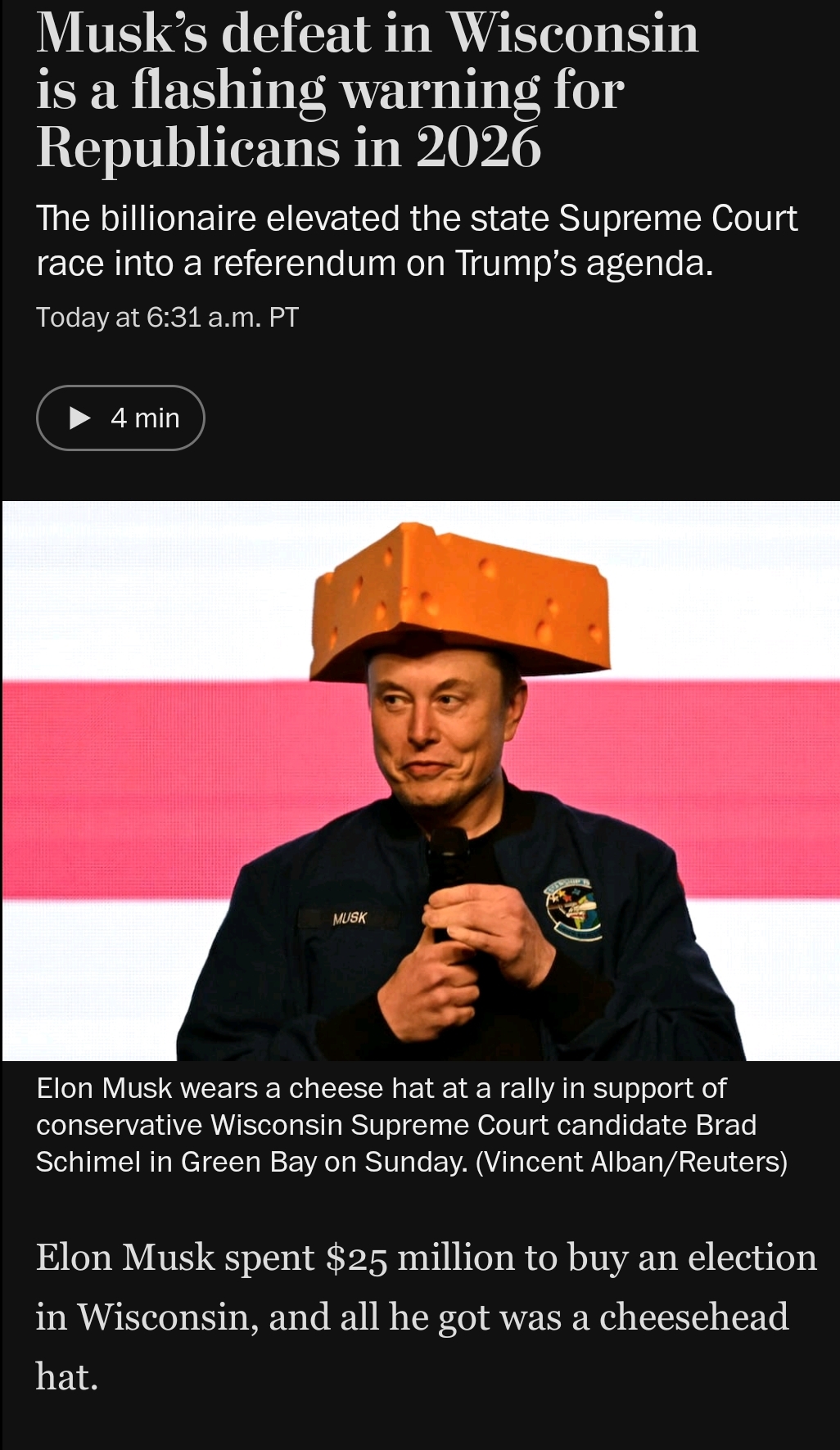
Washington Post opinion article: Musk’s defeat in Wisconsin is a flashing warning for Republicans in 2026

Gift link (no paywall)


Apparently the language was popular among early 20th century socialist movements because it was of an international character and therefore not associated with any nationality and its use by international socialist organisations wouldn't show favour to any particular country. It was banned in Nazi Germany and other fascist states because of its association with the left wing, with anti-nationalism, and because its creator was Jewish. It has mostly languished since then but still has around 2 million speakers with about 1,000 native speakers.


In the United States, I'd probably name Oregon City, the famous end of the Oregon Trail and the first city founded west of the Rocky Mountains during the pioneer era. Its population is only 37,000.

view more: next ›