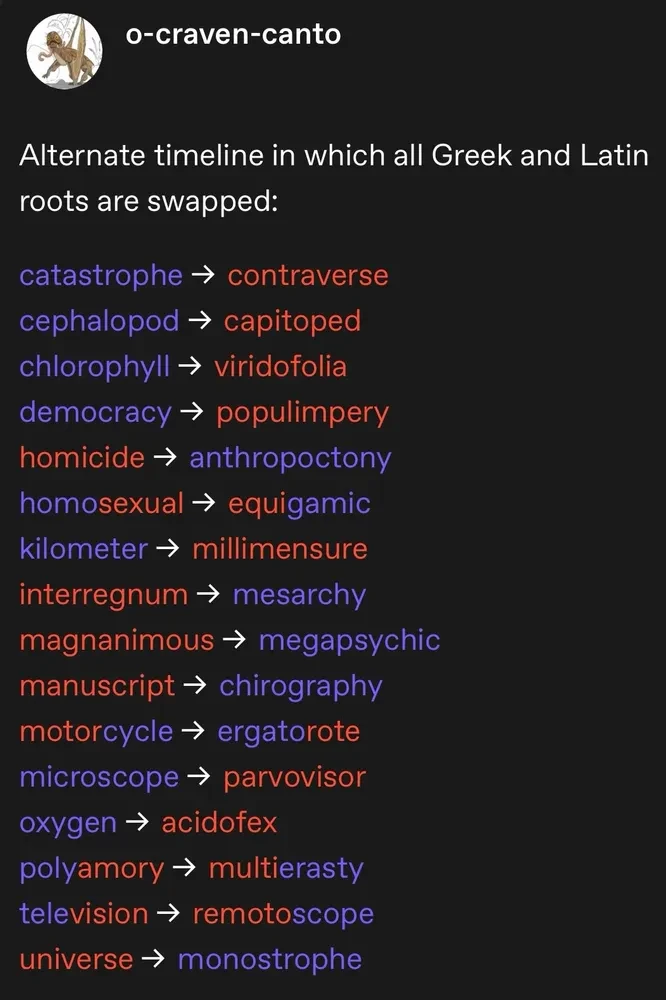
"this monostrophe is a contraverse"
- that one Douglas Adams quote
this post was submitted on 13 Aug 2026
328 points (98.8% liked)
Linguistics Humor
1766 readers
1 users here now
Do you like languages and linguistics ? Here is for having fun about it
For serious linguistics content: !linguistics@mander.xyz
Rules:
- 1- Stay on Topic
Post about linguistics or language humor & memes - 2- No Racism/Violence
- 3- No Public Shaming No shaming someone that could be identifiable or recognizable
- 4- Avoid spam and duplicates
founded 3 years ago
MODERATORS
I feel like these would be great substitutions for a retrofuturistic book.
Or interesting ways to make an alt history seen different.
Yup, I found a method of introducing fantasy names for stuff in my TTRPG campaign
!worldbuilding@lemmy.world might appreciate this
Does whatever frontend you're using not have a cross-post button?
I'd do it for you, but I'm not sure if alt history actually fits with the rest of what's on there, and don't want to get in trouble.
Populimpery is on the nose.
This is breaking my brain
I love that
Ah yes, clearly we are in dire need of an anastrophe as described by Marx and Engels in The Cenonite Chiroplect. Cephality is killing the planet, the ergate need to rise up.
def pocketing _remotoscope _ for a silly occasion.
I always knew he's a megapsychic person.
Now do helicopter, heh
Spirala?
Relevant Vsauce for why I chose the word: https://youtube.com/shorts/EupTKqL3f1E
That video is the reason I knew the roots lol
Huh. Helicopterum - elicoptero - germanic: whirlybird.
whirlybird gets the wyrm
I recently learned a few Greek/Latin facts. Might as well share them here.
Ulysses and Odysseus
Ulysses and Odysseus are the same guy. Odysseus is his Greek name, Ulysses is the Latin translation. Originally, only the Latin versions of the stories survived, so it was known as Ulysses. In the 1900s(?) the Greek versions of the story was (re)discovered. So, for a while Odysseus was the name used in scholarship, but the popular one was still Ulysses. Eventually, Odysseus took over in popularity, maybe because "an odyssey" became a known term.
Heracles and Hercules
Are the same dude too. Hercules is the most well-known name, but it's the Latin one. His Greek name has a lot more meaning. He was the result of an affair between Zeus and Alcmene. He was given the name Heracles, meaning something like "Pride of Hera" to try to reduce her hatred of him.
Zeus
Zeus was actually pronounced in Ancient Greek as effectively something like /zdeu̯s/ in IPA or "zdayoos" in sorta phonetic English. You may recognize that pronunciation as the Latin "deus" meaning god. The Greeks called their gods "theos", which is similar but unrelated to "deus". So, the Romans took their word for "god" from the main god of the Greeks. The Greeks took the name of their main god from the Proto-Indo-European Dyēus, the god of the daytime sky.
Planet Names
The only planet with a Greek name is Uranus, named for Ouranous, who is the grandfather of Zeus.
If the other celestial bodies went by their Greek names it would be:
- Sol -> Helios
- Mercury -> Hermes
- Venus -> Aphrodite
- Earth (Terra) -> Gaia
- Luna (Moon) -> Selene
- Mars -> Ares
- Jupiter -> Zeus
- Saturn -> Cronus
- Uranus (Ouranous) [Greek] -> Caelus [Latin], see "ciel" in French, "cielo" in Spanish, etc.
- Neptune -> Poseidon
Also, when they started naming some of the outer planets they started with Jupiter, then Jupiter's father Saturn, Ouranus is the father of Cronus, the Greek equivalent of Saturn. So the 6th planet is the father of the 5th, and the 7th planet is the father of the 6th. But the 8th planet is the brother of the 5th.
Months
- January / Janus, doesn't really have a Greek equivalent
- February, not named after a god
- March / Mars -> Ares
- April, not named after a good
- May / Maia (same name in Roman and Greek)
- June / Juno -> Hera
- July / Julius Caesar
- August / Augustus Caesar
- September, septem being the Latin number 7, used for the 9th month
- October, octo being the Latin number 8, used for the 10th month
- November, novem being the Latin number 9, used for the 11th month
- December, decem being the Latin number 10, used for the 12th month
doctor zayus, doctor zayus
I love legitimate theater
I think we should popularize "Selene" as the scifi name for the moon, the name people would use when "the moon" might well mean Enceladus to some people.
"Luna" is relatively well-known and all but it always sounded a bit off to me, it doesn't sound planet-y..
But maybe that's just because i'm swedish and it sounds like a verb to me. "Jag måste hem och luna mitt marsvin"
I know a couple of romance languages. In Spanish it's "la luna", in French it's "la lune", so to me it just sounds like "the moon".
Selene is good because it really sounds like a name and isn't widely used.
Back in the day there where only 10 months and later for some reason to make it better cycle with the moon or something they introduced january and february as the 11th and 12th month, or direclty as the first and second idk the exact history of this
It was July and August. Roman emperors. They put them as early in the cycle as they could without displacing a God.
January/Janus is the god of doorways, thresholds and transitions, and so was the only option for the god of starting a new year. Also more important than we typically consider. There just weren't explicit temples in the same way as others because their domain was every doorway, gate, and transition. When your temple is a giant door people mistake it for a gate. Which it is.
This should have included "autokinecticon."
Vision is scope, but scope is visor?
I imagine it has to do with verb conjugation
I think what has happened here is that OOP has tripped up on what "vision" meant
We seem to have gotten "scope" from Ancient Greek twice. One is σκοπέω (skopéō), which is a verb for "look at" or "examine", and the other is σκοπός (skopós), a noun for "watcher". So I can see how they'd get scope (verb) = vision and scope (noun) = visor
Unfortunately the Latin word that we get vision from means "eyesight", which neither sense of scope works for. I think the appropriate old Greek word is ὅρᾱσῐς (hórāsĭs), so maybe remotorasis would be a better guess for "television" on this post
(disclaimer, I'm not a linguist and also don't really know anything about Latin or Ancient Greek, I might be wrong)
It could also be that they chose "remotoscope" over "remotorasis" intentionally because the former is such a fun word.
"scope" also fits in with how we already use that word, e.g. microscope/telescope/periscope.
I'd wager most (non-indian, because i'd assume they don't use the latin/greek parts of english as much) english speakers could figure out what "remotoscope" means even completely devoid of context.
It's definitely the more fun option
You can see the colors, right? It's swapping Greek roots for Latin roots... and vice versa.
In actual Greek: -Homicide is Anthropoktonia -Magnanimous in Greek is Megalopsychos. -Manuscript is Cheirographo.
Do not take megaspsychic from me!
Parvovisor... And then your dog needs a vaccine against micro, I guess? I didn't realise that was a Latin root.
english is fucking bloated with latin. so if you want to know the english language, you have to learn latin.
We've also got a lot of Greek though, depending on which language was the fashionable one for science at the time.
I mean you could make an even stronger argument for French or whatever flavour of German. Obviously, you can speak it fine without any of them.
Some of these are also words though, like chirography.
That one seems like it should be chirograph in the OP