this post was submitted on 16 Mar 2026
55 points (98.2% liked)

news

24670 readers
621 users here now

Welcome to c/news! We aim to foster a book-club type environment for discussion and critical analysis of the news. Our policy objectives are:

We ask community members to appreciate the uncertainty inherent in critical analysis of current events, the need to constantly learn, and take part in the community with humility. None of us are the One True Leftist, not even you, the reader.

Newcomm and Newsmega Rules:

The Hexbear Code of Conduct and Terms of Service apply here.

  1. Link titles: Please use informative link titles. Overly editorialized titles, particularly if they link to opinion pieces, may get your post removed.

  2. Content warnings: Posts on the newscomm and top-level replies on the newsmega should use content warnings appropriately. Please be thoughtful about wording and triggers when describing awful things in post titles.

  3. Fake news: No fake news posts ever, including April 1st. Deliberate fake news posting is a bannable offense. If you mistakenly post fake news the mod team may ask you to delete/modify the post or we may delete it ourselves.

  4. Link sources: All posts must include a link to their source. Screenshots are fine IF you include the link in the post body. If you are citing a Twitter post as news, please include the Xcancel.com (or another Nitter instance) or at least strip out identifier information from the twitter link. There is also a Firefox extension that can redirect Twitter links to a Nitter instance, such as Libredirect or archive them as you would any other reactionary source.

  5. Archive sites: We highly encourage use of non-paywalled archive sites (i.e. archive.is, web.archive.org, ghostarchive.org) so that links are widely accessible to the community and so that reactionary sources don’t derive data/ad revenue from Hexbear users. If you see a link without an archive link, please archive it yourself and add it to the thread, ask the OP to fix it, or report to mods. Including text of articles in threads is welcome.

  6. Low effort material: Avoid memes/jokes/shitposts in newscomm posts and top-level replies to the newsmega. This kind of content is OK in post replies and in newsmega sub-threads. We encourage the community to balance their contribution of low effort material with effort posts, links to real news/analysis, and meaningful engagement with material posted in the community.

  7. American politics: Discussion and effort posts on the (potential) material impacts of American electoral politics is welcome, but the never-ending circus of American Politics© Brought to You by Mountain Dew™ is not welcome. This refers to polling, pundit reactions, electoral horse races, rumors of who might run, etc.

  8. Electoralism: Please try to avoid struggle sessions about the value of voting/taking part in the electoral system in the West. c/electoralism is right over there.

  9. AI Slop: Don't post AI generated content. Posts about AI race/chip wars/data centers are fine.

founded 5 years ago
MODERATORS
 

Bullets:

The TPY-2 radars are part of the THAAD missile defense system, and identify and direct allied air defenses against inbound ballistic missiles.In the early days of the war, Iranian forces targets the radars, knocking out at least four, across four countries.Raytheon (RTX) is the Pentagon contractor for the TPY-2 radars, which cost $500 million each, and feature a Gallium-Nitride populated array. China has a monopoly on the production of gallium, with 98% of the world's total. China also has export bans on its gallium to weapons makers, including Raytheon.

Inside China / Business is a reader-supported publication. To receive new posts and support my work, consider becoming a free or paid subscriber.

Report:

Good morning.

In the earliest days of the war, Iranian forces launched drone and missile attacks against strategic radars across the Persian Gulf region. These radar installations are crucial in air and missile defense, and serve as a theater-wide warning system. The THAAD system is Terminal High Altitude Area Defense, and identifies and engages incoming ballistic missiles.
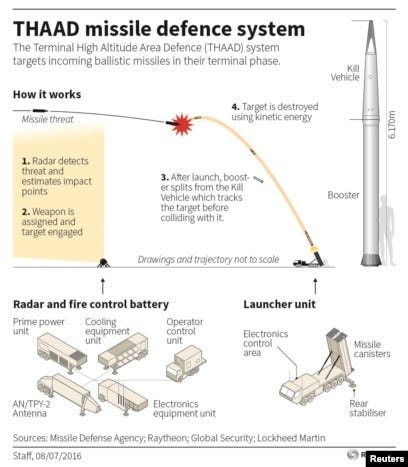
Obviously this system is reliant on radars to make that all work, and Iran is knocking out those radars. At an Air Force Base in Jordan, a TPY-2 radar was hit, and those come with a $500 million price tag. That’s just for the radar, plus the cost of the missiles, which are useless without that radar. Another attack took out a radar in Saudi Arabia. And two others in the UAE and Qatar.

A replacement radar is being hurried over to Jordan to replace the one blown up there, and further down the Wall Street Journal points out that another race is on to finish the war in Iran before stockpiles of interceptor missiles run out.

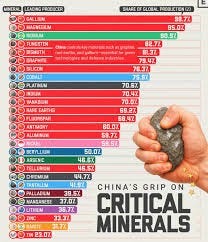
From the start of this channel we have pointed out that the supply chains for the Pentagon all run through China. Literally not a single weapons platform or strategic asset gets built without rare earth metals, and China has monopolies on almost all of them. What’s more, China has dual-use export bans, that expressly forbid their sale to companies that are building weapons. All the Pentagon contractors, in other words, cannot source raw materials from Chinese companies.
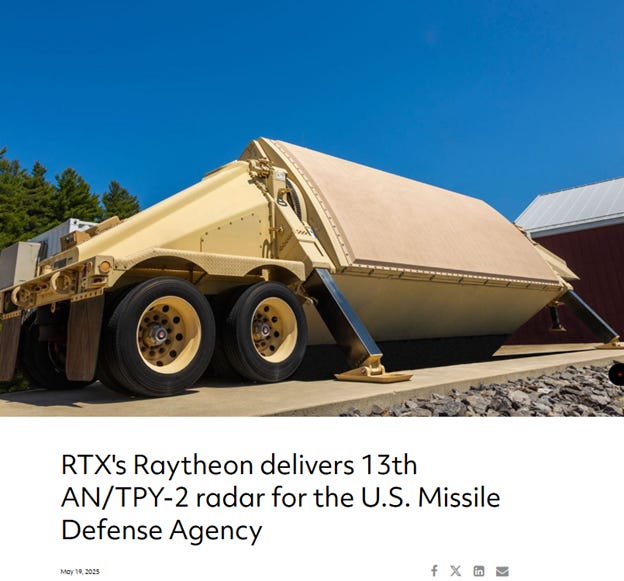
The TPY-2 radars are built by Raytheon, and are scarce. This is a press release from Raytheon from last May, 2025, after the company delivered just the 13th TPY-2 radar, and which was the first such delivery to the US Missile Defense Agency.
So in the first few days of the war, Iran took down at least four of them. The system is a Gallium Nitride populated array system. Gallium Nitride allows for longer range and surveillance capability.
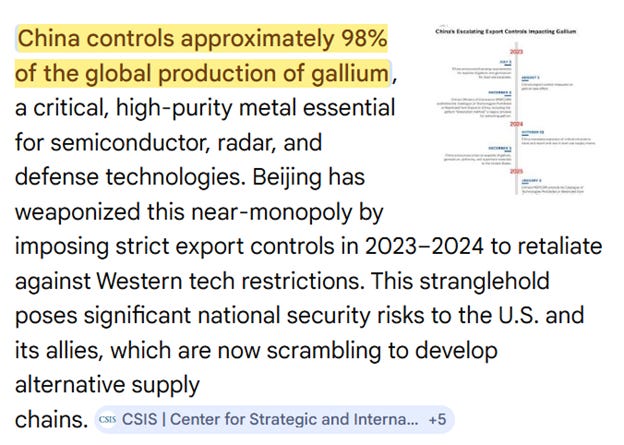
China has a monopoly on the production of gallium. 98% of the global production of gallium comes from here, while the United States is 100% dependent on imports. So these radar systems that are being blown up by Iranian drones and rockets, cannot be replaced until China relaxes those export bans to weapons makers.

A caveat here, because this is a common point of confusion: China previously had hard bans on all exports of gallium, germanium, and antimony. But as part of the trade deal with the Trump Administration, that restriction was removed, last November. But exports from China to weapons makers, and to companies on the dual-use export control list—those stay.

This is to say that some Western civilian manufacturers can import these metals, including gallium. But weapons makers cannot: Raytheon is one of the companies on that list. China’s “Unreliable Entities List” includes top Pentagon contractors, like Lockheed Martin, General Dynamics, and Raytheon, and those companies are banned from importing from China. So all these radars that got blown up in the first two weeks -- $2 billion so far and counting just for the THAAD system radars -- they’re gone forever.

Be Good.

**Resources and links:**China’s rare-earth mineral squeeze will hit the Pentagon hardhttps://www.defenseone.com/threats/2025/04/chinas-rare-earth-mineral-squeeze-will-hit-pentagon-hard/404776/RTX's Raytheon delivers 13th AN/TPY-2 radar for the U.S. Missile Defense agencyhttps://www.rtx.com/news/news-center/2025/05/19/rtxs-raytheon-delivers-13th-an-tpy-2-radar-for-the-u-s-missile-defense-agencyTerminal High Altitude Area Defense Radar Successful in Integrated Flight testhttps://raytheon.mediaroom.com/index.php?s=43&item=667The US military needs Chinese semiconductors to build advanced weapons. Not the other way around.

Presidential Document: Addressing the Threat to the Domestic Supply Chain From Reliance on Critical Minerals From Foreign Adversaries and Supporting the Domestic Mining and Processing industrieshttps://www.federalregister.gov/documents/2020/10/05/2020-22064/addressing-the-threat-to-the-domestic-supply-chain-from-reliance-on-critical-minerals-from-foreignChina suspends ban on exports of certain metals used in chip and electronics manufacturing to the u.s.https://www.cnbc.com/2025/11/09/china-suspends-ban-on-exports-of-gallium-germanium-antimony-to-us.htmlCritical Minerals and Defence technologieshttps://www.sfa-oxford.com/knowledge-and-insights/critical-minerals-in-low-carbon-and-future-technologies/critical-minerals-in-defence-and-national-security/Radar Bases Linked to US THAAD Systems Hit in Jordan, Saudi Arabia and uaehttps://politicstoday.org/radar-bases-linked-to-us-thaad-systems-hit-in-jordan-saudi-arabia-and-uae/U.S. Rushing to Replace ThAAD Radar in jordanhttps://www.wsj.com/livecoverage/iran-war-news-updates-2026/card/u-s-rushing-to-replace-thaad-radar-in-jordan-P764k4GQIjTocK36lHLr

Inside China / Business is a reader-supported publication. To receive new posts and support my work, consider becoming a free or paid subscriber.


From Inside China / Business via this RSS feed

top 14 comments
sorted by: hot top controversial new old
[–] Infamousblt@hexbear.net 20 points 20 hours ago (3 children)

I assume these companies can just setup shell companies to buy the gallium or find other ways around the export controls. As long as China is putting rare earths on boats to the US the US can and will find ways to get them to weapons manufacturers. Sure China could then just ban exports again but at that point it's already here. And so far they have been entirely milquetoast with any real response to anything so once the US starts running out again China can just relax the controls again just enough to let the metals flow to the US again.

This just all feels like posturing and not any real issue. Maybe I don't understand something but if the metals are here I don't see anything stopping the US from making sure they get to weapons rather than to civilian use products.

[–] Beaver@hexbear.net 8 points 19 hours ago (1 children)

Much hay has been made about how the rare-earth export controls are going to end US munitions manufacturing, but I suspect it will only be an annoying bump in the road. We've seen US sanction-busting efforts be fairly effective using a lot of middlemen to obfuscate the source and destination of trade goods. It stands to reason that the USA will use the same techniques to get around China's ban on exports of raw materials to weapon manufacturers.

[–] Jabril@hexbear.net 4 points 17 hours ago

It will cost them a lot more to pull that off which is still extra pressure, but also China has demonstrated an ability to have more control over the supply chain by the nature of the state owning a super majority of the relevant Chinese companies involved with extraction and refinement.

The trying to get all the capitalist nations to uphold Russian sanctions is hard because there is no real material incentive to do so and no great unity of capitalist nations to follow through on purely ideological reasons and they can't really be punished for not following through.

If China finds out anyone is not following their sanctions, they have the power to cut them out and make things much harder and more expensive for them and both a material and ideological incentive to do so.

[–] Trying2KnowMyself@hexbear.net 8 points 19 hours ago

Yeah, the article admittedly is probably a bit too hopeful about the actual impact of the current export controls.

[–] carpoftruth@hexbear.net 7 points 19 hours ago

Yes, the US efforts to sanction russian oil demonstrate how challenging it is to truly prevent commodity products from flowing. Galliun and other critical minerals aren't a perfect analogue, but considering that the US has infinite money for this kind of thing, I bet the spice will find a way to flow regardless.

[–] comrade_pibb@hexbear.net 19 points 21 hours ago (1 children)

Who could have foreseen the consequence of hollowiy out your manufacturing base

[–] Trying2KnowMyself@hexbear.net 23 points 21 hours ago (1 children)

And starting trade wars with every other nation while you’re at it

[–] chgxvjh@hexbear.net 6 points 19 hours ago

Art of the deal

[–] StarkWolf@hexbear.net 6 points 17 hours ago

The worst person you know?

This is him now: Feel old yet?

Anyway, whether he's right about China's exports not being able to eventually get to Raytheon etc, which I'm not fully convinced the US won't find another way to get around that. I'm at least happy to see more evidence that it will cause serious problems and be very hard to replace in the immediate future.

[–] da_gay_pussy_eatah@hexbear.net 6 points 18 hours ago (2 children)

Can't they just recover the gallium from the destroyed radars?

[–] Shinji_Ikari@hexbear.net 5 points 18 hours ago (1 children)

Gallium has a very low melting point. It's sometimes used in PCB rework by folks in the know because it will mix with the normal solder and keep things fluid for longer, helping remove components.

I would imagine that upon being missiled, the gallium would instantly melt and be scattered around in a 400ft radius.

It'd be like mining for platinum by sweeping the dust on your local freeway to scavenge the catalytic converter particulate.

[–] mactan@lemmy.ml 5 points 17 hours ago

I distinctly remember Codylab doing that ages ago and it works

[–] Trying2KnowMyself@hexbear.net 1 points 18 hours ago

Do they have domestic recovery capabilities? I think they were working on it, but I think “just recover” is doing a lot of heavy lifting.

[–] cabb@lemmy.dbzer0.com 4 points 19 hours ago

Where does the other 2% of the world's supply come from and how much is that? Do military radars consume a lot or do they only use tiny amounts?

This article seems like it's over-stating the impact on the US. The loss of the radars is still a big deal, given the 2 years it takes to build one iirc and will have an impact on the US and Israel in the medium-term but I'm not convinced the radars cannot be manufactured at all. Specifically these radars are made in small number so I doubt they'd be affected but it might pose a problem for other US-made weapons if the limited supply they can get right now is redirected to these radar units instead of other products.