Bullets:
The TPY-2 radars are part of the THAAD missile defense system, and identify and direct allied air defenses against inbound ballistic missiles.In the early days of the war, Iranian forces targets the radars, knocking out at least four, across four countries.Raytheon (RTX) is the Pentagon contractor for the TPY-2 radars, which cost $500 million each, and feature a Gallium-Nitride populated array. China has a monopoly on the production of gallium, with 98% of the world's total. China also has export bans on its gallium to weapons makers, including Raytheon.
Inside China / Business is a reader-supported publication. To receive new posts and support my work, consider becoming a free or paid subscriber.
Report:
Good morning.
In the earliest days of the war, Iranian forces launched drone and missile attacks against strategic radars across the Persian Gulf region. These radar installations are crucial in air and missile defense, and serve as a theater-wide warning system. The THAAD system is Terminal High Altitude Area Defense, and identifies and engages incoming ballistic missiles.
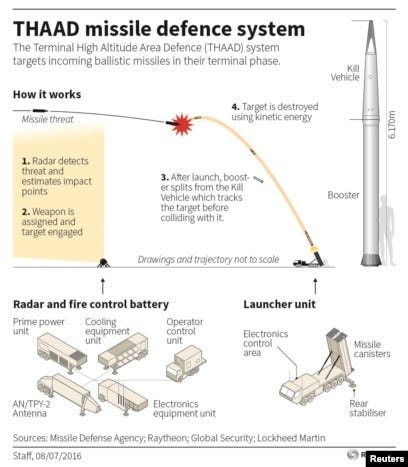
Obviously this system is reliant on radars to make that all work, and Iran is knocking out those radars. At an Air Force Base in Jordan, a TPY-2 radar was hit, and those come with a $500 million price tag. That’s just for the radar, plus the cost of the missiles, which are useless without that radar. Another attack took out a radar in Saudi Arabia. And two others in the UAE and Qatar.
A replacement radar is being hurried over to Jordan to replace the one blown up there, and further down the Wall Street Journal points out that another race is on to finish the war in Iran before stockpiles of interceptor missiles run out.
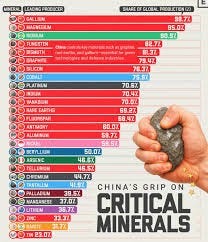
From the start of this channel we have pointed out that the supply chains for the Pentagon all run through China. Literally not a single weapons platform or strategic asset gets built without rare earth metals, and China has monopolies on almost all of them. What’s more, China has dual-use export bans, that expressly forbid their sale to companies that are building weapons. All the Pentagon contractors, in other words, cannot source raw materials from Chinese companies.
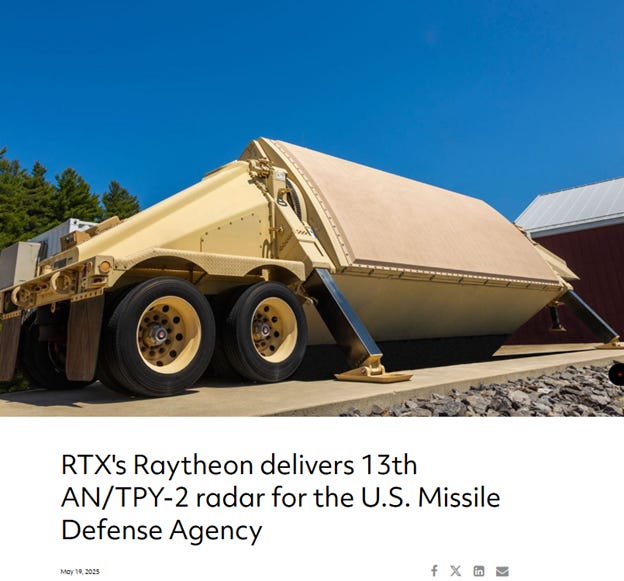
The TPY-2 radars are built by Raytheon, and are scarce. This is a press release from Raytheon from last May, 2025, after the company delivered just the 13th TPY-2 radar, and which was the first such delivery to the US Missile Defense Agency.
So in the first few days of the war, Iran took down at least four of them. The system is a Gallium Nitride populated array system. Gallium Nitride allows for longer range and surveillance capability.
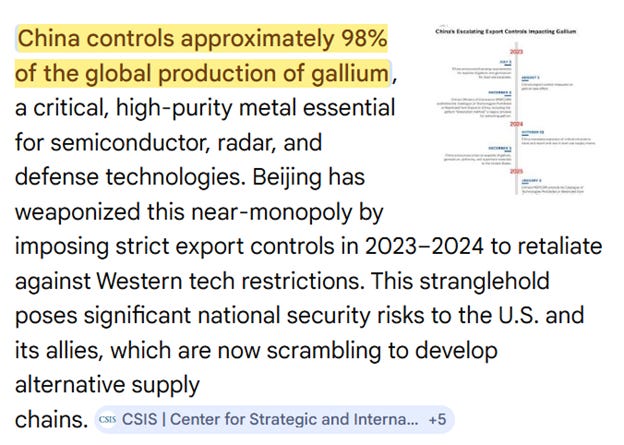
China has a monopoly on the production of gallium. 98% of the global production of gallium comes from here, while the United States is 100% dependent on imports. So these radar systems that are being blown up by Iranian drones and rockets, cannot be replaced until China relaxes those export bans to weapons makers.
A caveat here, because this is a common point of confusion: China previously had hard bans on all exports of gallium, germanium, and antimony. But as part of the trade deal with the Trump Administration, that restriction was removed, last November. But exports from China to weapons makers, and to companies on the dual-use export control list—those stay.
This is to say that some Western civilian manufacturers can import these metals, including gallium. But weapons makers cannot: Raytheon is one of the companies on that list. China’s “Unreliable Entities List” includes top Pentagon contractors, like Lockheed Martin, General Dynamics, and Raytheon, and those companies are banned from importing from China. So all these radars that got blown up in the first two weeks -- $2 billion so far and counting just for the THAAD system radars -- they’re gone forever.
Be Good.
**Resources and links:**China’s rare-earth mineral squeeze will hit the Pentagon hardhttps://www.defenseone.com/threats/2025/04/chinas-rare-earth-mineral-squeeze-will-hit-pentagon-hard/404776/RTX's Raytheon delivers 13th AN/TPY-2 radar for the U.S. Missile Defense agencyhttps://www.rtx.com/news/news-center/2025/05/19/rtxs-raytheon-delivers-13th-an-tpy-2-radar-for-the-u-s-missile-defense-agencyTerminal High Altitude Area Defense Radar Successful in Integrated Flight testhttps://raytheon.mediaroom.com/index.php?s=43&item=667The US military needs Chinese semiconductors to build advanced weapons. Not the other way around.
Presidential Document: Addressing the Threat to the Domestic Supply Chain From Reliance on Critical Minerals From Foreign Adversaries and Supporting the Domestic Mining and Processing industrieshttps://www.federalregister.gov/documents/2020/10/05/2020-22064/addressing-the-threat-to-the-domestic-supply-chain-from-reliance-on-critical-minerals-from-foreignChina suspends ban on exports of certain metals used in chip and electronics manufacturing to the u.s.https://www.cnbc.com/2025/11/09/china-suspends-ban-on-exports-of-gallium-germanium-antimony-to-us.htmlCritical Minerals and Defence technologieshttps://www.sfa-oxford.com/knowledge-and-insights/critical-minerals-in-low-carbon-and-future-technologies/critical-minerals-in-defence-and-national-security/Radar Bases Linked to US THAAD Systems Hit in Jordan, Saudi Arabia and uaehttps://politicstoday.org/radar-bases-linked-to-us-thaad-systems-hit-in-jordan-saudi-arabia-and-uae/U.S. Rushing to Replace ThAAD Radar in jordanhttps://www.wsj.com/livecoverage/iran-war-news-updates-2026/card/u-s-rushing-to-replace-thaad-radar-in-jordan-P764k4GQIjTocK36lHLr
Inside China / Business is a reader-supported publication. To receive new posts and support my work, consider becoming a free or paid subscriber.
From Inside China / Business via this RSS feed
Do they have domestic recovery capabilities? I think they were working on it, but I think “just recover” is doing a lot of heavy lifting.