Couldn't this just be planetary capture? A low mass sun just happened by a slow moving planet that had been ejected from it previous orbit, and both of them were just like, "wanna hang out?" and that's that? I know the odds are astronomical (pun), but it is the universe we are talking about... things do happen.
this post was submitted on 30 Nov 2023
140 points (98.6% liked)
[Dormant] moved to !space@mander.xyz
11423 readers
1 users here now
This community is dormant, please find us at !space@mander.xyz
You can find the original sidebar contents below:
Rules
- Be respectful and inclusive.
- No harassment, hate speech, or trolling.
- Engage in constructive discussions.
- Share relevant content.
- Follow guidelines and moderators' instructions.
- Use appropriate language and tone.
- Report violations.
- Foster a continuous learning environment.
Picture of the Day
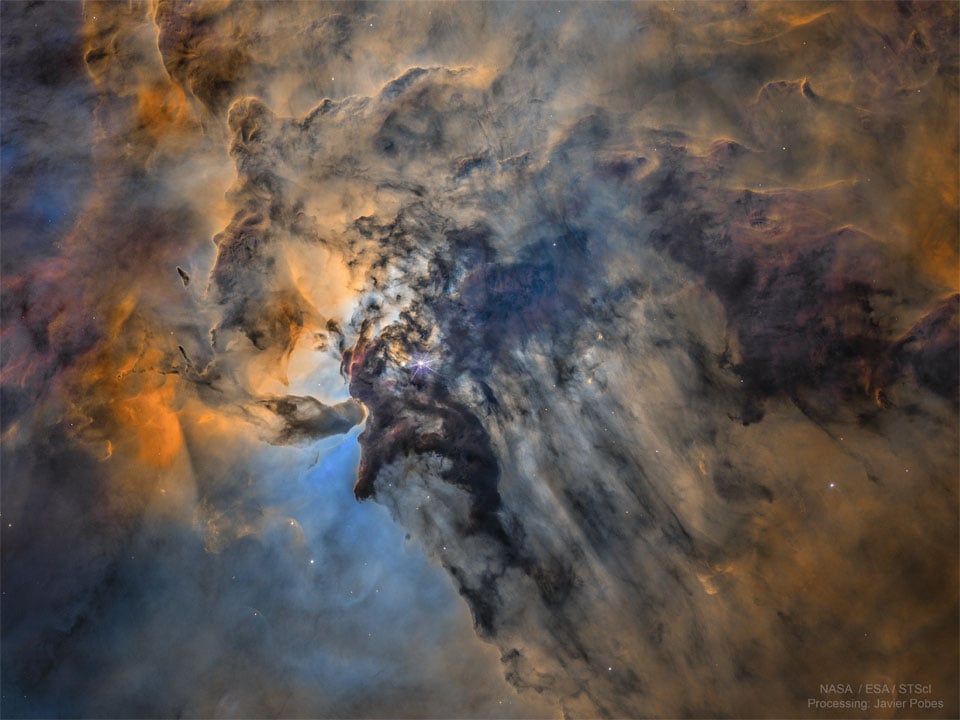 The Busy Center of the Lagoon Nebula
Related Communities
🔭 Science
- !astronomy@mander.xyz
- !curiosityrover@lemmy.world
- !earthscience@mander.xyz
- !esa@feddit.nl
- !nasa@lemmy.world
- !perseverancerover@lemmy.world
- !physics@mander.xyz
- !space@beehaw.org
- !space@lemmy.world
🚀 Engineering
🌌 Art and Photography
Other Cool Links
founded 3 years ago
MODERATORS
Most likely. Couple this with the recent report that there are way more rogue planets than previously thought.
Which is kinda terrifying when you think about it
Especially for someone (me) who just watched Melancholia - gulp!
Why?
That’s exactly what I was thinking. Almost like they are dependent on each other for orbit.
the neutron star is small enough to sneak into a solar system and get away with a planet as a hostage.. it's the ninja star..
Beyond that, Jupiter is 100,000 times the mass of the Earth. Should Jupiter not exist? This star is a red dwarf, or maybe the smallest possible main line type G2V star that we've seen, it could also be an M class star. This planet is in the same general area of the gravitational field of said star, that the asteroid belt and Jupiter would occupy in our star's much larger gravitational field. It seems probable that giant rocky planets would form, but be so far outside the "Goldilocks zone" of the star as to be permanently frozen.
Edit: I'm not an astronomer, so I probably missed something.
It just sounds like the headline should read something like: "This planet couldn't exist around Sol, so why does it exist?" or "We found a planet that can't exist in our solar system, here's why the star it exists around probably allowed its formation."
Edit 2: The average density of "empty space" inside galaxies is 28.9 solar masses of dust per cubic light year. There's more than enough dust out there for any star to form its own inner planetary, asteroid, and comet, systems. As well as several outer planets.
The close orbit makes that less likely, due to the way orbits work. Even if the planet was moving very slowly when it encountered the star, it accelerates as it gets closer and would end up with an elliptical orbit with a farthest point at about the same distance away as when the star first became a dominant force on it. If it were our system, the planet would spend most of its time in the Ort Cloud and occasionally it might venture into the area the gas giants live in or maybe even the inner solar system. It wouldn't necessarily be on the same plane as the other planets, too.
In order to find a close orbit and stay in it, it would have to kick other planets out, giving its momentum away when it was close (which makes it rarer than just a capture, especially considering it might not even be on the same plane as other planets in orbit). Or some other event would need to perturb the orbit just right.
But unlikely doesn't mean impossible.
Don't fat shame that poor planet, it's just doing its thing!
Also don't small shame the star, it's trying it's best!
These poor celestial bodies don't deserve this type of disrespect.
It was probably a wandering planet that was captured by the dwarf star.
Neat!