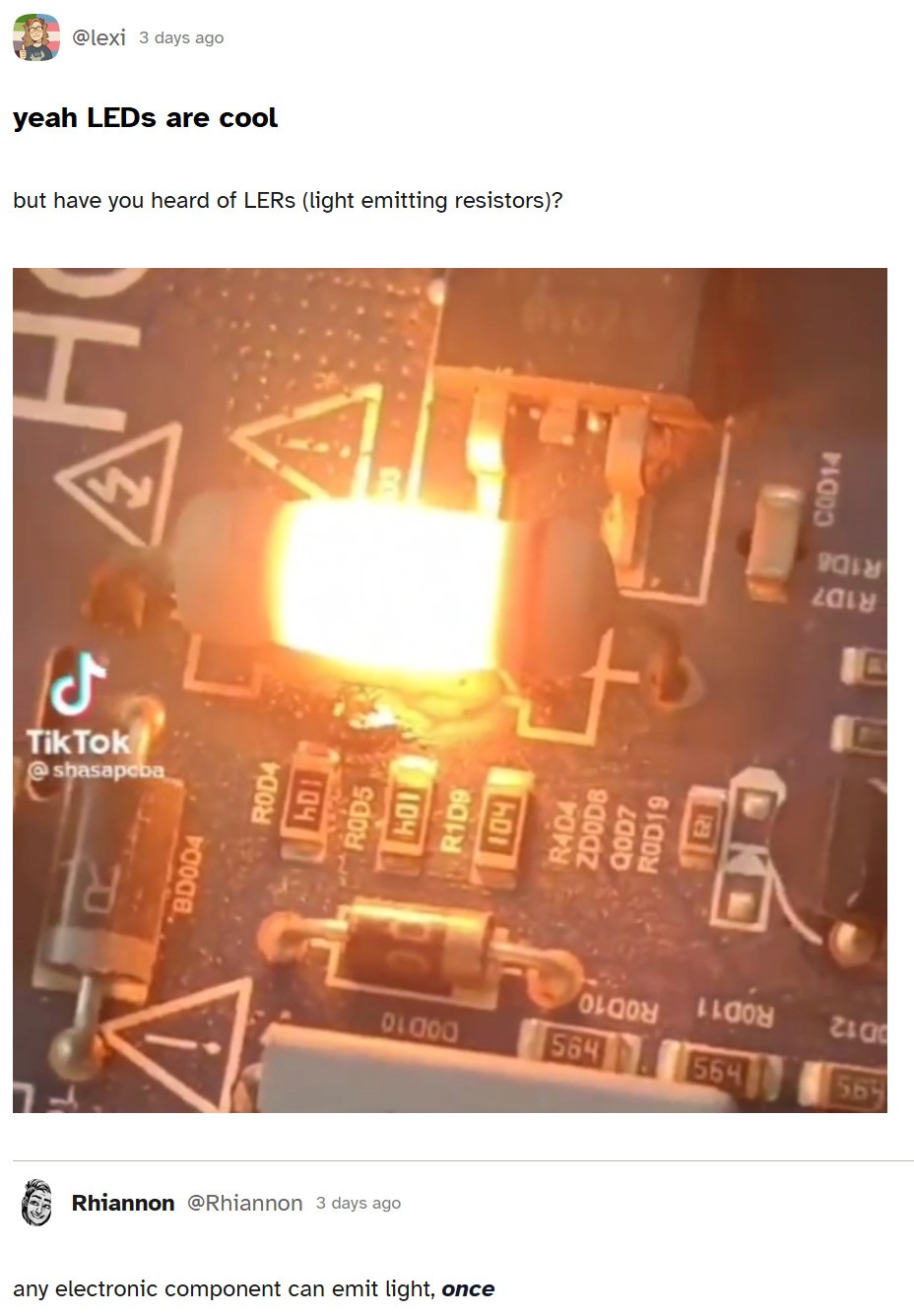
All electronics are light emitting resistors if you use them wrongly enough.
A place to post memes & images that won't absolutely obliterate your mental health! Memes must not stray into hopelessness and be generally positive or neutral.
I made this with my kid in mind, so that they can have a good, safe place to look at memes, just made to make folks laugh and smile!
Only goofs & silliness. (:
All electronics are light emitting resistors if you use them wrongly enough.
And smoke machines
Release the magic smoke!!
and space heaters.
Even when used correctly, they are above absolute zero, so they emit light. Just not in the spectrum visible to human eye
In that case do I count as a LER since living beings emit IR?
Nah, plenty become open gas lamps before that.
We have gone full circle; LER is the new retronym for light bulb.
Without the bulb around it.
Incandescent lightbulbs are literally this.
More specifically, an incandescent bulb is a light-emitting PTC thermistor. The resistance of the filament is very low at room temperature, acting like a short circuit. With a lot of current, the filament heats up which causes the resistance to go up as well (PTC = positive temperature coefficient). As the resistance goes up, the current goes down, and the filament reaches an equilibrium temperature.
Incandescent light bulbs can be used as protection devices for repairing electronic equipment. If you make a mistake during the repairs and cause an accidental short circuit inside the device, the incandescent bulb (wired in series with the device) will limit the current based on the wattage of the bulb. 120 Watt bulb on 120 V AC circuit => 1 amp max current through the device. For a 60 W bulb the limit is 0.5 amp.
This is a lot lower current than the usual 15 amps allowed (before tripping the breaker) by a common NA household circuit.
We can expand on that a bit. A breaker does not simply open at its rated current. It should actually never open at the rated current. At 2x the current it takes some time. At 10x the rated current it still takes WAY too long. Traces, components, etc. everything are long vaporized at that point. And this makes sense too, they protect the wiring in the house, not devices with unknown power draw and current spikes.
Clarifying that the equipment should always be fixed disconnected from AC, the light bulb is supposed to assist in TESTING the fix, in case something in the equipment is still broken.
Then it's not a thermistor, that's for sensing.
And those shitty hot plates
So you're implying LEDs don't have impedance?!
Fair point! Any electrical component that is not a superconductor is technically a resistor in addition to whatever else it does.
Isn't this a light bulb?
Been there, done that, never attempted CRT repair after that.
Thanks to the capacitor plague 20+ years ago I had to deal with a bunch of FEG’s (flame emitting GPUs)…
Ugh, that picture triggered a lot of buried PTSD 😅

Yeah but did you know LEDs are also photodiodes? You can shine a light on them and read that as input voltage.
This guy has a great project where he turns his LEDs into a programming interface using his phone's flashlight:
Once the smoke has cleared we check the connections we made earlier.
Everything is a light emitting resistor if you push enough power through it.
Bring in the Tesla coil!!! 😈😈😈
Someone is going to celebrate new computer day pretty soon
Don't let the smoke out. All electronics work due to having magical smoke inside. If you let the smoke out then it stops working.
For those of you who would like to do stuff of this kind, here's a video of Jeff Geerling showing how to use a microcontroller board and a power supply to blow up a capacitor! (He also shows a few other things you can do with microcontroller boards.) https://www.youtube.com/watch?v=Sd42q3OaOrE
Seems kinda hard on the PCB though.
But would be useful when you also want to desolder nearby components at the same time, so multipurpose.
I once discharged a 5 F capacitor into a 1 Ohm resistor.
It created an unpleasant smell on burning up.