this post was submitted on 16 Oct 2026
625 points (95.8% liked)
Linux
68249 readers
207 users here now
From Wikipedia, the free encyclopedia
Linux is a family of open source Unix-like operating systems based on the Linux kernel, an operating system kernel first released on September 17, 1991 by Linus Torvalds. Linux is typically packaged in a Linux distribution (or distro for short).
Distributions include the Linux kernel and supporting system software and libraries, many of which are provided by the GNU Project. Many Linux distributions use the word "Linux" in their name, but the Free Software Foundation uses the name GNU/Linux to emphasize the importance of GNU software, causing some controversy.
Rules
- Posts must be relevant to operating systems running the Linux kernel. GNU/Linux or otherwise.
- No misinformation
- No NSFW content
- No hate speech, bigotry, etc
Related Communities
Community icon by Alpár-Etele Méder, licensed under CC BY 3.0
founded 7 years ago
MODERATORS
you are viewing a single comment's thread
view the rest of the comments
view the rest of the comments
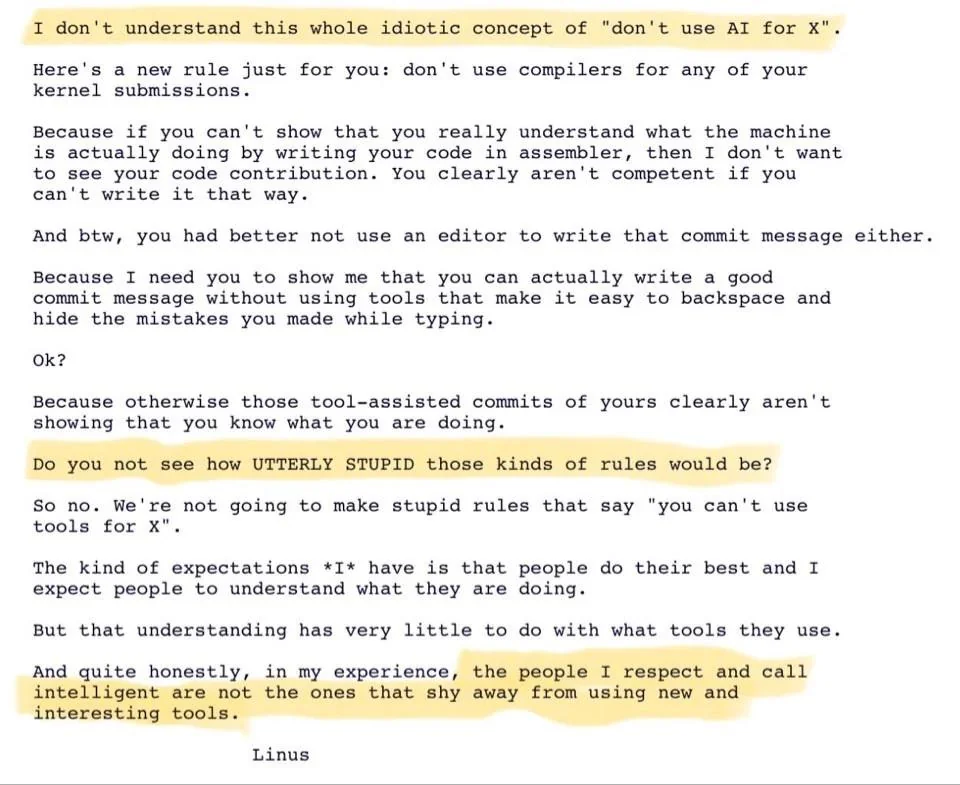
Compilers are incredibly complex things and the often have undefined behaviors that slip in because the compiler has to interact with the operating system at large, and that means the code actually doesn't run the same on every platform, or even every version of the same operating system. So, while they are technically deterministic, the reality is that you get surprising and unexpected behaviors in practice.
Also worth nothing that the probability distributions for an LLM are fixed at training time, and that is why the weights are static. When doing inference, models are selecting from a top-k of probable tokens at each autoregressive loop for your typical LLM. When you adjust top-k to 1 or simply set the “temperature” to 0, it will always give you the same result from the same input.
Thanks