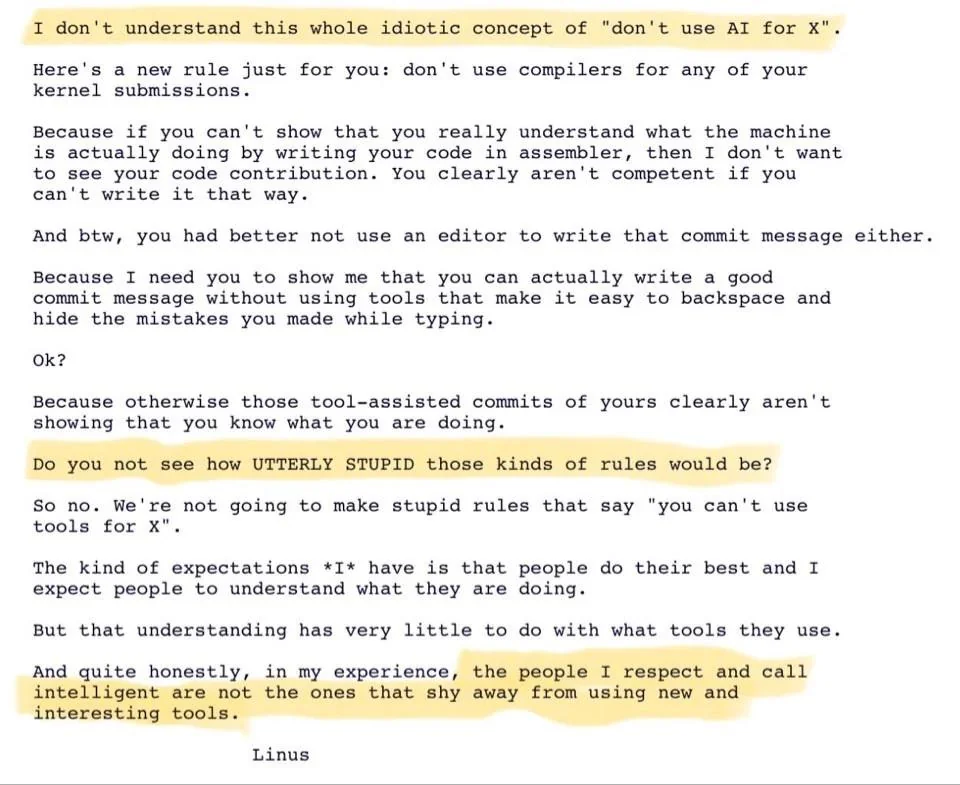
Yeah, but your compiler wasn't made with massive copyright infringement, stealing much needed water and rampant corruption, was it?
From Wikipedia, the free encyclopedia
Linux is a family of open source Unix-like operating systems based on the Linux kernel, an operating system kernel first released on September 17, 1991 by Linus Torvalds. Linux is typically packaged in a Linux distribution (or distro for short).
Distributions include the Linux kernel and supporting system software and libraries, many of which are provided by the GNU Project. Many Linux distributions use the word "Linux" in their name, but the Free Software Foundation uses the name GNU/Linux to emphasize the importance of GNU software, causing some controversy.
Community icon by Alpár-Etele Méder, licensed under CC BY 3.0
Yeah, but your compiler wasn't made with massive copyright infringement, stealing much needed water and rampant corruption, was it?
It's perfectly ok to use a new tool to do your work faster, more efficiently, and with greater precision if these improvements are justified by the cost of the tool. But if that tool is a coal-fired, water hoarding, ophan crushing, billionaire-owned kleptobot, your results need to be better than pure gold to be worth the true cost of using it.
It's that "greater precision" part that is hard to ensure.
If someone is checking their work with AI or thoroughly checking the work after, great.
But it's a hard difference to teach
I guess Linus doesn't care about the environment or any of the other issues surrounding A.I. I'm not anti-AI just for the sake of being anti-AI. I have a huge problem with AI bcz of it's environmental impacts, intellectual property violations, job impacts, attempts to replace all employees with AI, the general dumbing down of society and worse off the internet is bcz of AI, the surveillance state being built around it. I could go on, but you get the point. I am a staunch, no AI person bcz of all those reasons and a hundred more.
This isn't an age thing, or a, I am getting older and Im stubborn thing. AI is literally ruining the planet and everything on it, and this guy thinks we should just accept that.
I say fuck off with that noise, I don't have e to accept anything.
as a pro-AI, anti-cloud nerd? All of these problems disappear when we address the real problem of Capitalism.
there are abandoned tech certs for building datacenters that produce 110% of their own electricity. these are distinct from the data mines these useless nerds want to build.
without capital, the surveillance state dies.
intellectual property is a capitalist myth invented to hold us back and induce rents, and I'm tired of pretending otherwise.
oh no, you fired me from a job I'd rather not have to do and I still get to survive because we slew capitalism? ahhh, how will I cope with the blow to my identity?
His line seems to be 'don't submit shit code.'
Even if you wrote it by seance with a Oujii board, just make sure it works, and that great grandma Ada agrees to a GPL license.
The comparison between AI and compilers is kind of stupid though. When you program in a given language, you're writing out the entire logic and behavior of your program. Not to mention that the compiler is a deterministic machine, it will always behave in a certain manner and produce predictable results. On the other hand, using AI, you just write a sentence. Then it "creates" a whole bunch of code that will not always be the same, even if you always use the same model and prompt. Not to mention all of the detrimental effects AI has, cognitively speaking, when you start to rely on it. On top of this, all AI models were trained on unfathomable amounts of stolen information.
When the topic is AI, the quality of some of these Lemmy threads drops down to the level of YouTube comments.

I got banned from the Fuck AI community for saying Linus isn’t stupid. Not that he’s right on AI, just that he’s not stupid.
Indeed, the atmosphere is toxic.
We’re on a site where people happily discuss their arr stack or transpiring the PS5 system, but bemoan AI is killing artists and coding.
There are real ethical issues, job impacts, environmental issues, property rights issues (real and intellectual), privacy, a stack of cards economy etc.
But there is also utility, and frankly the genie is out of the bottle. For better or worse.
Catching kernel bugs in Linux with AI should be seen as a good because they’re not being exploited offensively by private actors. AI review that catches the most annoying 80% of errors or issues saves human time, while not contributing slop to the kernel.
There is a lot to discuss if you show up in good faith.
Also, Linus is an asshole. Why would anyone be surprised he reacted like an asshole? His point on his expectations is actually clear and sensible to me. He probably could have said just that, but he’s an asshole, and acting how you would expect after a bunch of people are yelling at him.
Nuance is a hard concept to get in most Lemmy comment threads. It's obvious it's just a tool that uses an insane amount of resources that can do some good in certain applications. The problem stems from it being abused for evil and stupid things.
Can AI be used to help flag cancerous growths in x rays and help save lives? Absolutely! Can it also be used to track every human being on the planet for surveillance purposes while its proponents build massive biome-destroying data centers to act as the infrastructure? It sure can!
All that said, I still don't feel confident about rolling in AI code to open source projects when bots aren't accountable to their contributions. They should require a huge amount of oversight which I doubt is happening at the moment.
Cory Doctorow's "Reverse Centaurs Guide to Life After AI" has a short section that pertains to this. He talks about how someone like Linus essentially doesn't have a boss and has untold resources for whatever "AI" "tools" he finds useful.
He isn't ever forced to use the wrong tool for the job or use a tool that simply doesn't do what his boss thinks it does. He doesn't have to worry about getting fired or his coworkers getting fired because his boss was sold a story about reducing labor costs with this cool new "tool". He simply uses what's useful to him with the probably millions of dollars of compute made available to him by the tech giants.
95% of people don't have that luxury. They have a boss itching to get rid of them or 10x their workload with the help of the "tool" that Linus is so happily and defiantly praising on behalf of the monopolists.
I don't see how this means he's wrong though, if people are hating AI as a proxy for hating their abusive relationship with their employer, that doesn't seem like a strong argument that everyone who isn't in that situation must also hate AI.
It doesn't mean he's wrong! it means he's out of touch and doing the propaganda work of capital for free much like many other self-employed/business owning/petit-borgeois people who think they're on the side of capital.
It also means that his praise for and indeed positive experience with this "tool" is largely irrelevant to the broader social/economic discourse surrounding so called AI.
Blind hatred for AI as a technology is inherantly reactionary, but that doesn't mean that the implementation of the technology today isn't problematic in many ways.
Yeah I notice he doesn't address the costs, economic and environmental, of LLM proliferation. Way to ignore a large part of the argument while calling anyone opposed to your position stupid.
I hope he gets to eat those words one day, but I doubt he would ever admit he was wrong.
Conversations on this subject will continue to stagnate and miss the important points as long as people continue to act like the discussion of ethics is the same as the discussion of efficacy. People who disagree with AI on a principle of its impacts being negative will often call it “a lying machine which is regularly wrong and offers no utility”.
May I suggest that people with criticisms of the ethics and impact of AI take a charitable position towards the utility offered by AI. Accept something along the lines of a positive account given by an experienced software engineer - it’s useful, it presents risks but also it presents new ways to get certain work done well in much less time etc.
Even if you do not believe this, the point is it is a much more ambiguous argument than the ethical argument or the concerns over the impact of AI on the species, environment or society. You weaken those arguments by putting them along side poorly justified, somewhat falsifiable claims that AI just doesn’t work.
I'm finding the allure of AI is particularly strong for people who have risen to positions of power where they had to stop doing the work themselves. Instead, they had to work through other people to get bigger projects done.
The allure is that you can just say what you want done, and it does it. If it's done it "wrong" you can just tell it it's wrong and not have to worry about arguing the technical differences. As such you feel like you get closer to what you wanted, rather than somebody else's take on what you wanted.
The things is, when you are removed from the code, you can only work at a high level. That person you asked to do something is considering 10 other low level concerns that you didn't consider. I think Linus's recent patch series is a good example. He saw a potential optimisation, did a proof of concept but missed a race condition. He's now handed it over to the person that normally works in that area and knows the details. Can the optimisation actually work? Who knows?
I feel about ai like i feel about cars. 90% of the idiots out there drive really poorly, but that doesn't mean responsible people are smart to never drive a car. Same with AI, overwhelming majority of people are using AI incorrectly, i.e. recklessly dangerously, but that doesn't mean responsible people should never use it.
Pretty good analogy because health damage from cars don't just come from accidents, which are terrible and tragically visible, but from pollution which is a lot less visible yet kills even more.
The problem with "LLM requires skill to use correctly." is that LLM's are not being sold as a skill but rather the end of skill.
hes comparing knowing how open concepts work vs using proprietary tech whose purpose is to hook you and then enshittify after you become reliant on it
Weird, i disagree with Linus.
AI is not a tool. Its an addiction. Maybe the first dozen times (more likely: never) you use it "as a tool". Very quickly, you depend on it. You need it to refactor. Then you need it to debug. Then you need it to write. Next thing you know, you spend 0 time writing code (the fun part) and 100% of your time as a reviewer (the worst part). Suddenly it isnt fun. A few fools even get TWO AI MODELS, one to write, the other to debug.
Its a virus. I cannot tell you how many 300+ line commits ive rejected because they straight up dont do what the person said they do or also do some extremely asinine 2nd thing that breaks other pieces of code (which they would know if theyd actually used it).
A tool requires input. A hammer can never do anything i dont explicitly tell it to do. A good word editor does exactly what i want it to do. A good compiler does exactly what it says it will do. AI does not. Ai is a glorified autocomplete, and i dont want my code to be automatically generated. Its asking for thousands of issues down the line. If AI was any good, Windows would be a usable platform by now.
Dont get me wrong; i know that it is sometimes used as a tool by people, and meticulously checked over, but more often than not, it isnt.
I think he's kinda right in that competent engineers can write good code using LLMs. I don't know whether they're actually more productive that way though. The problem lies in the fact that incompetent engineers can write a lot of bad, but good-looking code using LLMs, which might be a pretty big burden on the maintainers.
Also, comparing LLMs to compilers doesn't really work in my opinion. Compilers follow strict rules and translate one kind of logic into a different kind of logic, while LLMs turn natural language and vague notions into some kind of logic. Writing code is telling the computer precisely what it should do and prompting is vaguely telling it what end result you want and those are two fundamentally different things.
The other practical side of this is enforceability.
Lets say Linux banned all use of VSCode in contributions, this second. And any Microsoft tools. No exceptions. And it makes sense, because there is an evil blatantly anti-linux entity behind it... What are people gonna do?
Keep using it anyway, and just not disclose it.
This is why linux doesn't tell people what tools they can and can't use. Practically, they can't police what tools people use, just what they contribute. Just like (to a reasonable degree) they don't try to police people who contributes to the kernel, but instead judge them by their contributions. Other contributors don't have to like those tools or contributors, but that is how a project like this must operate.
I’m no expert but a compiler does not equal and LLM built on stolen data
I'm kind of gobsmacked by this. I've heard younger developers compare LLM with compiler and chalked it up to ignorance, but I don't get what this is.
Can I write code in assembly? Yes. Of course. It's true that I never do it, but if there was a rule that you needed to write some assembly now and then to certify as a kernel developer I don't see how it would be any kind of impediment.
Comparing more directly: if you hand me a compiled binary and the source code and ask "why is the bit at address 0xXXXXXXXXX a 0?" I can, with 100% certainty, answer that. Probably in less than a day of effort. If I ask "why did the LLM output "for" as the XXXXth word of its utterance, can Linus say why?
And "can you write a good commit message without an editor?" Uhhh? At least when I was in school, this was something people did for fun/messing around. I still do cat > somefile when I need to put some quick text together. In fact, Claude will sometimes write a Git commit by cat-ing into a file--which it's doing because there's so many online examples of this. Fucking weird things for Linus to pick. Makes me think his brain's rotted.
LLM is like a compiler? Then please replace the C sources with English and let it compile!
Strangely idgaf about whether he respects me
It’s a pretty reductive take, that treats tools as politically and behaviorally inert. The work on understanding how cultural artifacts use us just as much as (or maybe more than) we use them goes back several centuries.
But Linus is just an engineer, after all. There’s no reason to treat him as some high-minded philosopher (and he’d probably be the first to tell you that). And for as long as the history of thought into the politics of artifacts may be, the history of engineers focusing only on solving the problem in front of them and not thinking about “where the rockets come down” is about as long.
I have mixed opinions on his stance towards AI.
I confess, I’m guilty. I’ve used AI to diagnose random issues with my little personal blog (please don’t hate me, I’m just a man without a degree). That said, I understood the simple code well enough to see what I was getting wrong and comprehend the AI generated suggestion, so it wasn’t all that different than looking things up on a wiki and implementing it. The primary difference, for me, was that I had already spent two weeks digging deeper and deeper for my answers, only finding outdated or incorrect information, and Claude delivered the correct answer in about 10 seconds.
In my opinion, the reason it was a good idea to implement the AI generated code was that I understood it. There was a human brain looking at that result and going “aha! I see what I was missing!” If I hadn’t understood what I was looking at, it could have been doing anything, and I wouldn’t have felt comfortable implementing it. If I hadn’t at least tried to the old fashioned way first, I wouldn’t have used it. But after weeks of hitting dead ends and with the knowledge that there was an extremely powerful tool that could give me my answer in seconds, it began to feel foolish to continue punishing myself with wasted time.
In Linus’ case, I think it is safe to say he understands enough about Linux to interpret the AI suggestions and be a safeguard against slop. I’m not too concerned about his contributions to the kernel if he’s using AI to think outside the box or diagnose a complicated problem.
But! There is a major risk factor when people start implementing code that they don’t understand, or when it is a crutch for their total lack of comprehension. Vibe coding and using a diagnostic tool are different things. I hope Linus gives some real thought to the realistic limits that need to be in place for people who aren’t knowledgeable enough to filter AI suggested code through their own brains, because it wouldn’t take long to destroy a reliable system like Linux if they incorporate AI generated code with no experienced human in the drivers seat.
Apologies to those who just fundamentally hate AI and think I’m a fool for using it, I just wanted to share my experience as an unschooled computer nerd who finally gave in and tried it out a couple of times.