this post was submitted on 28 Jul 2026
753 points (99.2% liked)
Political Memes
12246 readers
1828 users here now
Welcome to politcal memes!
These are our rules:
1) Be civil
Jokes are okay, but don’t intentionally harass or disturb any member of our community. Sexism, racism and bigotry are not allowed. Good faith argumentation only. No posts discouraging people to vote or shaming people for voting.
2) No misinformation
Don’t post any intentional misinformation. When asked by mods, provide sources for any claims you make.
3) Posts should be memes
Random pictures do not qualify as memes. Relevance to politics is required.
4) No bots, spam or self-promotion
Follow instance rules, ask for your bot to be allowed on this community.
5) No AI generated content.
Content posted must not be created by AI with the intent to mimic the style of existing images
founded 3 years ago
MODERATORS
you are viewing a single comment's thread
view the rest of the comments
view the rest of the comments
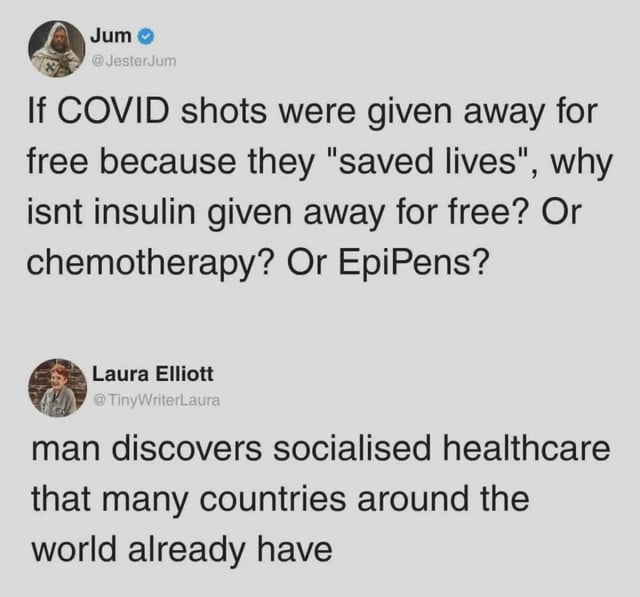
Because one of those things is contagious, impacting consumers and laborers and therefore halting commerce until addressed. It was determined to be more profitable to give away free shots. Yay capitalism.
Yes, herd immunity is inapplicable to diabetes, cancer, or allergies.
Edit: Is there a way to generically refer to not OP but the original original poster? The guy, for example, who's confused in this post (Jum). Is OOP standard?
Object Oriented Person
Ornery and Officious Periodontologist
Orange Octagonal "*P**olygon
OOP, yes
Unless of course OP's comment refers to multiple other comments, in which case it's OOPS
Fun fact: the Danish word for oops is "ups", which makes it fun to receive packages from United Parcel Service here 😁
It's the same in german, i was always saying i wouldn't get my parcel because ups!
(although GLS is far worse)
Unfortunately I don't think that it is standard, people also use OP to refer to a commenter higher up a single comment thread, so then the normal OP becomes the OOP, meaning the OP in the post would become the OOOP. Or we could use "Pre-Original-Original-Poster"...
I've never understood that. That's literally not the OP. The original poster is the one who posted the post, not a comment.
Using the word that way is antithetical to its very meaning. It's like if I randomly started calling my cousin my grandfather, but unironically (side rant: "unironically" is used to mean "non-sarcastically," because people can't grasp the difference between sarcasm and irony 🤦♀️).
Anyway, you could refer to the "top-level comment," but I don't think there's an acronym for that. But I've seen OC used, it's just rare. OC can refer to any higher-level comment though as long as the context makes it clear which one it's in reference to.
But the one who posted the post is not OOP. That's OP. OOP is the one who posted the post that OP's post refers to.
I guess the POOP would then be any OOPs from OOP's post or prior...
Oh yeah I fully agree it's stupid. OC of course can bring up more confusion since it usually means Original Content.
Oh yeah you're right, I was thinking Orange County which shouldn't cause much confusion, but Original Content could definitely be ambiguous with Original Comment. You're right...
Oops
Herd immunity wasn't aplicable to COVID either
Care to explain, or do we not believe in the germ theory of disease now?
SARS-CoV-2 mutates continually into new variants that can escape immunity derived from infections and vaccines. It also can be transmitted asymptomatically and without pathognomonic signs, impeding public health control. SARS-CoV-2 appears not to substantially engage the systemic immune system, as do viruses such as smallpox, measles, and rubella that consistently have a pronounced viremic phase. Moreover, neither infection nor vaccination appears to induce prolonged protection against SARS-CoV-2 in many or most people
Cool, thank you!
I think I was always dimly aware of the notion, but one of the things that covid really highlighted for me was that people in power are able to put an actual cash figure on every human life.
"If we spend more than £X on a given solution to this problem, it will stop being financially worthwhile"
And £X+ was the point at which disabled people, or younger people, or both, or whoever, were just left to die. Governments spent a lot of money, for sure, but not a penny more than was necessary to keep the economy (somewhat) upright and their cronies in cocktails and bigger yachts.
Even worse, the £X is the short-term financial gains. Reducing poverty and homelessnes DOES profit over long run, but we don't have anyone at top competent enough to tradeoff it with "slightly less profit margins increased by next year."
That each human being has an estimated cash value is something that was taught in school when I went at least. It was more related to how much a death costs estimated based on how much value the person could have brought in if alive.
Yup, it's like the old recall equation from Fight Club.
a * b * c = x
It doesn't matter how catastrophic the crashes are nor how many people, including kids, die as a result of them. The only thing that does matter is if the cost of a recall is cheaper than the estimated total cost of settlements.
What's really wild is that every government has multiple numbers depending on what they're spending on. The amount that their departments associated with it will spend to rescue a citizen held hostage is different from the amount they'll spend to save a life from disease which is different from the amount any particular infrastructure related department will spend to save a life, which may all be different from each other, and may be different based on cause of death (my government will spend a lot more to save a life from a passenger train related death than from a freight train related death or an automobile death)
ETA: https://en.wikipedia.org/wiki/Value_of_a_statistical_life
I couldn't believe that on the discovery of a deadly airborn virus, they decided to keep the airports open.
Yeah... Only
They did sort of try to just let it run its course. Dan Patrick even said on TV that a bunch of old people should sacrifice themselves to save the economy. Hell, even after it was found to have really spread and start killing everybody else too, Dr. Oz said we should send kids back to school because it would only result in 2-3% total mortality. They tried to do nothing. They tried to demonize wearing a mask. They tried to keep businesses and schools open. They really didn't want to do anything differently, and they didn't until cases and deaths skyrocketed. And there are still an embarrassing amount of people who think that the shots didn't help and were actually harmful, most COVID deaths were not from COVID, and masks are for "woke libtards". The post that we're commenting on is far from an anomaly.
I don't disagree with your description of events, but you're imposing a reasoning behind them for which there is little evidence. The idea I'm pushing back against is that vaccines (here Covid) and I suppose now Covid policy in general, resulted from some clever metric of keeping people alive because of their income generating value. There's no evidence government works like that, and masses of evidence that government decisions are in fact a mix of submission to industry lobbying, blatant electioneering, and simple incompetence.
Whatever the policies were, they would almost certainly have been whatever the loudest industry lobby, focus group committee, or egotistical politician wanted at the time. Not some sociopathic genius doing life-value calculus.
I'm not saying that it was the government who did that calculation. I think that companies did that calculation. I think that losses in revenue and even worse forecasting led companies to loudly call for blanket changes in policies so that the bleeding could be stopped. And then they got massive loans to get through the tough times, and most of those were forgiven, so it was effectively a business stimulus package.
I think it had nothing to do with life value and everything to do with consumer confidence. A loud minority still wanted to go out, but that wasn't adding up to a whole lot of money, and they were gonna soon run out of customers at the rate they were getting hospitalized. Not to mention the impact to the workforce.
I was just talking with my wife about flu shots. Health insurance covers an annual flu shot, and it's because it lowers their cost to have as many people vaccinated as possible, even though they have to pay for that shot. Similar sort of calculation.
What losses in revenue? As I said earlier, deaths an hospitalisations were overwhelmingly in older age brackets and poorer neighbourhoods. Companies were compensated for closures, and able to profit enormously from the 'supply chain problems' by price gouging. They made a fortune on the vaccine itself, not to mention the increase in future products off the back of the RNA research. What losses in revenue were on the horizon?
Health insurance costs in America have risen by over 130%, so there’s no evidence of insurance companies offering flu shots to save money, they just demand more premium to cover it.
Far more likely, in my view, is that taking regular vaccines has become a marketable product (for various reasons) which insurance companies have jumped on. Offer the shot, up the premium to cover it (plus a healthy profit). It simple market expansion.
If there’s a market (or one can be fabricated), then there’s a product to sell. If you can add a flu shot, up the premium to cover it, and not lose customers, then it makes sense to do so. Doesn’t have any bearing on whether it works. Same metric would apply to a medicine which did absolutely nothing whatsoever. As long as advertising it justified a rise in premiums larger than the cost of it, and customers don’t jump ship.
This is want I mean by comfortable narratives around medicine. If literally any other industry had added a service to their product, you'd assume it was simply something they thought they could market, and probably be suspicious that it was any use at all. But when a medical company adds a service (and charges more for it) people have to do this mental gymnastics to make the company's actions all for the best in the end.
Health insurance costs in America have risen by over 130%, so there's no evidence of insurance companies offering flu shots to save money, they just demand more premium to cover it.
Far more likely, in my view, is that taking regular vaccines has become a marketable product (for various reasons) which insurance companies have jumped on. Offer the shot, up the premium to cover it (plus a healthy profit). It simple market expansion.
If there's a market (or one can be fabricated), then there's a product to sell. If you can add a flu shot, up the premium to cover it, and not lose customers, then it makes sense to do so. Doesn't have any bearing on whether it works. Same metric would apply to a medicine which did absolutely nothing whatsoever. As long as advertising it justified a rise in premiums larger than the cost of it, and customers don't jump ship.
*Yay American capitalism.