this post was submitted on 12 Mar 2026
567 points (99.1% liked)
History Memes
2902 readers
1441 users here now
A place to share history memes!
Rules:
-
No sexism, racism, homophobia, transphobia, assorted bigotry, etc.
-
No fascism (including tankies/red fash), atrocity denial or apologia, etc.
-
Tag NSFW pics as NSFW.
-
Follow all Piefed.social rules.
-
History referenced must be 20+ years old.
-
Avoid posting AI-generated content whenever possible.
Banner courtesy of @setsneedtofeed@lemmy.world
OTHER COMMS IN THE HISTORYVERSE:
- !historyruins@piefed.social
- !historyart@piefed.social
- !historyartifacts@piefed.social
- !historyphotos@piefed.social
- !askhistorians@piefed.social
founded 1 year ago
MODERATORS
you are viewing a single comment's thread
view the rest of the comments
view the rest of the comments
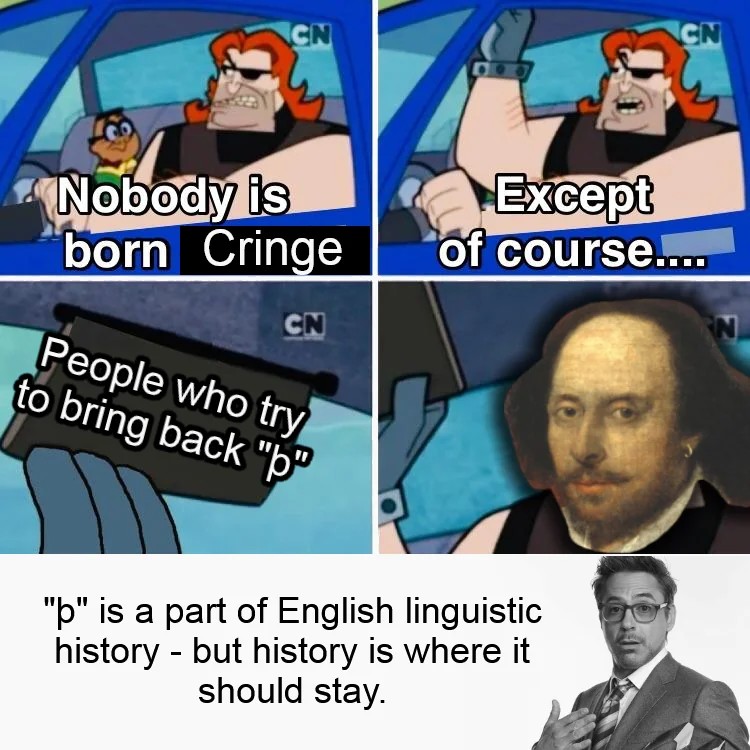
Ðis is true, if you want to replace th, ðat isn't even the right letter sometimes
Depends how far back you go. Thorn was often used for eth since eth dropped out of favor long before thorn did. Thorn being in use is why we have ye olde shoppe. Ye is just the spelled with a thorn. Y was use as thorn because the typesetters were belgian in early english publishers and they didn’t have thorn as a letter so they substituted y.
So what you're saying is, the Belgians stole our thorns!
Y tho?
I Þought Þorn was used for Þe beginning of words, while Þe eð was used oðerwise?
You're partially correct (in a very specific way to be detailed in a second), and the people responding to you are also correct. Here's the connection:
Pre-Old English only had voiceless fricatives, so 's', 'f', and theta (Þ), but underwent a sound change just before we have attested Old English whereby all (singleton) fricatives became voiced between other voiced sounds. So, 's' > 'z', 'f' > 'v', and theta > ð. (Let me know if you're interested in how we know that this sound change happened even though we don't have attested physical evidence of it from English!) This is why we have alternations in Modern English like:
loaF : loaVes (originally it was hlaf : hlafas, with "f" in both words)
This means that, for much of attested Old English, "th" fricatives at the beginnings (and ends) of words would be voiceless, and "th" fricatives in the middle of words would be voiced (unless they were next to a voiceless sound, like the 'f' in soft, but I don't think there are any examples of that for 'th').
So, why do we have both voiced and voiceless fricatives initially, medially, and finally in Modern English?
Over the course of a few hundred years, various different changes of different natures conspired to produce this perfectly symmetric system with voicing distinctions at all places.
Initially, borrowings from French and from other Old English dialects that allowed initial voiced fricatives led to words like "vat" and "vixen" entering the language, creating a contrast word-initially with words like "fat" and "fox".
Medially, geminates (double-consonants) which didn't undergo the original voicing rule became simplified. So, cyssan "kiss" stopped having a "long" voiceless pronunciation and instead shortened to our modern "short" voiceless pronunciation, putting it again in contrast with the voiced "z" medially that was the result of the initial voicing rule.
Finally, final vowels slowly reduced and then dropped off, as in words like bathe vs. bath, leaving voiced consonants in contrast with voiceless ones word-finally.
So, the change started as a perfectly symmetric system of voiceless consonants in all positions, initial, medial, final:
F : F : F
Changed to a predictable (allomorphic) distribution due to regular medial voicing:
F : V : F
And then ultimately developed into another perfectly symmetric (phonemically distinct) system due to the conspiracy of various different borrowing and sound changes processes:
F/V : F/V : F/V
(Btw, these "conspiracies" are one of the advantages of Optimality Theory over older Rule-Based Phonology, which I can discuss more if anyone's interested).
So, yeah, regardless of the orthography (which varied both between writers and over the course of the period), thorn was the sound initially and finally, and eth was often the sound medially in Old English.
See? not only do we get þs, we also get some education!
It's like Carmen Sandiego, all over again.
Initially eth was the voiced dental fricative (as in "them") and thorn was unvoiced (as in "thin")
Two different sounds, þ is th like in thought, while ð is th like in the.
AFAIK, that's how IPA does it, but they aren't really any languages that use/used it like that consistently.
Icelandic says hello (save for a few exceptions).
Þis is þe rule in Icelandic.