this post was submitted on 10 Feb 2026
764 points (98.0% liked)
Curated Tumblr
7185 readers
8 users here now
For preserving the least toxic and most culturally relevant Tumblr heritage posts.
Here are some OCR tools to assist you in transcribing posts:
-
FOSS Android Recs per u/m_f@discuss.online: 1 , 2
Don't be mean. I promise to do my best to judge that fairly.
founded 2 years ago
MODERATORS
you are viewing a single comment's thread
view the rest of the comments
view the rest of the comments
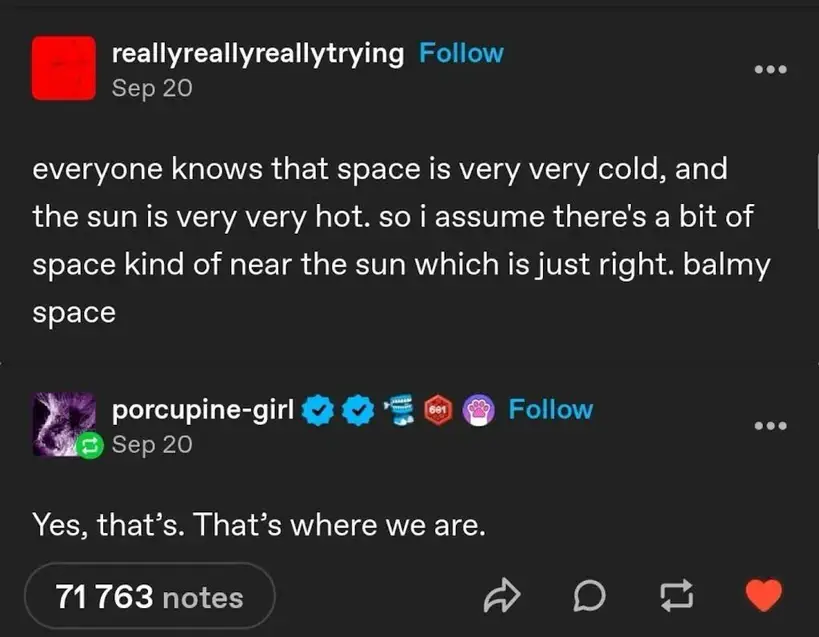
To expand on the "doesn't work like that" part: In the vacuum of space there is no air to exchange warmth with your body, or your space suit. You might be comfy on the side of your body facing the sun (if you're at that distance where it provides the right amount of radiative heat) but the side facing away from the sun will get no heat, and therefore be cold. I imagine that would feel very weird... if you could feel it on your skin, without a space suit, without being ripped apart by the vacuum, of course.
Does anyone know whether this "uneven distribution of heat energy" is a problem for space suits or if that little bit of air inside is enough to distribute it?
NASA EVA suits have liquid (water) cooling systems to avoid cooking the astronaut while outside the ISS.
I don't know how they actually work though. The only way to shed the heat is to radiate it away or to sink it into warming something else up.
Found this on Wikipedia:
Though I think that's specifically for removing the astronaut's body heat.
What a great system. I wonder how the development of that worked. Did they theorize the necessity of a system like that or were the first space walkers quite unconfortable?
It's also for removing the suit systems heat, and heat from sunlight. As much as we love to say space is cold, the problem things in space have is the exact opposite. Without air for the convection or conduction of heat things in space, be they satellites, a space station, or a human in an EVA suit, have a very hard time expelling heat. The International Space Station has enormous radiators on the dark side of it's solar panels for this very reason, getting rid of heat is hard when you can't just blow air over a heat sink.
Also, for what it's worth, the average energy of what few particles there are in the vacuum of space tends to be pretty high, but they're so dispersed that it's entirely negligible.
I always try to explain that space is cold on average but near a star it is really hot.
Case in point: the Earth. Standing on its surface under 100km of atmosphere, the sun will still burn your skin in minutes... imagine sunburn without the ozone layer.
There are glacier fed lakes when i live. You can float in incredibly cold water and if you have just the right equilibrium you can half float in freezing cold water while half getting a nice sun bath. And it IS very weird.
One spot I camped at for many years had nice sandy area that was about 200 meters out into the lake before a drop off. As it was only about a meter deep it used to warm up the top foot or so of the water when it was fairly still and you could stick your arm down into the water and actually feel the temperature drop like there was a line underneath the water.
Was great place to camp before it got overwhelmed by mosquitos
A lot of nice places in the world that are a joy to be in until the mosquitoes show up. Do we have to have mosquitoes? Can't the world manage without them?
We're gonna find out one way or another. They already released genetically modified mosquito into the normal mosquito population several years ago. If everything goes to plan, those specific species of mosquitoes, that also happen to bite humans, should completely die out in the next 100-200 generations.
I have no idea how short a mosquito generation is, but I suspect that means 50-200 years.
Entomologists will always be happy to write about it.
Let's say about a 50 day lifespan, that's roughly seven generations in a year, so maybe about 14 years? If the bitey mosquitoes aren't gone, at least the worst of the world leaders should hopefully be dead by then.
Oh wow, that sounds amazing! Apart from the mosquitos maybe.
If I can find some old pictures I'll share
Why can some objects exist in space without getting ripped apart like a human would. Is that what actually happens to a human anyways?
Ever seen a picture of a blobfish in it's deep ocean habitat vs when it is at the surface? It's body is adapted to the extreme pressure of the deep sea, and when that pressure is no longer there, the forces keeping it's shape are no longer present and thus every bit of it expands. That's what would happen to us in the vacuum of space albeit on a lesser scale. Also, we're like 70% water which boils in a vacuum.
As I understand it, this in fact will not happen. Our circulatory system is a closed loop and strong enough to not expand into vacuum. The water inside our body is kept close to usual pressure by our skin, blood vessels etc.
The main immediate danger in space without a spacesuit would be holding your breath. Your lungs are not built to withstand a whole atmosphere of pressure from the inside, and will get damaged if you hold your breath.
Of course if you don't, you'll have another problem.
Thanks for the clarification. I knew the whole lungs problem and that was really what I had in mind but just kind of assumed there'd be similar dangers to other bodily functions but I see that's not the case.
I do believe the water would still be an issue for your eyes and maybe even mouth but good to know you wouldn't immediately have blood literally boiling in your veins.
What if we spin around like a spit roast so the heat gets evenly distributed?
How fast should we spin as well?
I wonder what it would do in relation to vertigo. I mean there's no gravity to affect the vestibular system, but there are strong visual cues.
Ah crap, I'm going to go down a "what happens when an astronaut spins" rabbit hole today, ain't I? I had shit to do, oh well
This uneven heat distribution confuses the brain and is perceived as pain. Veritasium (or maybe vsauce) did a video on it. Putting frozen and warm hotdog against the skin.
the uneven heating would likely feel like being next to a fireplace
But imagine the side facing the sun is comfortable. Then it keeps warming up. And it keeps warming up. And you try to cool down, but it doesn't cool, it just stays the same temperature or keeps warming up.
You don't think a function of the temperature from the sun to the earth forms a continuous line? You think it's piecewise? It's continuous! Yeah it probably bottoms out to effectively zero pretty quick, but there's some distance from the sun that would be the right temperature. Sure, the other rays from the sun might not make it livable. Sure, it might be so narrow there's no way to effectively keep yourself in orbit there without getting sucked closer and burning up. Sure, it's a dumb thought experiment, but there's no way there isn't some point where it's comfortable.
The thing about temperature is that it's not instant. Radiation from the sun heats stuff up, and that heat is absorbed by whatever the radiation hits according to its reflectivity and shape, and then lost from conduction, convection, and radiation. The characteristics of what's being heated by the sun and the environment it's in are what determine how hot it gets.
Exactly, so there must be some environment between us and the sun that's comfortable.
I'm not a scientist, but I'm pretty sure temperature is the energy given to the molecules in the air by the radiation from the sun. Since there is no air in space to excite, it's just really cold until it's not.
The photons would directly excite the molecules in your body.
Which is why space suits are white. If they were darker, you‘d get cooked on a space walk. In a vacuum, the sunlight can heat you up but it’s much harder to radiate heat away.
Physics sure is exciting!
so hot right now
There's convective and radiative heat, while the first one needs some medium to transmit energy (air...), the second one simply beams it onto you
3 mechanisms for heat transfer: conduction (heat moves from one bit of matter to another when they are touching), convection (in a fluid, hot matter move about), and radiation (pure heat, only form that goes through a vacuum, this is just like lower frequency light that we can't see).
Thanks, I thought conduction was under convection, so to say
Okay, thank you. I’m not a very smart man, and had always wondered how planets can be heated by the sun but not space itself. It never occurred to me it’s because of the vacuum of space that keeps it cold.
Gotta have stuff to be heated. Nothing can't be heated. But the energy that heats stuff can still pass through the space where the nothing is.
Temperature is how much movement there is at the molecular or atomic level(depending on how you are measuring.
There is a lower limit, but no upper limit on how much heat can be measured.
This is the basis of the Kelvin scale and starts at absolute zero or the temperature at which all movement (energy) stops
Air is a medium. Flowing air is a decent heat exchanger, still air is bad at it