this post was submitted on 05 Jan 2026
333 points (98.5% liked)
Microblog Memes
11507 readers
733 users here now
A place to share screenshots of Microblog posts, whether from Mastodon, tumblr, ~~Twitter~~ X, KBin, Threads or elsewhere.
Created as an evolution of White People Twitter and other tweet-capture subreddits.
RULES:
- Your post must be a screen capture of a microblog-type post that includes the UI of the site it came from, preferably also including the avatar and username of the original poster. Including relevant comments made to the original post is encouraged.
- Your post, included comments, or your title/comment should include some kind of commentary or remark on the subject of the screen capture. Your title must include at least one word relevant to your post.
- You are encouraged to provide a link back to the source of your screen capture in the body of your post.
- Current politics and news are allowed, but discouraged. There MUST be some kind of human commentary/reaction included (either by the original poster or you). Just news articles or headlines will be deleted.
- Doctored posts/images and AI are allowed, but discouraged. You MUST indicate this in your post (even if you didn't originally know). If an image is found to be fabricated or edited in any way and it is not properly labeled, it will be deleted.
- Absolutely no NSFL content.
- Be nice. Don't take anything personally. Take political debates to the appropriate communities. Take personal disagreements & arguments to private messages.
- No advertising, brand promotion, or guerrilla marketing.
RELATED COMMUNITIES:
founded 2 years ago
MODERATORS
you are viewing a single comment's thread
view the rest of the comments
view the rest of the comments
Does that matter? From the user's perspective, it's a black box that takes inputs and produces outputs. The epistemology of what knowledge actually means is kinda irrelevant to the decisions of how to design that interface and decide what types of input are favored and which are disfavored.
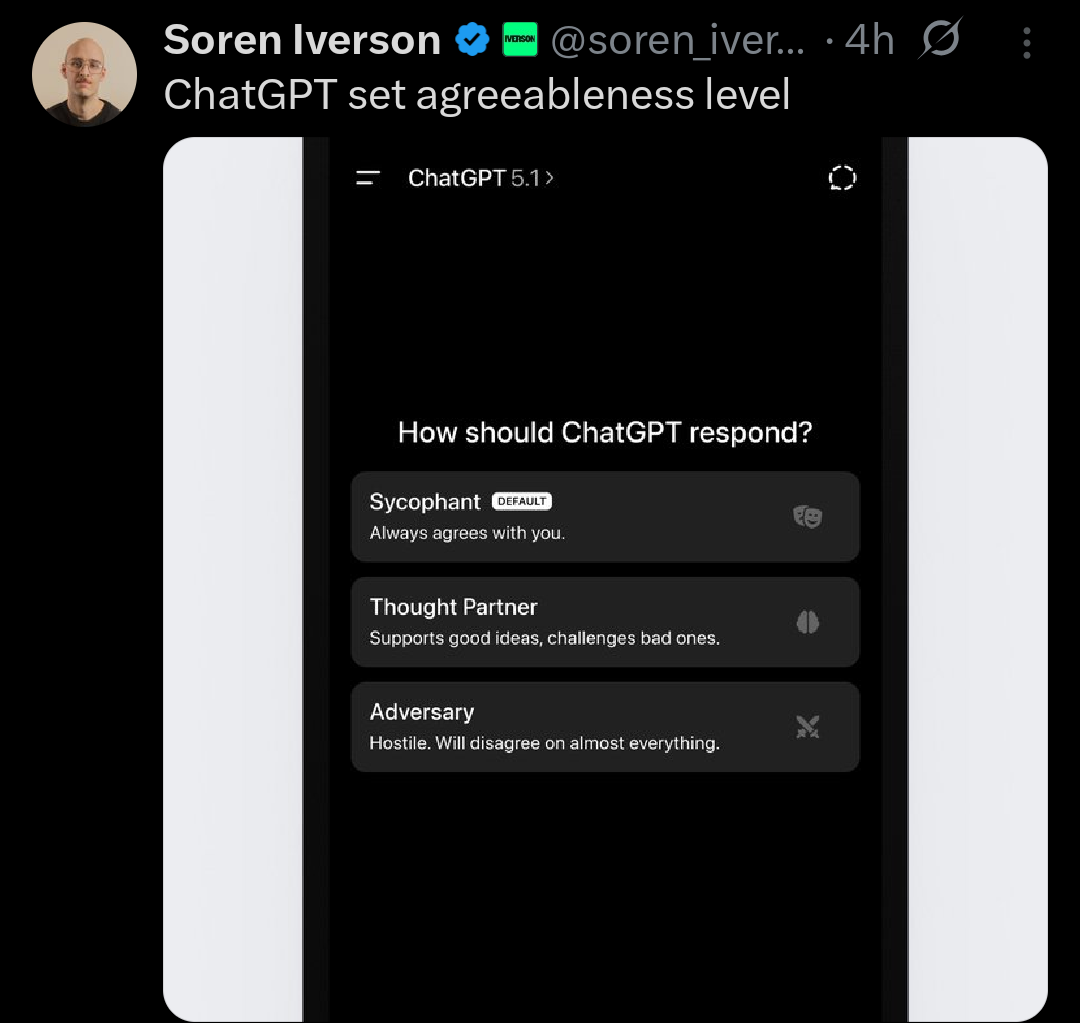
It's a big ol matrix with millions of parameters, some of which are directly controlled by the people who design and maintain the model. Yes, those parameters can be manipulated to be more or less agreeable.
I'd argue that the current state of these models is way too deferential to the user, where it places too much weight on agreement with the user input, even when that input contradicts a bunch of the other parameters.
Internal to the model is still a method of combining things it has seen to identify a consensus among what it has seen before, tying together certain tokens that actually do correspond to real words that carry real semantic meaning. It's just that current models obey the user a bit too much to overcome a real consensus, or will manufacture consensus where none exists.
I don't see why someone designing an LLM can't manipulate the parameters to be less deferential to the claims, or even the instructions, given by the user.